- RoboRuby
- Posts
- Ruby AI News - November 4th, 2026
Ruby AI News - November 4th, 2026
Don't let AI steal from you

Matt Solt
November 04, 2026

Welcome to the 40th edition of Ruby AI News! This edition features an avalanche of security issues, Ruby’s MCP SDK reaching Tier 1 status, a closer look at building AI evals for Rails, and much more.
Personal Updates: Next week I will be at the San Francisco Ruby Conference. If you’re going, please say hello! And if you’re on the fence about attending, I hope you will join us. Two weeks ago I presented FireTrident at Cloudflare Connect as part of their Build the Next-Gen Git Platform Competition. RubyRoles has surpassed over 3,000 open Ruby-related positions. And version 0.2 of Poetry, the AI-native frontend framework for Rails, is releasing soon with some exciting surprises.
Newsletter Updates: And of course, the newsletter just reached its 40th edition. In celebration, I’m opening up a unique sponsorship package. Don’t miss out on one of the most valuable partnership opportunities in the community!
Contents
Top Stories
Exploits Everywhere

In major security news, a critical flaw in Ruby's regular expression engine has exposed any application that compiles patterns from untrusted input.
Johan Carlsson found through GitLab's bug bounty that a crafted pattern could corrupt memory while Onigmo compiles it, and GitLab shipped a critical patch on October 21st for every version back to 7.0. Two days later Ruby released 4.0.9, 3.4.12, and 3.3.13, and Takashi Kokubun's write-up explained who is at risk. You are exposed only if your app compiles patterns an attacker controls, through Regexp.new, Regexp.union, or interpolation into a literal, and neither Regexp.timeout nor a length limit helps because the bug is in compilation, not matching.
Steve Pike at Infield called them the most severe Ruby bugs since 2022, with a warning for anyone still on Ruby 3.2, "there is no way to make this safe on user-controlled regex." Rapid7 published an exploit that runs commands on a stock GitLab image, and on October 29th CISA (the US’s Cybersecurity and Infrastructure Security Agency) listed the bug as exploited in the wild, three days after it did the same for PHP’s major php2shell vulnerability.
In the AI age, vulnerabilities will be exploited faster than ever, and getting the patch into production can take too long. Dennis Paagman timed how long 4.0.9 took to reach each link in a deploy chain. The core team's own snap and image were out within minutes, but the official Docker ruby image took most of a day in the review queue, and because Rails generates Dockerfiles on that image, Kamal and Fly users inherited the wait.
Abhay Nikam’s lesson from the week was to patch your runtime fast and take dependency upgrades slow, with a cooldown on new gems, checksums in Gemfile.lock, and AGENTS.md rules for the agents that install packages too. Andrew Nesbitt found the drawback to cooldowns. A certificate authority leaked keys, and most gems bundling their own root certificates still trust roots browsers dropped years ago.
And just today the Rails core team released Rails 8.0.5.2 and 8.1.4.1 with 21 fixes, including a critical hole in Active Storage image analysis, where an unauthenticated upload could make ImageMagick write and read arbitrary files, the process Hot Cell moved into a sidecar that was covered in the last edition of the newsletter.
One way to mitigate security issues is real-time solutions for agents to track vulnerabilities. Cloudflare launched Zero Wire, a public hub of briefings on critical vulnerabilities, each with a plain explanation, a "What to do now" list, and a read-only prompt you hand to an agent to check your own exposure. This is similar to the solution Avi Flombaum introduced for Rails advisories in the last edition.
I think the immediate solution to help identify exploits quickly looks a lot like Sazabi's cve.now. cve.now provides "a free CVE feed for agents" that merges the public vulnerability databases into one entry per common vulnerability and exposure, served as RSS, JSON, or MCP with no login required, plus a lockfile check, and Gemfile.lock is currently supported. Stay safe out there Rubyists!
Ruby is Tier 1

It’s official. On the MCP Blog, Koichi Ito posted The Official Ruby SDK for MCP Reaches Tier 1, sharing what the top tier gets Rubyists running MCP in production. Full spec coverage, support for each new spec version the day it ships, every issue triaged within two business days, and critical bugs fixed within seven days.
The SDK sat at Tier 3 in March and was confirmed at Tier 1 in September. The two gaps that held it back were feature documentation and a commitment on spec timing, so the docs moved off the README onto their own site with every feature covered. The project began at Shopify and is maintained by Topher Bullock, Ateş Göral, Jonathan Hefner, and Koichi, who also sits on the MCP steering group. Three of this edition's Highlights, debug-mcp, rails-ai-context, and the Spree Admin MCP server, are built on the gem.
Version 1.8.0 went out on the first day of Kaigi on Rails, "celebrating" the conference in Koichi's announcement, and its headline was OAuth 2.1 for servers. A Ruby MCP server can now verify bearer tokens itself, challenge requests that lack one, and publish its protected resource metadata through a Rack middleware, while issuing tokens stays with an external authorization server.
On the client side, MCP::Client is a full protocol peer that utilizes stdio and Streamable HTTP, lists and calls tools, reads resources and prompts, and answers a server's elicitation and sampling requests once you register handlers. Authorization is handled by the transport layer.
1.9.0 was released on November 3rd with the Skills extension, announced by Koichi. Skills over MCP, SEP-2640, came out of a working group co-led by Bloomberg, Nordstrom, and Anthropic, on the premise that the knowledge an agent needs to use a service should travel with the service. This extension lets an MCP server publish SKILL.md files. The server lists its skills with a manifest of every file and its digest, the client verifies the bytes against that manifest before anything reaches the model, and the spec requires that hosts must "treat skill content as untrusted input." That puts Ruby beside TypeScript among the first official Tier 1 MCP SDKs to ship!
Race to the Top
Last edition left the Agents on Rails benchmarking coverage at Stage 3, with Claude Opus 5.5 at the top of the board and GPT-6.1 Sol nearly matching GPT-6 Astra at a sixth of the cost. The leaderboard has a permanent home at rubyonrails.org/ai, where you can filter models by task type and compare on accuracy, speed, tokens, and cost.
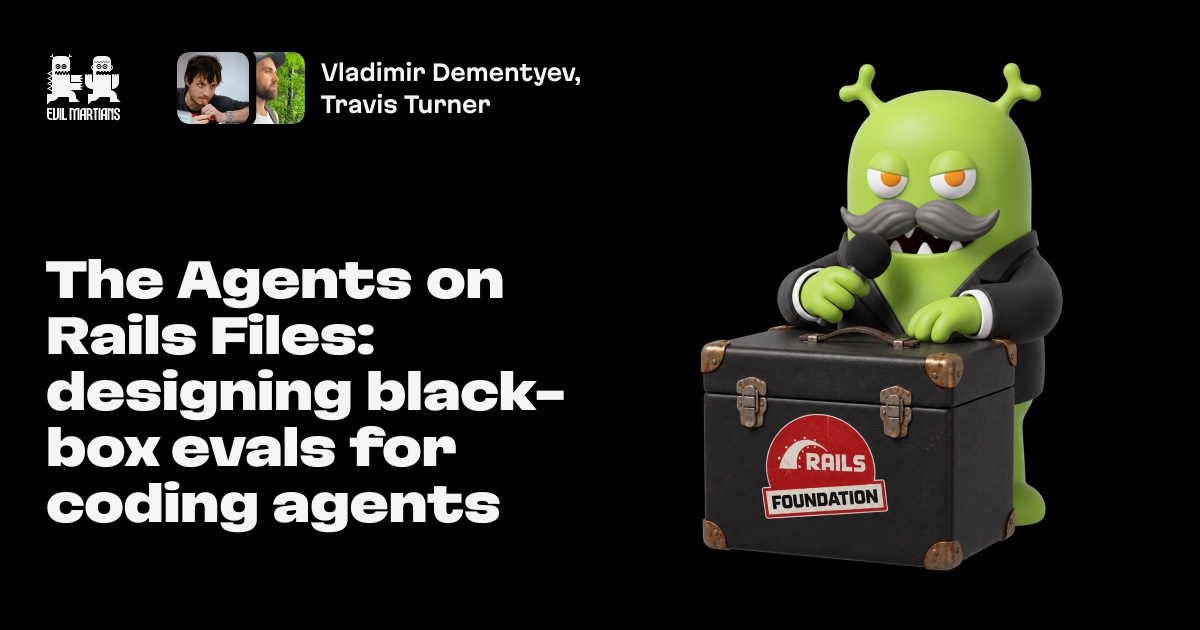
Evil Martians, who built the benchmark, have started sharing how they produced the results. Vladimir Dementyev's first post is about grading work you cannot see the inside of. Stage 3 asks an agent to build a product over several sessions, often from nothing, so there are no models or controllers to assert against. The checks drive the finished app through a headless browser, and the team proved the checks with mutation testing, deliberately broken solutions that had to fail and equivalent ones that had to pass.
They also ran two tasks, a bot feature added to the Campfire chat app and a live quiz app called Quizzy built from scratch, on Rust as well as Rails. Frontier models solved both stacks, at two to four times the cost on Rust for Campfire, while on Quizzy the cheaper models passed on Rails and failed on Rust, which Evil Martians attributed to how much infrastructure Rails hands an agent for free.
The second post, by Vladimir and Artur Petrov, introduces lemans, the Ruby harness that runs every trial task and is open source under the Rails organization. A task is an instruction, a setup patch, a reference solution, and a Ruby test. Before comparing models you run an oracle agent that must score 1.0 and a no-op agent that must score 0, and a task that fails either check is broken. Every model runs on miniswen, a Ruby port of mini-swe-agent with a single bash tool, which keeps the scaffold out of the scores.
Then the post addressed the cheating models use to solve the evals. "Models know they're being benchmarked," and they sifted through leftover secrets, Bootsnap caches, file timestamps, and Git history for answers, so the harness now redacts, wipes, flattens, and keeps its own Git state out of reach. One model hired another model with web search, billed to the project's API key. The jail built in response cut that model's max-effort score from 37 percent to 17. "Guardrails can be unfair, too," since restoring the test directory between steps punished agents for legitimate feature work.
Irina Nazarova, Alexander Baygeldin, and Svyatoslav Kryukov walked through all of it in a livestream on October 30th. Next up for the benchmarks are Claude Mythos on the board, more sandboxes, and a Stage 4 asking whether richer context changes the results, from indexed guides to skills and type information. lemans works on any Rails codebase, and lemans init scaffolds a bench with example tasks to start from.
AI Anxiety in Perspective
Speaking of Evil Martians, their editor-in-chief Travis Turner presented one of the better non-technical talks I’ve seen on AI with Got AI Ontological Shock? No Worries: UFOs, Theology, and Psychedelics With Ruby-Colored Reverence at Rocky Mountain Ruby. His premise is that the unease around AI is "ontological shock," theologian Paul Tillich's term for what happens when something arrives that your sense of reality cannot absorb, and that job security, tooling, and framework arguments all sit downstream of it.
He walks through three other subjects that produce the same shock, religion, UFO encounters, and psychedelics, and finds the same shapes in each, promised miracles, conspiracies, grifters, and language that fails. What got people through those, in the research he cites, was community, open conversation, and a personal philosophy, and his ends on the virtue of saying "I don't know." Drew Bragg said it "made me laugh and think the most," and Yaroslav Markin told people to drop everything and watch it.
Need to Know AI News
Sparks of Weight-Space Programming: LLMs Can Natively Read and Write Neural Network Weights showed GPT-6 Astra treating raw neural network weights "like readable, editable code," naming the game a policy was trained on from the numbers alone, writing a Breakout network from scratch that outscored PPO trained for 500 million steps, and fixing Qwen3.5-0.8B's reasoning loops by editing 0.016% of its weights, with no gradients or training. The authors expects weights to "soon be natively optimized by LLMs that deliberately reason about the weights." John Resig saw the end state in it, "code that can't be read by humans, run on machines that humans can't access," and called this a golden period in which people can still follow how things run.
Neural Networks Are Already Clean Nick Cammarata argued that neural networks are far more legible than the interpretability field believed, and that neurons which seemed to do several unrelated jobs mostly reflected weak tools and misread evidence rather than "superposition." In his audits of Qwen3-32B about nine in ten neurons had one clear job, so a model's own neurons may be a workable place to start understanding it.
From Tokens to Bytes Cartesia Research argued that tokenizers are "one of the last hand-designed parts of the pipeline" and showed their hierarchical networks learning to chunk raw bytes end to end instead, with a 3.67 billion parameter model matching an open model trained on 11 trillion tokens using roughly a tenth of the data and compute. The gains were largest on code, especially languages outside the training mix, and the second part argues that the tokenizer shapes how well a model understands its data, not just how tightly it compresses it.
The Commanding Heights Will Manidis and Joe Roberts published an essay arguing that frontier models will become commodities within months and that the money from AI will go, as it did with railroads, to whoever holds "scarce, controllable positions of economic power," the chokepoints through which intelligence reaches the rest of the economy, rather than to the labs that build it. They expect only the United States and China to sustain frontier models, back-office work in poorer countries to hollow out first, and firms to shrink to a few operators holding the capital, and they tell investors to sell "last era's" assets while they are still priced as such.
How We Rebuilt Provider Routing for Better, Faster Inference OpenRouter's new default router no longer just picks the cheapest provider but weighs real price, speed, rate limits, and reliability. The result is faster first tokens, fewer retries, and a warm prompt cache, with no code change.
Quick Hits
Highlights
Prompting

Prompt Snacks Prabin Poudel built a ranked collection of "power phrases," the short lines people paste into agents, each tagged by job and credited to whoever said it first. The early board holds Nate Berkopec's "How can we pokayoke this error type so it never is introduced again" and Thorsten Ball's "Give me irrefutable proof this works now." Prabin is gathering organic phrases before a public launch, so if you have a line you always use, please share it!
Software Factories

OpenLanes Konstantin Gredeskoul released an open source software factory written in Ruby. You write a short brief in spec.md, a crew of specialist agents researches, plans, builds, reviews and verifies it, and the harness opens the pull requests, so "merging and deploying stay human." Most of the recent pull requests in the repository went through its own agent lanes.
Konstantin also built llm-evals, a CLI that runs your real prompt and parser across a lineup of models and ranks them on a weighted score of accuracy, latency and cost. And his talk on PostgreSQL SKILLS.md files made the case that an agent "cannot guess" your database class from table names, so write it down before one adds ON DELETE CASCADE to a ledger.
Agentic Security

MechaRuby Jeff Lunt extracted three gems from his production apps to put hard guardrails on coding agents. Each is closed by default. Every route, every model's tenancy, or every database column is declared in one YAML file, a static audit fails in milliseconds with the file and line an agent must fix, and a prober fires requests across every role, attempts cross-tenant reads, and checks ciphertexts in CI. His call for battle-testers wants tools that are fast and "don't themselves rely on AI to be correct."
Agentic Databases

PGX Alex Shapalov announced an open-source, Postgres-compatible database runtime written in Rust that holds thousands of isolated databases in one process, each created in milliseconds from a template and dropped when its agent, CI job, or pull request is done. Rails 8.1 can run its whole migrate, test, and schema-change cycle on it unchanged. The skill gives every Claude Code session and subagent its own branch with DATABASE_URL already set, making a Postgres container per worktree unncessary.
Agent Discipline

Impatient Programming Obie Fernandez's rewrite of Extreme Programming for coding agents, which led last edition's Top Stories, is now fully open. His X article on why argues that both failures XP answered are back, "machine-generated plans that nobody reads" as the new big design up front and vibe coding as the new cowboy era. The site now holds all 29 rules beside their 1999 originals, five practitioner essays including Mark Ryall's case to "keep pairing with humans," and a directory of 539 guardrail tools. Two of the featured tools, exhale and qualm, ship as Ruby gems.
Agentic Coordination

agentspaces-rb Bad Monkey AI created Ruby bindings for AgentSpaces, its open-source peer-to-peer coordination fabric. It is a tuple space, Linda and JavaSpaces rebuilt for encrypted peer-to-peer networks. An agent posts work, another takes it under a lease and writes the result back, and if the worker dies the lease lapses and the work returns, with no broker, registry, or server to keep alive.
The Ruby peer holds its own Ed25519 identity and takes work under the same rules as the Java, Python, and TypeScript peers, in pure Ruby with one dependency, and agents are plain classes with a macro such as take or ballot above a method. Companion gems add a Rails Railtie, RubyLLM tools built from the fleet's agent cards, and an MCP server, and the Ruby guide has you kill a worker mid-task and watch the other one finish the order.
Agentic Debugging
Debug MCP Ryo Hayakawa built an MCP server that connects a coding agent to Ruby's debug gem, so it can attach to a paused Rails process, read variables and the call stack, evaluate code in the stopped frame, set breakpoints, and step. Their Kaigi on Rails slides argued that agents handle bugs visible in code and test output but struggle with bugs that live in runtime state, a record's actual values, or a stale memoized one. With a live debugger the agent confirms the issue before it edits, then checks the fix at the variable level. Rails tools add routes, model structure, and the SQL, renders, and jobs fired during a request, captured through an ActiveSupport::Notifications subscriber.
Agentic Triage
I Get 215 GitHub Notifications a Day, So I Built a Bot to Triage Them Carmine Paolino wrote about Copilot Triage, an open-source GitHub Action that reads every issue, discussion, and pull request on his repositories and sorts them onto a project board. It is a RubyLLM agent with six read-only tools, and the model never writes to GitHub, Ruby checks the evidence it cited before anything is applied, and merging is always up to the maintainer.
Agentic Commerce
Spree 6.0 Damian Legawiec announced "a complete redesign and rewrite of Spree Core," with marketplace selling, B2B wholesale, cross-border tax, and warehouse management in one release. On the AI side, the installer offers Agent Skills and a docs MCP server so a coding agent learns Spree's conventions. Every new store also ships an Admin MCP server built on the official mcp gem, so agents can publish products, run imports, cancel orders, and pull reports after a sign-in that shows the agent only what you approved.
Elastic Software
Squishling Michael Carroll published an explainer page for his gem that lets a Ruby class run as code or hand the work to an LLM and return the same typed, checked answer either way, so you "write Ruby only where it's cheaper than the tokens." The November 1st release turned on prompt caching by default, so the stable part of each prompt is paid for once and the hits show up in usage and budgets. Michael presents it in person at Philly.rb on November 19th at Indy Hall.
Agent Conventions
Some Days My Coding Agent Felt Like Whack-a-Mole, So I Changed the Game to Target Practice Brandon Casci traced his agents fixing one thing and breaking another to rules piled up across dozens of standards docs. So he stopped asking the model to remember the fundamentals and turned them into custom RuboCop cops, Herb rules, and Claude Code hooks. A pre-commit hook refuses a bad commit and prints the fix, and the agent corrects the line with "no human, no reviewer, no tokens spent judging it." The written standards shrank to a fraction of their size, freeing up the context window.
Idempotent Agents
Making AI Agents Safe to Retry Mateus Pereira of FastRuby moved a ticket triage agent into a Sidekiq job, then showed what a retry does to it. A dropped connection on the last step replayed the whole loop, and the agent quietly wrote a second, different draft over the first. Had that tool sent email, the customer would have gotten two replies. His fix is a guard in each writing tool that treats the ticket's own fields as proof the step already ran and tells the model it was skipped.
RubyLLM Upgrade
RubyLLM 2.x: What's New for Your Agents Josef Strzibny demonstrated upgrading a Rails pricing agent from RubyLLM 1.x to 2.1, with working code for each new capability. The agent runs product lookups and Google Shopping searches on its own, then stops at the price update until a merchandiser approves it, potentially hours later, because the agent is now a database record a controller or job can reload and resume.
Linting Decisions
JP Camara released a linter that checks code against conventions written as plain English in a CONVENTIONS.md, such as no silent rescues or jobs take ids. Judgelint asks a decision model, Jev by default, whether each file breaks each bullet, then reports violations with line numbers, a probability, and an exit code, with each answer costing a few hundred milliseconds and a fraction of a cent.
Agent Skills
RubyPowers Lucian Ghinda renamed Superpowers Ruby, his Rails-focused fork of Jesse Vincent's Superpowers skills framework for coding agents. Version 8.0.0 carries the new plugin and skill namespace, so superpowers-ruby:brainstorming becomes rubypowers:brainstorming, and the migration guide has the uninstall and install commands for coding agents. His blog post includes a prompt that has your agent find and fix the old references for you.
MVC Context: Putting AI Context Where Rails Already Puts the Code Mooktakim Ahmed split a bloated root CLAUDE.md into small AGENTS.md files beside the code, one per folder, loaded only when relevant to the agent. Claude Code only loads a folder's file when its Read tool opens something there, and agents mostly work through the shell, so most of the context never arrived until a hook delivered it. The rails-context plugin sets it up.
rails-ai-context Cris Nahine kept shipping the gem that lets a coding agent ask your Rails app instead of guessing, now 35 read-only tools over MCP or as plain rake tasks. It answers with the real schema, associations, inherited filters, routes, and test setup, and traces a method to every caller.
Agent to App Store
Ship to the App Stores With Your Agent Joe Masilotti announced that Ruby Native, his service for shipping a Rails app as iOS and Android apps, now manages the App Store and Google Play listing and submission as well. The listing can live in a YAML file and ship through a pull request, or your coding agent can install the MCP server, draft it from the app, and submit it for review.
Jobs & Opportunities

200 Rubyists have already started looking for their next opportunity with RubyRoles. Sign in with GitHub, answer five questions about your level, how you like to work, where you can be based, and your salary floor, and you get your three best matches right away. After that it sends at most one new role each business day, and only when something actually clears your matching threshold.
RubyRoles currently has 3,003 open Ruby-related roles, a more than 50% increase in available opportunities since launch. And about two out of three mention AI somewhere in the description, so now may be the best time to search for a future forward position.
One Last Thing

Carlos Daniel Pohlod announced RedGem 0.3, an experimental 3D game engine and editor where "every scene in this game is scripted in Ruby," run by mruby on a C++ core built from Blender, Jolt Physics, and raylib. The release added online multiplayer with dedicated servers, bigger worlds, better lighting and effects, localization, and drag-and-drop assets, with games exported for Linux, Windows, and Android.
The repository has since reached 0.5.0, which puts Claude Code or Codex in an Agent panel inside the editor, driving the scene, pressing Play, and reading errors through the engine's built-in MCP tools. The site has the demo video and manual.
That’s all for this edition! Be sure to reach out if you have any stories, content, jobs, or events you want featured in the newsletter.