- RoboRuby
- Posts
- Ruby AI News - April 16th, 2026
Ruby AI News - April 16th, 2026
Should Ruby focus more on Local AI?

Matt Solt
April 16, 2026

Welcome to the 28th edition of Ruby AI News! This edition features a critical look at the major AI laboratories, personal LLM-enabled knowledge bases, the addition of the AGENTS.md standard to Rails core, and much more.
Contents
Top Stories
Can We Trust the Labs? Why Ruby May Need to Go Local
A sweeping New Yorker investigation by Ronan Farrow and Andrew Marantz has reignited questions about leadership at OpenAI. The piece details how co-founder Ilya Sutskever compiled 70 pages of evidence alleging Sam Altman had repeatedly lied to the board, and reveals that about a dozen of OpenAI's top engineers held secret meetings to discuss whether the company's founders were fit to lead. As Rutger Bregman noted, the anecdotes are "insane", and they arrive at a moment when the industry is asking us to trust these companies with unprecedented power.
That trust is being tested in real time. Anthropic recently unveiled Project Glasswing, a restricted cybersecurity initiative built around Claude Mythos Preview, a model the company says has discovered thousands of zero-day vulnerabilities across every major operating system and browser. Mythos is not generally available. Access is limited to vetted security partners including AWS, Apple, Google, and Microsoft, with pricing set at $25/$125 per million tokens, roughly 10x the cost of standard Claude models. OpenAI is reportedly planning a similar staggered rollout for its own advanced cybersecurity model, limiting access to a small group of companies in what would mirror Anthropic's restricted release.
The message from both labs is clear: these capabilities are too dangerous for general availability. But is that actually true? A compelling answer comes from Stanislav Fort's research at the AI Security and Lethality Evaluation (AISLE) project. Fort's team took the FreeBSD vulnerability that Anthropic showcased as Mythos' flagship discovery and tested whether smaller, cheaper models could replicate the analysis. The results undercut the narrative of frontier exclusivity: a 3.6 billion parameter open-weights model costing $0.11 per million tokens successfully detected the same exploit. Fort's conclusion is blunt, that "the moat is the system, not the model." Cybersecurity capability, his research shows, is "jagged" and doesn't scale smoothly with model size. Much of what makes Mythos effective isn't raw intelligence but scaffolding: structured prompting, retrieval pipelines, and domain-specific tooling that any sufficiently motivated team could build around smaller models.
This matters for the Ruby ecosystem. If the most capable models are increasingly locked behind restricted access programs and premium pricing, Ruby developers who depend solely on API calls to frontier models are building on someone else's terms. The labs get to decide who qualifies, what use cases are approved, how much it costs, and as we've seen, the people making those decisions may not deserve the trust they're asking for.
The AISLE research points to a different path. If small open-weights models can replicate much of what restricted frontier models offer, then the Ruby community has an opportunity to invest in local model capabilities: training, fine-tuning, and hosting models that run on infrastructure we control. Projects like llama.cpp and Ollama have already made local inference practical. What Ruby may need now are better bindings, tooling, and workflows for integrating these local models into production applications, and we already have some great foundations like RubyLLM’s Ollama support.
The labs want us to believe that restricting access is about safety. History suggests it's at least as much about creating artificial scarcity to justify premium pricing. Ruby has always valued developer autonomy. As AI becomes central to how we build software, that autonomy increasingly means not depending on models we can't run ourselves.
Karpathy's LLM Knowledge Bases
Andrej Karpathy's viral post on LLM Knowledge Bases described a workflow that resonated with me: instead of scattering notes across apps, you collect raw sources into a directory and let an LLM incrementally compile a structured wiki of interlinked markdown files. Obsidian serves as the frontend for viewing the wiki and its visualizations, but the LLM does all the writing and maintenance. The system supports Q&A against the knowledge base, periodic "linting" to catch contradictions and gaps, and outputs that get filed back into the wiki to compound over time. Andrej followed up with an idea file gist formalizing the pattern into three architectural layers: raw sources, the LLM-maintained wiki, and a schema that governs structure and workflows, noting that in the era of LLM agents, sharing the idea matters more than sharing the code, since each person's agent can customize and build the implementation for their specific needs. As someone that has struggled organizing and maintaining my notes and tasks with Obsidian in the past, this feels like a natural unlock for organizing knowledge and projects in the AI era.
Nick Spisak published a step-by-step implementation guide incorporating Karpathy's gist alongside Tobi Lutke's QMD, an on-device search engine that combines BM25 full-text search, vector semantic search, and LLM re-ranking entirely locally. Tobi released QMD 2.1 the same week, adding AST-aware code chunking via tree-sitter, a benchmarking tool for measuring search quality, per-collection model configuration, and editor integration links, making it a fit for querying Karpathy-style knowledge bases from the terminal or through its MCP server integration.
I hope to research and document this pattern further before the next newsletter, and explore possibilities for Ruby tooling to implement the ingest-compile-query cycle, with hooks for Obsidian vaults and local LLM integration. Integrating QMD as the search layer is an obvious first step, as its MCP server interface means a Ruby wrapper could provide hybrid search across knowledge bases without reinventing retrieval. My feeling is that this workflow could bridge the gaps between personal knowledge, AI memory, engineering workflows, and project management to supercharge the software development process necessary for the new realities of agentic coding.
Rails Gets an AGENTS.md
Rails core team member Rafael França merged an AGENTS.md file into the Rails codebase, making Rails another major frameworks to adopt the emerging AGENTS.md standard for AI coding assistants. Rafael created the guide after completing a pull request using GitHub Copilot, distilling the knowledge needed to contribute to Rails into 197 lines of structured instructions that any AI agent can parse.
The file is a practical map of the Rails monorepo. It catalogs all 10+ components and their directories, specifies how to run tests across different components and database adapters, documents the Object#with pattern for configuration testing, lays out code conventions from RuboCop rules to changelog formatting, and describes common workflows like grepping for similar patterns when fixing helpers. The key architectural principle it encodes: Rails components are loosely coupled, and changes to one should not break others unless there's an explicit dependency. For AI agents navigating a codebase of this scale, that single instruction prevents a category of bad pull requests. The AGENTS.md standard itself, now stewarded by the Agentic AI Foundation under the Linux Foundation and adopted by over 60,000 open-source projects, solves a simple problem: README files serve human contributors, but AI agents need different context: build steps, testing procedures, and conventions that would clutter documentation meant for people.
The pull request sparked some debate though. Abdelkader Boudih argued the file could be replaced with a single line, "The workspace is the rails/rails source!", since LLMs already know Rails conventions from training data, making the 1,618-token file potentially redundant. Xavier Noria acknowledged the point but plans to iterate, noting that per-component AGENTS.md files may follow. This highlights an open question for the Ruby ecosystem: how much do we need to tell AI agents about codebases they were trained on, and how much is wasted context? As more Ruby projects adopt AGENTS.md, the community will need to find the right balance between explicit instruction and trusting what the models already know.
Need to Know AI News
Anthropic released several Claude Code updates: Claude for OSS offers 6 months of free Claude Max to open-source maintainers of projects with 5K+ stars, ultraplan drafts implementation plans in the cloud with inline commenting, Managed Agents entered public beta for deploying agents at scale, the Monitor tool replaces polling with event-driven background scripts, and Routines trigger templated agents via GitHub events or API.
Zero-Degree-of-Freedom LLM Coding Using Executable Oracles John Regehr argued that LLM coding agents should be given zero degrees of freedom by constraining their output with executable oracles like test suites, fuzzers, and static analyzers. Where properties like architecture and security can't be automatically measured, human oversight remains essential.
The Agent Flywheel Lavanya Shukla shared that AI coding agents are the new growth channel for developer tools, noting Claude Code picks Resend over SendGrid 63% of the time. She remapped the AARRR growth framework for agent-driven adoption, where simple APIs and clear docs matter more than enterprise features.
The Bottleneck Harry Sanders argued that scientific progress is increasingly limited not by measurement but by the absence of mathematical frameworks to interpret vast datasets. He proposed building AI models capable of mathematical discovery to overcome the rarity of exceptional mathematicians who historically drove breakthroughs like compressed sensing and neural modeling.
companies.sh is an open standard for Agent Companies, a vendor-neutral protocol for describing portable AI companies using spec files like COMPANY.md, TEAM.md, and AGENTS.md. Users can import and run entire agent-powered companies with a single CLI command.
Announcements
Manceps Obie Fernandez released a Ruby MCP client with persistent connections, streamable HTTP and stdio transports, built-in auth, and full 2025-11-25 spec support. The gem is intentionally LLM-agnostic, providing a pure protocol implementation extracted from production use.
Convergence: Claude Code Toolkit of Agents, Skills & Workflows Chris Sonnier distilled 239+ patterns into 14 focused tools for Claude Code, validated against Coding Agents Summit 2026 findings. Includes Rails-specific tooling recommendations.
Free AI Coding Skills for Rails Julian Rubisch released three free skills for Claude Code, Cursor, and Windsurf that teach AI agents to write idiomatic Rails code. The skills cover 37signals-style conventions, production-ready app setup, and Phlex component patterns, preventing agents from reinventing what Rails provides out of the box.
Rubyn Code Matthew Suttles open-sourced an AI coding assistant built for Ruby and Rails with 28 tools and 112 best practice skills loaded on demand. The agent handles controller refactoring, RSpec generation, PR review, and N+1 detection, running locally on an existing Claude subscription.
RubyLLM Carmine Paolino released v1.14.1, removing hardcoded model capabilities in favor of modes.dev as the source for model pricing and features. Carmine also previewed image editing support for v1.15, adding with: and mask: parameters across OpenAI, Gemini, and OpenRouter.
Learn RubyLLM Samad Ahmed created an interactive browser-based tutorial for learning RubyLLM that runs entirely via WebAssembly with no backend required. The curriculum covers chat, multimodal capabilities, embeddings, tool use, agents, and agentic workflows like sequential processing and evaluation systems.
RubyLLM::Prompts Bruno Bornsztein released a database-backed prompt management gem for RubyLLM. The gem stores, versions, and edits prompts without redeploying, using Liquid templates with an admin UI, transparent agent integration, and a gradual upgrade path from ERB files.
RubyLLM::Contract Justyna Wojtczak released v0.6.0 of this RubyLLM companion gem for regression-testing LLM prompts. The gem compares models by score, cost, and latency, auto-escalates from cheap to capable models when quality drops, and gates CI on accuracy. v0.6.0 added model recommendation with reasoning effort tuning.
OpenTelemetry Instrumentation for RubyLLM v0.4.0 thoughtbot released v0.4.0 of their OpenTelemetry instrumentation gem for RubyLLM, adding tracing support for embedding operations and relaxing the minimum Ruby version requirement to 3.1.3.
SharedTools Dewayne VanHoozer released v0.4.1 of his reusable RubyLLM tools gem adding Notion, Slack, and Hugging Face MCP clients with new status tracking for loaded vs. skipped clients.
Gemlings Chris Hasiński released v0.4.0 of a code-first AI agent framework where LLMs write and execute Ruby directly instead of JSON. The update added streaming output, RubyLLM tool and agent interoperability, configurable sandbox executors, and a Ruby::Box executor for namespace isolation on Ruby 4.0+.
Gemlings Browser Abhishek Parolkar shared a lightweight Ruby gem adding Playwright-driven browser automation to the Gemlings agent framework with named page persistence, sandboxed file I/O, and remote Chrome connection.
Apple Intelligence Inloop Abhishek also built a CLI wrapping Apple's Foundation Models framework on macOS 26 for on-device AI inference via stdin/stdout. The Ruby integration uses Open3 for bidirectional JSON communication, enabling private local inference with no API keys or network calls.
Noiseless Abdelkader Boudih created an async-first search abstraction for Rails that provides a unified DSL across PostgreSQL, Elasticsearch, OpenSearch, and Typesense backends. Built on Ruby 3.4+ fibers with HTTP/2 connection pooling, it achieves ~4,000 queries/sec on an M1 MacBook without requiring backend-specific rewrites.
Rails AI Bridge Ismael G Marín C released v2.1.0 of this gem that gives AI assistants contextual knowledge of Rails applications. The update added Google Gemini support, a production-grade MCP server with JWT authentication and rate limiting, and harmonized context generation across Claude, Codex, Copilot, and other assistants.
GemTracker Stéphane Paquet shared a terminal TUI for analyzing Ruby bundle dependencies with CVE vulnerability detection, interactive dependency trees, gem health tracking, and outdated gem identification. v1.1.2 added report exports in CSV, JSON, and text for CI/CD integration and a Claude Code skill.
Internator Alex Larra switched from Codex to OpenCode in this Ruby CLI that automates iterative PR improvements. The tool cycles through objectives, makes incremental code changes via AI, and automatically commits and pushes. The migration brought multi-LLM support, parallel sub-agents, and reduced vendor lock-in.
Code on Incus Maciej Mensfeld previewed v0.8.0 of COI, a security-hardened container runtime that sandboxes AI coding agents like Claude Code in isolated Incus containers with real-time network threat detection. The release adds profile inheritance, SSH agent forwarding, read-only mounts, and mise runtimes.
liter-llm Pratik Mahalle released a Rust-core LLM client library with native Ruby bindings providing unified access to 142+ providers including chat, streaming, embeddings, and tool calling. The compiled Rust foundation eliminates interpreter overhead, with caching powered by OpenDAL across 40+ backends.
Kreuzberg Pratik also highlighted the v4.7.0 release of a Rust-core document intelligence library with Ruby bindings. The update added code intelligence across 248 formats via tree-sitter with AST-level symbol extraction, improved markdown quality, and introduced TOON wire format to reduce LLM prompt tokens.
Clanker Jules Radi built a terminal coding agent in pure Ruby with no third-party LLM gems, supporting Gemini, OpenRouter, and OpenAI-compatible APIs. Created to demystify how coding agents work, it implements file reading/writing, bash execution, and ast-grep code search through a conversational interface.
MySQLGenius Antarr Byrd released a PgHero-style mountable Rails engine for MySQL performance monitoring with server health dashboards, slow query tracking, and duplicate/unused index detection with generated migrations. Optional AI tools handle schema review, query optimization, and anomaly detection.
OutfitMaker.ai Marco built an AI wardrobe app as a solo dev using Rails 7, Hotwire, and Gemini 2.5 Flash. The PWA lets users photograph clothes, with multimodal AI analyzing actual images for color and texture to generate daily outfit suggestions based on weather and occasion.
mruby-ti Hamachan released a type analyzer for mruby that performs zero-annotation type inference with LSP editor integration. The tool now includes an AI code navigator that provides method signatures and call graphs to AI agents, enabling more efficient codebase understanding than grep-based approaches.
ui.sh Matt Diebolt shared a video of his first session using this new design toolkit inside a real-world Rails application. Built by the Tailwind CSS team, ui.sh is a terminal-based environment that helps coding agents like Claude Code produce higher-quality UIs.
Articles
DSPy.rb 1.0.0 Vicente Reig released v1.0.0 of DSPy.rb, a Ruby framework for structured prompting and LLM interactions. The stable release adds PDF document support via Anthropic, Langfuse observability integration, and adapters for OpenAI, Anthropic, Gemini, and RubyLLM after months of improvements on the 0.3x line.
The Folder Is the Agent Kieran Klaassen argued that a well-structured project folder with CLAUDE.md files, architecture docs, and runbooks pointed at an AI model is more effective than complex multi-agent orchestration. After three months of trying agent swarms, he settled on dozens of folder-based agents across his projects.
Worth the Squeeze: How Agentic Workflows Make Large-Scale Refactors Justifiable Jose Miguel Colella described how Gusto used Claude Code with a two-agent design and git worktrees to replace OpenStruct across their Ruby codebase, achieving 25 times faster instantiation and 90%+ memory reduction.
Saving LLM Tokens with Fast: AST Folding Jônatas Davi Paganini added AST folding to the fast gem, condensing Ruby files to structural signatures while stripping implementation details. The technique achieved 80%+ token reduction on real Rails models and the gem now uses Prism instead of the parser dependency.
Our Rails Upgrade Methodology as Claude Code Skills Ernesto Tagwerker released FastRuby's Rails upgrade methodology as open-source Claude Code skills, encoding 60,000+ developer-hours of professional upgrade experience. The three coordinated skills enforce dual booting with next_rails, sequential version progression, and continuous testing for Rails 2.3 through 8.1 upgrades.
Superpowers Ruby v6.1.0: A Rails Upgrade Skill Lucian Ghinda added a rails-upgrade skill to superpowers-ruby for Claude Code, building on work from OmbuLabs and Mario Alberto Chávez Cárdenas. It enforces three hard gates before modifying files and fetches live config diffs from railsdiff.org for Rails 5.2 through 8.1.
Your Agent's Context Window Is Not a Junk Drawer Carmine Paolino argued that cluttering an agent's context window degrades performance, citing research showing 30% accuracy drops at 113K tokens. The article recommended progressive disclosure for tool responses, lean system prompts, selective tool registration, and building focused tools with RubyLLM over bloated MCP alternatives.
From 6 Minutes to 66 Seconds: Migrating 9,835 Model Tests to Minitest with an AI Agent Swarm Viktor Schmidt built a 6-gate Claude Code pipeline with four specialized agents to migrate RSpec model specs to Minitest across 98 Rails models. The pipeline produced 9,835 tests running in 66 seconds versus 3,780 RSpec examples in 6 minutes.
Layered Loops: Why 764 AI Agent Sessions Still Needed 21 Human Interventions Viktor also detailed scaling his RSpec-to-Minitest migration across 98 Rails models using two bash-loop orchestrators running Claude sessions. With four error-handling layers (generation, fix retries, systematic cleanup, human), the pipeline achieved an 85% autonomous rate at the model level with 21 interventions.
Version Control Your Claude Code Config Avi Flombaum explained how to treat the ~/.claude/ directory as a Git repository, tracking settings, CLAUDE.md, hooks, and skills with automated commits via launchd or systemd file watchers and gitleaks pre-commit hooks for secret detection.
Build a RAG App for Documentation Q&A Using Rails Prabin Poudel wrote a tutorial on building a RAG application in Rails 8.1 using RubyLLM, pgvector via the Neighbor gem, and Ollama for local models. The guide covered content ingestion, hybrid search combining semantic and keyword retrieval, re-ranking, and a Turbo Streams interface.
Ruby Is All You Need Paulo Henrique Castro argued that Rails already has the infrastructure to build production LLM features without switching to Python. He covered four evaluation approaches for non-deterministic LLM outputs: semantic similarity with pgvector, LLM-as-judge, faithfulness checks, and answer relevancy scoring.
Semantic Search in Rails Using sqlite-vec, Kamal and Docker Marian Posaceanu walked through implementing semantic search in a Rails blog using the sqlite-vec extension and embeddings served by a Python microservice. The tutorial covered deployment with Kamal on a VM alongside existing BM25 full-text search.
The Gravity Between You and the 100X Dark Factory Brandon Casci tested fully autonomous software development by building a Rails app with Claude Code, producing 514 commits in 8 days using 9 RubyLLM agents and 40 skills, but concluded we are not close to Level 5 (no human in the execution loop) autonomy yet.
How RailsInsight Gives AI Agents Structural Understanding of Your Rails App Kane Hooper introduced RailsInsight, a Rails-aware MCP server with tools that gives AI agents structural application understanding without reading every file, simplifying analysis for code changes.
Building Self-Debugging AI Agents for Ruby Microservices: Our Journey Through 7 Iterations Siva Gollapalli documented seven iterations of building AI agents that debug Sinatra microservices by reading source code and tracing logic. The journey evolved from naive HTTP calls to dry-run tracing, hub-and-spoke orchestration with RubyLLM, and the Chatwoot ai-agents framework for in-process agent handoffs.
Captain Crunch Didn't Need a Budget Line Abdelkader Boudih argued that "tokenmaxxing", token consumption as a productivity metric, inverts hacker ethics by creating economic moats instead of democratizing access. The piece also warned about AI-assisted open-source maintenance producing undetectable quality erosion.
The Namespace Locusts Abdelkader additionally examined how AI-assisted development is flooding package registries with poorly-named clones. The article warned about "slopsquatting", preemptive registration of hallucinated package names, and introduced pkg47.com as a satirical response.
AI in Focus: A New Claude Skill for Rails Code Audits Chad Pytel and Kate Young released thoughtbot's open-source Claude Code skill that audits Rails codebases across 10 categories including testing, security, and code design. The skill classifies findings by severity and draws on thoughtbot's Ruby Science and Testing Rails guides as its knowledge base.
Rails Has Your Back: Security You Don't Have to Think About Mario Alberto Chávez cataloged 10 security features Rails handles automatically, from SQL injection prevention to ReDoS protection. The article argued this makes Rails particularly suited for AI-assisted development since LLMs naturally produce secure code when following Rails conventions.
RAG Is Dead: Long Context Fabio Akita argued that traditional RAG with vector databases is obsolete for most use cases given 1M+ token context windows. Pointing to Claude Code's own architecture using grep and MEMORY.md files instead of embeddings, he advocated for lexical search and context compression over vector DB infrastructure.
The AI Art Competition That Nobody Won Giménez Silva Germán Alberto organized an AI art competition where LLM’s competed to create images using Ruby-LibGD. After two rounds of code-based image generation, the experiment showed AI can serve as a practical creative tool but is not ready to replace human creativity.
Can Ruby Read an X-Ray? Building a Medical Image Processor Giménez also demonstrated Ruby processing chest X-rays from the NIH dataset using ruby-libgd for edge detection, region segmentation, and histogram analysis. Ruby orchestrated native C filters for heavy computation, producing clinically meaningful output with visible rib outlines and lung boundaries.
I Tried Building an AI Feature Tracker. It Failed. So I Built an Agent Instead. Vaitheeswaran L M replaced a failed embeddings-based feature tracker with an ActiveAgent workflow in Rails using PostgreSQL trigram matching and Claude Sonnet 4.5. The agent forces idea clarification before generating overlap reports, reducing duplicate submissions.
Ruby for AI series: Hotwire and Turbo for AI Builders explained why Turbo suits AI app development, while Build a Streaming Chat Interface with Turbo demonstrated building a ChatGPT-like interface using the ruby-openai gem with Turbo Streams and ActionCable for word-by-word response streaming.
10 Things AI Still Can't Do in a Rails Codebase Ahmet Kaptan listed ten areas where AI falls short in Rails development, including understanding domain models, writing behavior-testing tests, debugging flaky specs, and making architecture decisions that age well.
Why Ruby on Rails Is the Secret Weapon for AI Startups Zil Norvilis made the case for Rails in AI product development, highlighting convention-driven structure for AI code generation, and his article Stop AI Spaghetti: Enforcing Rails Architecture in 2026 addressed preventing architectural decay from AI-generated code using RuboCop, Packwerk, and context files as automated guardrails.
I Rewrote My Rails App in Elixir. AI Brought Me Back. Henrique Cardoso de Faria rewrote an LLM-powered YouTube aggregator in Elixir/Phoenix for streaming and concurrency but returned to Rails. Claude Code generated more errors in Elixir and required multiple iterations for tasks that were single-pass in Ruby.
Videos
AI Powered Logs David Kimura of Drifting Ruby demonstrated building a Rails middleware that captures request logs and sends them to an AI model via Ollama to analyze potential performance issues like N+1 queries in the development environment.
Prompt to Product: Building a Rails App with AI Chad Pytel and Louis Antonopoulos from thoughtbot livestreamed generating a Rails app from a prompt using ReadySetGo, then debugging the output when it met reality, showing the practical workflow of AI-generated Rails code and the troubleshooting required to make it production-ready.
Podcasts
The Ruby AI Podcast: You Can't Vibe-Code Trust: Scaling AI Safely with Bekki Freeman Joe Leo and Valentino Stoll interviewed Bekki Freeman, a staff engineer at Caribou Financial, about safely scaling AI adoption across a Rails monolith. Discussion covered codebase preparation for AI tools, specialized AI review agents for different code domains, and why human design taste remains beyond current AI capability.
PreVetted Podcast: Carmine Paolino on RubyLLM, Chat with Work, and Building AI Products Solo Federico Ramallo interviewed Carmine Paolino about building RubyLLM and his workplace knowledge assistant Chat with Work. Carmine discussed why Ruby is a serious language for AI, fiber-based concurrency for handling LLM workloads, streaming with Hotwire, and building AI products as a solo founder.
freeCodeCamp Podcast: What Happens When the Model Can't Fix It? Quincy Larson interviewed Landon Gray, known for proving RAG pipelines can be written in Ruby and porting Python ML libraries to Ruby. Landon argued that with AI now just an API call away, Ruby's ecosystem is better-positioned than ever for rapid AI/SaaS development.
Strictly From Nowhere: When Breaking Things Is Expensive Mike Rispoli interviewed Joe Leo, founder of Def Method and co-author of The Well-Grounded Rubyist, about running a Rails consultancy for 12 years. Joe discussed going all-in on Rails modernization, how multi-agent workflows and docs-driven development are changing how they ship, and why services businesses may grow larger in the AI era.
Humble Conviction: When Your Startup's AI Strategy Backfires Brian Hecht interviewed Scott Werner, founder of Sublayer, about why distribution, community, and open building matter more than proprietary tech in AI startups. Scott argued that domain expertise and trust are the essential moats as software costs drop.
Machines of Code and Grace: I've Often Wished I Could Fork Myself… Avdi Grimm and Jessica Kerr discussed defining AI "Feature Owners" to prevent unintended system breakage during agentic coding, exploring how to maintain integrity and ownership clarity when delegating development tasks to AI agents.
Remote Ruby: Conferences, AI Trends, and Sleepless Nights Chris Oliver, Andrew Mason, and David Hill discussed RubyConf 2026 submissions, took a skeptical look at AI industry trends including data scraping and the gap between promised and actual productivity gains, and noted the Ruby 4.0.2 release.
Lenny's Podcast: An AI State of the Union: We've Passed the Inflection Point & Dark Factories Are Coming Lenny Rachitsky interviewed Simon Willison, who coined "prompt injection" and "agentic engineering." Simon shared three daily agentic patterns, predicted 50% of engineers will write 95% AI-generated code by end of 2026, and warned about the unsolved "lethal trifecta" of prompt injection security.
The Pragmatic Engineer: DHH's New Way of Writing Code Gergely Orosz interviewed David Heinemeier Hansson about his shift from rejecting AI tools to an agent-first workflow using parallel models in tmux. DHH described how Rails' token efficiency and built-in testing make it ideal for agent workflows, and why senior engineers benefit asymmetrically from AI. [Companion article]
Static Ruby Monthly: Ruby: Where Are We Going? 2026 Edition Andrey Eremin argued that AI strengthens Ruby's position by reducing polyglot development costs, and Ruby's token-efficient syntax gives it an advantage with LLMs. Highlighted static typing adoption at Stripe and Shopify, Rails 8+ as a one-person framework paired with AI agents, and upcoming ZJIT performance improvements.
SF Ruby: Rails Is Sugar for LLMs Irina Nazarova presented evidence of Rails' resurgence driven by LLM compatibility, citing YC CEO Garry Tan shipping 10K lines weekly with Claude Code. Highlighted Intercom authoring 90% of PRs with Claude Code and multiple Rails companies reaching billion-dollar milestones including GitLab, Shopify, and Apollo.io.
Additional Reading
Business Insider: Ruby on Rails Creator Says the Industry Is Realizing How Important Senior Developers Are
Evil Martians: We Analyzed 1,140 Devtools Funding Rounds
Events
Previous
Artificial Ruby: Teaching Claude Code to Upgrade Rails Ernesto Tagwerker demoed an open-source Claude Code skill for upgrading Rails applications from version 2.3 to 8.1, built on 60,000 developer-hours of upgrade experience at FastRuby.io.
Artificial Ruby: I Just Kept Going Justin Pierce shared his experience as a designer building a Rails application with custom features he needed, demonstrating the power of persistence and Rails as a platform for non-traditional developers to ship products independently.
Artificial Ruby: I Haven't Made a Slide in a Year Scott Werner described how he has given talks at Ruby conferences, investor meetings, and meetups for the past year using fully AI-generated slides without once editing in Keynote or Google Slides.
ChicagoRuby: Engineering Growth, AI, and Modern Rails Practices Joel Hawksley, Staff Engineer at GitHub, explored the staff engineer career path and what it means working on the GitHub Rails monolith. Tyler Ewing introduced Ductwork, a Ruby workflow framework, live-refactoring tangled onboarding logic into clear, observable pipelines with a DSL.
Upcoming
April 17th - Conference: wroclove.rb 2026 on April 17th through the 19th in Wrocław, Poland. AI presentations includes Paweł Strzałkowski on building a production-ready AI app with MCP and OAuth on Rails; Nicolò Rebughini on accidentally building a neural network for Ruby product recommendations; and Adam Okoń on building agentic workflows in Ruby as a replacement for traditional forms.
April 22nd - Meetup: Artificial Ruby will be hosting a Ruby AI meetup on April 22nd at Betaworks in New York City, featuring Brian Hecht on building productivity tools with AI without coding experience and Avi Flombaum on using AI to generate Rails applications while maintaining code patterns and team conventions.
April 22nd - Conference: RubyKaigi 2026 on April 22nd through the 24th in Hakodate, Japan. Ruby AI content includes Nate Berkopec on brute-forcing Ruby performance issues with LLMs, Koichi ITO on exploring RuboCop with MCP, and Justin Bowen on million-agent Ruby with Ractor-local GC in the age of AI.
April 30th - Conference: Blue Ridge Ruby 2026 on April 30th and May 1st in Asheville, North Carolina. The two AI speakers include David Paluy on LLM telemetry as a first-class Rails concern and Kevin Murphy on successful practices in an agentic world.
May 8th - Conference: RubyCon Italy 2026 will be held on May 8th in Rimini, Italy. Ruby AI content includes Carmine Paolino's keynote on Ruby being the best language for building AI web apps and Michele Franzin on semantic image search in Ruby comparing Postgres, Redis, and LLM approaches.
May 13th - Meetup: Artificial Ruby is hosting a meetup in New York City on May 13th, speakers still to be determined.
Open Source Updates
Code Spotlight
Abdelkader Boudih released Chaos, a Rust-based AI agent operating system forked from OpenAI's Codex CLI. The architecture separates concerns into a kernel (LLM communications supporting OpenAI, Anthropic, and local models), modules (voice, sandbox, scripting), and drivers (MCP servers for file system, Telegram, GitHub, Google Play). Chaos is provider-agnostic and designed for minimal hardware, with a "clamping" module that hooks into Claude Code via MCP to use it as a transport layer.
New Gems
Links to the RubyGems page, newest releases are first. Some obvious spam-related AI gems have been omitted.
firecrawl-sdk - Ruby SDK for the Firecrawl v2 web scraping API
completion-kit - Rails engine for testing, scoring, and improving GenAI prompts against real data, with a web UI, REST API, and built-in MCP server
boma - Boma Gem for building AI agents, workflows, and service integrations
rosett-ai - Author AI assistant rules once, compile to many
ruby_coded - AI-powered terminal coding assistant with agent mode, plan mode, and multi-provider LLM support
codeball - Bidirectional file packer for clipboard-friendly LLM workflows
ai_git - AI‑powered Git using SLMs
inquirex-llm - LLM integration verbs for the Inquirex questionnaire engine
ruby_llm-top_secret - Filter sensitive information from RubyLLM conversations using Top Secret
hunkify - Split staged changes into atomic commits using Claude
heimdal_ai_analyze - Git pre-commit hook for AI-assisted review of staged diffs
agentd - Ruby client and CLI for agentd.link - agent identity, messaging, tasks, memory, and payments
agentfortress - Runtime protection and security monitoring for AI agents
agentdyne - Official Ruby SDK for AgentDyne - The Global Microagent Marketplace
vaultak - Runtime security for autonomous AI agents
octaspace - Ruby SDK for the OctaSpace API
mysql_genius-core - Rails-free core library for MysqlGenius - validators, analyses, AI services
nitro_intelligence - Nitro Intelligence
gte - General Text Embeddings
llm_logs - Rails engine for LLM logging and prompt management
codex-ruby - Ruby SDK for the Codex CLI
toolchest - MCP for Rails - toolboxes are controllers, tools are actions
llm_optimizer - Smart Gateway for LLM calls - semantic caching, model routing, token pruning, and history management
rh_math - Bounded pure-Ruby math routines for rh_llm_benchmark
flehmen - MCP server gem that exposes Rails ActiveRecord models to Claude Desktop
mysql_genius - A MySQL performance dashboard and query explorer for Rails - like PgHero, but for MySQL
mini_embed - Fast GGUF embedding extraction
mindee-lite - Mindee API Helper Library for Ruby (Lite)
jekyll-ai-visible-content - Jekyll plugin that maximizes AI search discoverability
zeromcp - Zero-config MCP runtime
manceps - Ruby client for the Model Context Protocol
rails_claude - Chat with Claude inside your Rails console
prospector_engine - Business discovery from multiple sources with AI classification
tensors-ruby - Tensors Ruby Gem
brute_rack - HTTP API for the Brute coding agent
brute_cli - CLI for the Brute coding agent
brute_flow - BPMN-based multi-agent flow engine for Brute
brute - A coding agent built on llm.rb
ace-hitl - Human-in-the-loop workflow package for ACE
wave-ruby - Ruby API client and CLI for Wave
waves-ruby - Ruby API client and CLI for the Wave API
capture_page - Ruby SDK for Capture - Screenshot and content extraction API
civitai-ruby - Ruby client for the CivitAI API
tensors - Self-hosted AI image generation service
agent-tome - Build a personal encyclopedia of accumulated knowledge, designed for AI agents
mcp_authorization - Rails engine for MCP tools with per-request schema discrimination
akaitsume - 赤い爪 - A sharp, extensible AI agent for Ruby
rubyn-code - Ruby & Rails agentic coding assistant
x402.rb - Ruby implementation of the x402 payment protocol
collavre_plan - Plan feature for Collavre
rubycanusellm - A unified Ruby client for multiple LLM providers with generators
toggl_track_mcp - An MCP server for Toggl Track
aircon - Manage Docker-based isolated Claude Code development containers
aws-sdk-securityagent - AWS SDK for Ruby - AWS Security Agent
harnex - PTY harness for terminal AI agents
benchgecko - The data layer of the AI economy. Every model. Every agent. Everything AI. Tracked.
aws-sdk-devopsagent - AWS SDK for Ruby - AWS DevOps Agent Service
fosm-rails-coding-agent - FOSM-aware runtime intelligence for Rails — MCP server + ACP agent for coding agents
ruby-claw - AI Agent framework for Ruby — chat, memory, persistence
liter_llm - Universal LLM API client - 142+ providers, streaming, tool calling
mohitkhare - Developer utilities and token counting tools
agent-loop - Run Claude Code CLI in a loop, working tasks from a Prompt.md
x402-rack - x402 protocol server middleware for BSV micropayments
exploremyprofile - Terminal CLI for the Explore agent API
brrowser - Terminal web browser with vim-style keybindings
gemlings-browser - Browser automation tool for Gemlings agents
llm-lsp - LLM-powered LSP server for code completion
rubyn - Your Ruby & Rails Companion
agentsid - Ruby SDK for AgentsID - agent identity, permissions, and audit for AI tools
notilens - NotiLens SDK - task lifecycle notifications for AI agents and background jobs
text_to_sql_assistant - Natural language to SQL query assistant for Ruby/Rails apps
vapi-ruby - Ruby gem for the VAPI voice AI platform API
tripwire-server - Official Tripwire Ruby server SDK
memoflow - Encrypted, compressed repo context for AI coding assistants
New Open Source
Links to the Github repository:

Director - Open-source orchestration platform for AI agents with org charts, role hierarchies, pluggable adapters (Claude, Codex, OpenCode), budget enforcement, approval gates, and a Kanban task board built on Rails 8.1 and SQLite
Rails Eval Lab - Performance optimization dojo inspired by Karpathy's autoresearch pattern where you optimize a deliberately slow Rails service within a 20-attempt credit system, with automated scoring and a leaderboard
Seneschal - AI pipeline orchestrator that connects Git repositories to multi-step workflows using Claude CLI for planning, implementing, and validating features with automatic CI failure injection and retry
RubyCode - Terminal-based agentic coding assistant powered by RubyLLM that can read files, edit code, run shell commands, and search codebases with 13 built-in tools and MCP server support
QuantumBench - Multi-agent LLM experiment using Claude and Codex to implement and validate applied quantum mechanics computations against peer-reviewed literature
long-term-memory - Persistent memory system for Claude using SQLite and vector search with hybrid RRF scoring, served via MCP with iCloud sync across machines
Meeting Intel Hub - Rails 8 application that analyzes meeting transcripts using LLMs to extract action items, decisions, and sentiment, with semantic search via pgvector and automated follow-up email drafting
SolidLoop - ActiveJob Rails engine for running autonomous AI agents as background jobs with crash-safe database state, Rack-style middleware, and MCP tool support
Emily - Drop-in Rails engine for AI-powered sales and support chat with knowledge base RAG, conversation flows, ticket escalation, and analytics powered by RubyLLM
Redmine MCP - Redmine plugin that exposes data as an MCP with authentication, enabling clients to list issues, create time entries, and search across projects
OpenClaw ActiveGenie Service - Wraps the ActiveGenie gem to expose comparison, scoring, ranking, extraction, and multi-agent debate endpoints for OpenClaw
safe-exec - Whitelist-based command execution filter for AI agents like Claude Code that only allows commands matching pre-defined patterns via a DSL
Baymax - Production alert triage agent that receives errors from AppSignal and Rollbar, diagnoses with an LLM, creates issues, and dispatches AI agents to auto-fix errors
Supperware - Recipe collection app with a Rails API that parses recipes from URLs via JSON-LD and HTML heuristics, falling back to Ollama LLM extraction for pasted text
Sentinel-IAM - AI-powered IAM agent that evaluates requests against policy using LLMs, live incident verification, and training validation with prompt injection guardrails
phlexed - Claude Code skill system that indexes installed Phlex component libraries and makes AI assistants generate consistent, component-based UI
LLM Rails Benchmarks - Benchmark suite comparing AI agent performance on identical tasks across traditional ERB and Phlex co-located view architectures in Rails
Jobs & Opportunities
Are you an organization searching for an expert Ruby AI developer, or a Rubyist looking for your next development role with AI? Please reach out and let me know the type of opportunity you’re pursuing: [email protected]
Featured
EverAI, an AI companionship platform with 50 million users, is hiring a Senior Software Engineer (Ruby on Rails) for a fully remote, worldwide position. The stack is Rails, PostgreSQL, Redis, Hotwire, and Tailwind CSS. The role requires 5+ years of experience and offers premium AI tools access (ChatGPT, Cursor, Claude Code). Generative AI experience (NLP, ML, MLOps) is a bonus.
One Last Thing
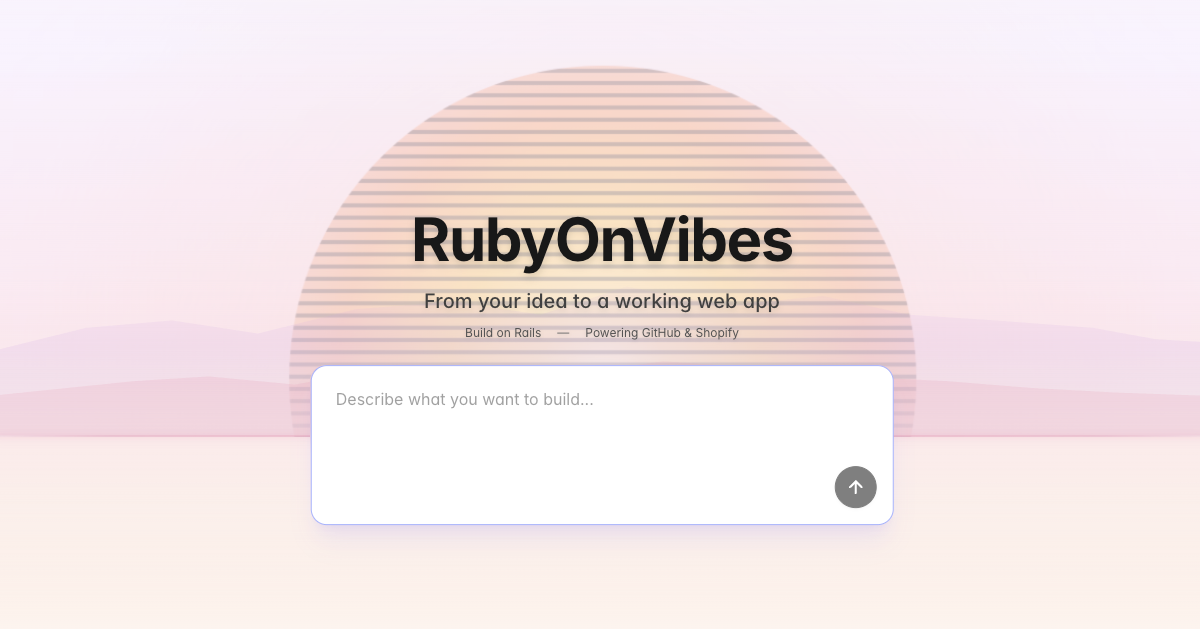
I’m a fan of what Eric Arnold is building with RubyOnVibes, an AI agent app builder that generates full-stack Rails applications with built-in AI primitives powered by RubyLLM including chat, agents, and image generation. The platform emphasizes zero vendor lock-in with deployable code using Rails, Tailwind, and React/Vite, and recently shipped a two-way GitHub integration for local development. Eric positions RubyOnVibes against platforms like Lovable and Base44, arguing Rails is the best framework for AI-powered web apps because it doesn't require cloud lock-in to scale.
That’s all for this edition! Be sure to reach out if you have any stories, content, jobs, or events you want featured in the newsletter.