- RoboRuby
- Posts
- Ruby AI News - December 3rd, 2025
Ruby AI News - December 3rd, 2025
The 20th edition!

Matt Solt
December 03, 2025

Welcome to the 20th edition of Ruby AI News! This edition features notes on the SF Ruby conference and community, DSPy.rb’s LLM-enabled documention, the surprise open source release of Fizzy, and much more.
I’m trying out a modified content format, let me know what you think. While I can’t always incorporate everything, feedback is always welcome: [email protected]. Let me know how I can improve the newsletter and make it more valuable read!
Contents
Top Stories
Conference and Community
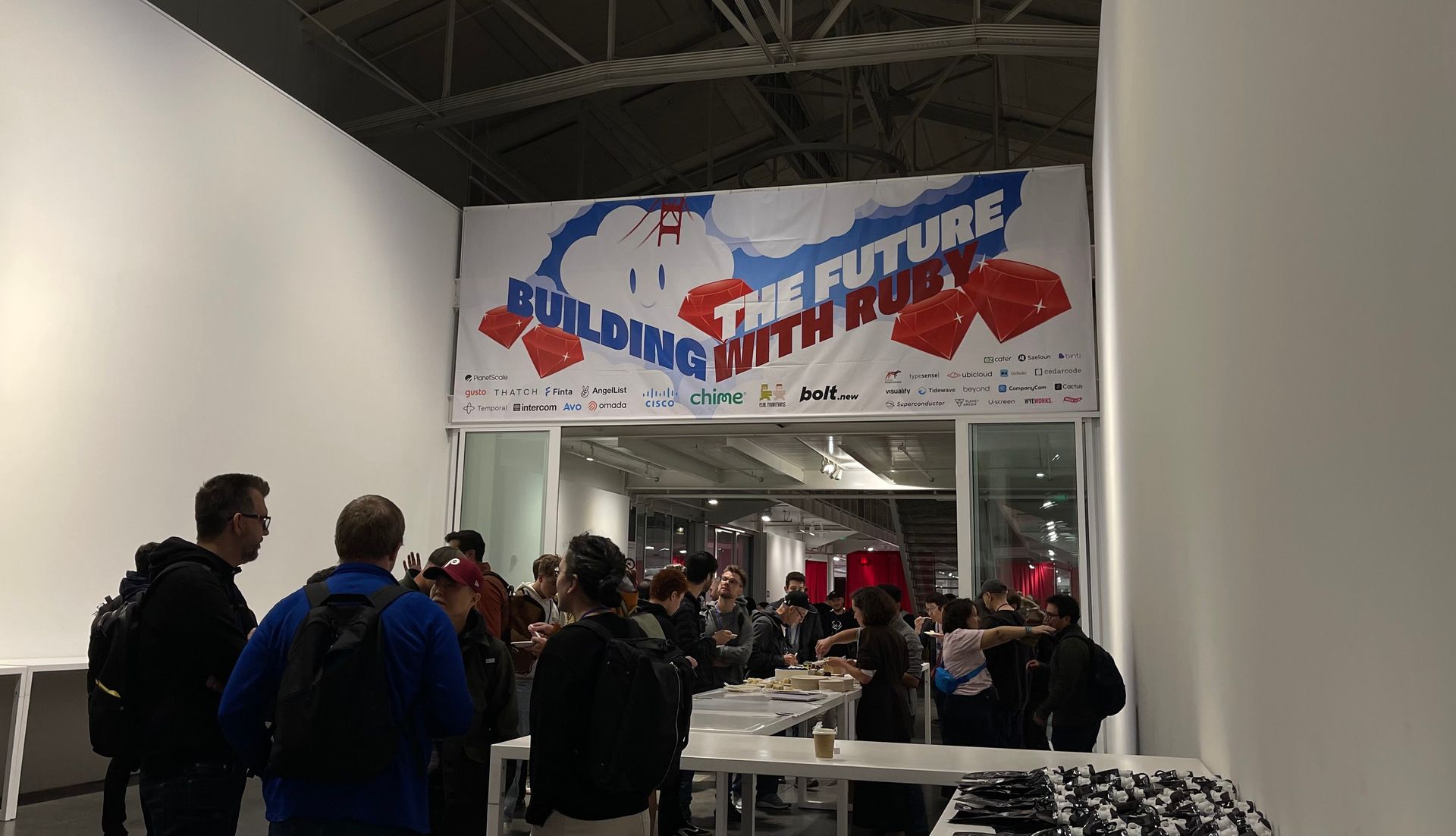
Two weeks ago, more than 400 Rubyists and dozens of AI-powered startups gathered for the San Francisco Ruby Conference. The message was clear: Ruby is ready for the AI era, and the community is ready to build it together. It was an incredible experience - meeting my Ruby heroes, making new friends, and discussing what comes next. To everyone involved: thank you. It was a privilege and an honor to be present.
It’s great to see others had the same experience. Rachael Wright-Munn shared her conference experiences (and gave a great presentation on the fun of programming as part of gaming), highlighting the venue, the events, and the talks that positioned Ruby for AI integration. Avinash Gosavi documented his highlights and shared the realization that “AI is becoming a core Ruby tool, not just hype”. Anton Tkachov has been tweeting out thoughts and summaries on all of the demos, presentations, and high points. And Adrian Marin reflected on the conference and introduced the concept of the "Thousand People Framework". He acknowledged that while Rails as the “One Person Framework” appeals to agile startups, we need to focus on messaging to large enterprises so that they can be assured of Ruby's viability, and share in the success stories of companies like Shopify, Chime, Bolt, Intercom, and Gusto.
I enjoyed all of the presentations, but the keynotes stood out and exemplified some of the biggest innovators in the Ruby community. Marco Roth brought his full vision for Rails view tooling to life with Herb, a parser that actually understands HTML+ERB, and ReActionView, a new ActionView engine that slots into existing Rails apps with HTML validation, real error feedback, and a debug mode out of the box. Vladimir Dementyev's “Rails X: Reflect, Evolve, Predict” laid out a vision for Rails' next era: safe and stable foundations, beginner-friendly onboarding (including “vibe-boarding”), better developer tooling with LSPs and linters, AI-native capabilities, and architecture ready to scale. Vladimir reminded us that Rails' future is shaped by what we choose to build together. Carmine Paolino's “RubyLLM: One API, One Person, One Machine” presented a vision for Ruby's AI future that feels true to the spirit of the Ruby language: one simple API designed for humans. It offers one interface for all providers, intuitive syntax, Rails-native integration, and async Ruby for significant concurrency gains. RubyLLM is a gift to the community, built to make AI feel natural, not bolted on.
And of course, not to be missed was Obie Fernandez (I missed it, no comment). His keynote, “Performance Starts With You,” emphasized that Rails is not the barrier in AI - developers are, making process more important than ever. Accidental complexity compounds until it becomes the status quo, and you no longer scale the app, you scale the people who build it. In his follow-up essay Ruby Was Ready From The Start, Obie expands on how XP principles - feedback, coordination, pairing, clarity, and courage - turn out to be exactly the skillset required for collaborating with AI agents. CHOP (Chat-Oriented Programming) isn't magic; it's pair programming with a partner that never gets tired but needs your guidance. “Ruby was ready for this future not because it anticipated AI, but because it has always been designed for the kind of collaborators we must now learn to be”.
The company demos really drove home what a team can accomplish building with Ruby and Rails. Tom Wheeler showcased how Temporal keeps Ruby workflows alive through unexpected failures. David Paluy represented Suppli, which modernizes payments and receivables for construction materials suppliers. Bart de Water walked through Thatch, which uses AI to tailor healthcare plans to your organization and employees. Brian Moseley presented how Sixfold uses AI agents to process millions of documents for insurance risk. Avinash Joshi demoed Cactus, a voice-based AI CRM that handles calls, leads, and job scheduling for home services. And Arjun Singh revealed how Superconductor spins up agents in virtual machines to parallelize Rails application development.
The startup demos were beyond impressive, even more so considering many of them were from solo technical developers. Brad Gessler shared an eye-opening TerminalWire demo on how easy it is to ship a CLI interface for your LLM-powered applications. Miles Georgi showed his AI-enabled Ruby command framework Foobara and his vision for tooling and automation discoverability. Raul Popadineți unveiled OG Pilot, which stunningly creates social preview images by extracting brand elements and applying multiple design styles. Evgeny Li demonstrated BemiDB, which centralizes data sources into a serverless analytics warehouse with built-in AI querying. And Carmine Paolino previewed ChatWithWork, an all-in-one AI that answers workplace questions by searching across connected tools instantly.
Then there's Kieran Klaassen's demo of Cora. Cora is an AI email client that controls your inbox, drafts replies in your voice, and builds daily summaries so you're not scrolling through endless emails. With an overwhelmingly positive response to the launch, subscribers and positive reviews are rolling in. Cal Newport of The New Yorker said "I'm not sure that A.I. has ever made me more excited than [seeing Cora's daily briefing]." And he's not the only one. Cora is redefining email and building a better experience than Gmail, Hey, and Superhuman - all with Ruby, AI, and a single developer.
But I think the highlight came on the 3rd day of the conference during the hack space at AngelList, witnessing a group of high school students from Hack Club demonstrate HCB, an open source fiscal sponsorship and banking platform that gives teen-led organizations nonprofit status, bank accounts, and transparent financial tooling. I spent a lot of time at the conference discussing ways to bring new developers to Ruby, and it was inspiring to see young Rubyists embracing Rails to bring their ideas to life, proof that the framework can still resonate with a new generation of hackers. I was so impressed with their vision, and how a single Rails application can foster an entire community of aspiring developers.
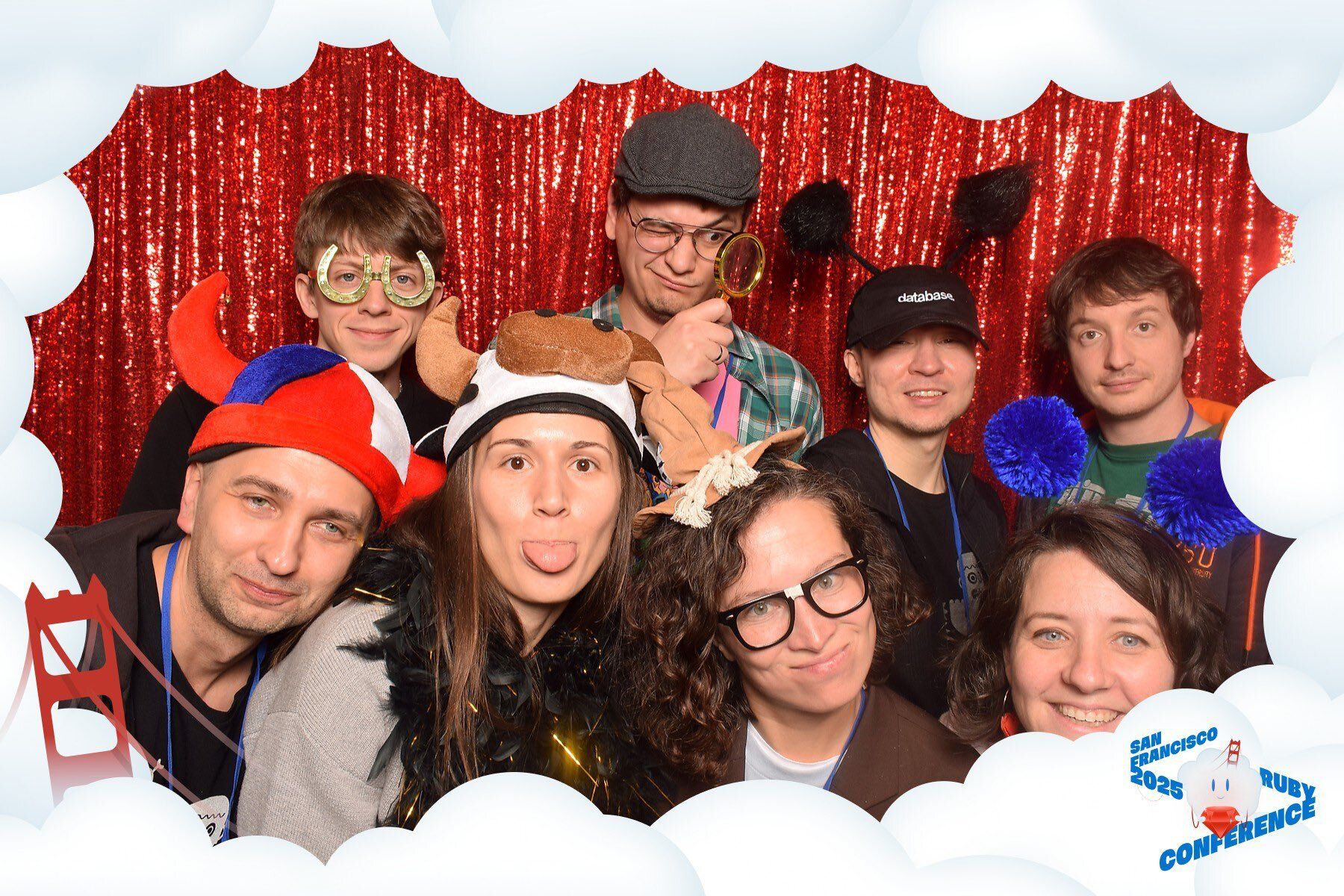
With help from members of the SF Ruby meetup group, the conference was organized by Irina Nazarova and Evil Martians. Evil Martians is a product development consultancy focused on developer tools, helping startups grow from seed stage to unicorn status. Don’t let the photo fool you - this is a team of world-class operators. But it does capture the spirit of the Ruby community, as they bring so much joy, creativity, and enthusiasm to the space each and every day. Their open source accomplishments are legendary: AnyCable, PostCSS, Overmind, AgentPrism, Autoprefixer, and Ruby Next just to name a few. A huge thank you to Evil Martians and everyone involved in putting together such a phenomenal event!
Putting on a conference for the benefit of the community requires a tremendous amount of time, energy, and funding, and the organizers are still looking for sponsorships to cover post-production. If your organization can help, please reach out at [email protected]. In exchange, I will contribute newsletter sponsorships, featured job placements, and proprietary data sets to any organization that pitches in. Let's make this a recurring event and keep strengthening our community through the collaborations and innovations that gatherings like this create.
Ruby now has the pieces in place to build what comes next. It has the generative AI libraries, the context engineering tools, the agentic protocol servers, and most importantly, the best language experience for the people that have to create, review, and understand the code. It's time to lean into Ruby's superpower - its community - and start collaborating to put all of these pieces together into a cohesive (and delightful) framework.
I spent the final day of my trip to San Francisco hacking away in a co-working space, on something inspired by the conference that I hope to share with you soon. While I was working, something big happened: Opus 4.5 was released. And it was just different. The moment felt as significant as getting my first Nintendo, accessing the internet for the first time, holding my first smartphone. No, it’s not sentient, but it is a revolutionary piece of machinery. It just worked. You’re no longer limited by how fast you can write code, but by how big you can dream. Let’s build the dream together.
DSPy.rb’s LLM-enabled Docs
Documentation isn’t just for humans anymore, so one of the most important things you can do as a developer when creating something new is to have great resources to help both humans and machines understand your code. Not only does DSPy.rb have a great blog and a complete documentation site, but it provides llms.txt and llms-full.txt files. LLMs.txt is a proposed standard for providing a structured, Markdown-formatted summary of your project, making web content more accessible to large language models. And while AI agent web search and parsing capabilities are constantly improving, this presents the most token effecient, clearest form of documentation data for an LLM’s context window.
Vicente Reig’s port of Stanford’s DSPy framework is quickly becoming one of the most powerful tools in a Rubyist’s AI toolboox for context engineering and building reasoning systems. Some recent highlights from the DSPy.rb blog include a series of tutorials demonstrating production AI patterns in Ruby. Evaluator Loops in Ruby shows iterative content improvement by pairing cheap drafting models with sophisticated evaluators. Building Chat Agents with Ephemeral Memory covers conversation history management and complexity-based routing between cost-effective and premium models. Let the Model Write Your Tools introduces CodeAct, enabling LLMs to dynamically generate and execute Ruby code rather than relying on predefined tools. And finally Does Chain of Thought Actually Improve Summaries? presents an experiment showing Chain of Thought thinking achieved a 3 percent improvement for direct prediction, a significant gain for production use cases where faithfulness and accuracy are the most important factors.
Vicente will be presenting at Artificial Ruby tonight on DSPy.rb and turning messy prompts into repeatable reasoning systems. Definitely stop by and check it out if you’re in New York.
A Glimpse into Fizzy’s AI Future
In a stunning development, 37signals introduced and open sourced Fizzy, a Kanban style tool designed as a simpler alternative to bloated project management software. Rob Zolkos immediatly fired up Claude Code to dig into the source code in The Making of Fizzy, Told by Git, documenting 18 months of engineering. Rob noted the exploration of adding AI features to Fizzy, revealing RubyLLM integration, sqlite-vec embeddings for semantic search, MCP capabilities, natural language command parsing, and AI summaries. Time will tell if these features make a return, but still interesting to see the implementations and the potential AI integrations.
Announcements

Compounding Engineering Plugin Kieran Klaassen released v2 of the Claude Code plugin featuring commands for planning, working in isolated git worktrees, and multi-agent code review with specialized reviewers. Kieran noted in a video tutorial on the plugin that Opus 4.5's ability to maintain context across parallel threads made this release possible.
Blazer AI Kieran Klaassen also released a Ruby gem that adds AI-powered natural language to SQL generation for Andrew Kane's Blazer gem using RubyLLM. The gem supports all RubyLLM providers with built-in security restricting queries to SELECT and WITH statements only.

Leva Kieran kept on shipping and updated the design on his LLM evaluation framework for Rails that enables systematic testing of language models against production ActiveRecord data with experiment tracking and a built-in UI at a mountable /leva endpoint.
Ruby LLM Agents Adham EL-Deeb released a Rails engine for building LLM-powered agents with RubyLLM, featuring execution logging, cost tracking, and a Turbo-powered analytics dashboard.
We're Doing It Live Joe Leo announced Phoenix's first public onboarding event "Get Flying with Phoenix" offering live setup assistance, 1,000 free credits, and direct team interaction for repository activation.
OG Pilot Raul Popadineți launched an AI-powered service that automatically generates branded Open Graph preview images for websites, pulling titles, colors, and favicons to create social media previews across multiple design styles without manual design work.
FerrumMCP Eth3rnit3 released a Ruby-based browser automation server implementing Model Context Protocol support with tools for navigation, DOM interaction, screenshots, and JS execution. The gem features multi-session management, BotBrowser anti-detection mode, and Docker images.
CraftDesk Maciej Mensfeld announced his Rails-built package manager for AI capabilities in Claude Code will be going open source. The current CLI tool manages skills, agents, commands, hooks, and plugins with dependency resolution, lockfiles, and knowledge sharing via the command line.
Claude Code Architecture Thibaut Baissac released a Rails-specific configuration for Claude Code with specialized skills for MVC patterns, ActiveRecord, and Hotwire, plus agents for code review, refactoring planning, and RSpec debugging.
Intelligence Kristoph updated his Ruby gem for uniformly interacting with LLM APIs across multiple providers to support Google's Gemini 3.0 API changes.
Ruby Console MCP Phạm Văn Hùng released an MCP server enabling AI assistants to execute Rails console, IRB, or Racksh commands with persistent sessions where variables maintain state between executions.
CTON Davide Santangelo released a Ruby gem for compact token-oriented notation that reduces LLM prompt token usage to 50-60% of JSON while preserving schema hints for reliable AI generation.
Ruby AI Code Generator Zencoder highlighted their AI coding assistant for Ruby and Rails development featuring real-time code completions, automated debugging, one-click deployment, and intelligent refactoring capabilities.
Articles
Vibe Check: Opus 4.5 Is the Coding Model We've Been Waiting For Katie Parrott, Dan Shipper, and Kieran Klaassen of Every reviewed Claude Opus 4.5 as a breakthrough for vibe coding that transforms multi-day projects into hours while handling extended sessions without performance degradation.
How to Write a Great agents.md: Lessons from over 2,500 Repositories Matt Nigh of Github analyzed 2,500+ repositories to identify best practices for agent.md files, finding that specific job definitions, executable commands placed early, code examples over descriptions, and clear boundaries outperform vague instructions.
Tips for Effective Prototyping with Rails 8 and Claude Code Jorge Bejar shared seven practical tips for AI-assisted Rails development, including establishing code standards via CLAUDE.md files and leveraging Rails' Solid stack to minimize dependencies.
The Next Million Rails Apps Kody Kendall argued that Rails' convention-over-configuration and deterministic file structure make it uniquely suited for LLM-assisted development, introducing Leonardo as a browser-based environment enabling non-engineers to build production Rails apps through chat.
57 Is Actually 15: How LLMs Gaslight Their Own Tools Abdelkader Boudih examined how LLMs override accurate tool outputs when they contradict training data, highlighting why he built ActionMCP for Rails with comprehensive logging to create audit trails of what actually occurred versus what models reported.
Hallucination Driven Development: When Senior Engineers Stop Verifying Abdelkader Boudih also critiqued the practice of accepting AI-generated code changes without verification, contrasting a viral claim of 2,400 files modified via a single Cursor prompt against proper iterative development.
How to Rev Up Your Rails Development with MCP Jack Rosa explained how the rails-mcp-server gem enables AI assistants to understand Rails application architecture, reducing guesswork during refactoring and allowing plain-English queries about model relationships.
Building a Browser-Based MMORPG with Ruby on Rails: Documentation-Driven Development with AI Max Lukin detailed a documentation-driven approach using Rails 8.1, Hotwire, and ActionCable, where structured documentation across three tiers guides AI assistance within defined architectural constraints rather than allowing autonomous decisions.
AI in Web Development: A Comparative Study of Traditional Coding and LLM-Based Low-Code Platforms compared chatbot implementations across Node.js, Python, Ruby, and n8n with LLMs (Grok, Gemini, ChatGPT), finding the low-code approach reduced development time by 60%.
Improving Web Accessibility with Trace-Augmented Generation José Valim explained how Tidewave's coding agent platform uses Trace-Augmented Generation (TAG) to map DOM accessibility violations directly to source code locations using framework-specific traces. Benchmarks showed 79% accuracy versus 40% for Claude Code across Rails, Phoenix, and other frameworks.
Postmark AI Prompts Postmark published pre-built prompts for integrating their email service using AI development tools like Cursor and Claude, covering Rails implementations for common workflows like password resets and inbound webhooks. Excited to see more services offering AI prompt workflows and documentation.
AI in Focus: Pair Programming with AI Chad Pytel, Clarissa Borges, and Michelle Taute of Thoughtbot demonstrated AI-assisted Rails development building an Action Mailbox feature, emphasizing that developers should describe problems rather than proposed solutions to get better AI suggestions.
The AI-Native Rails App: What a 2025 Architecture Looks Like Ivan Turkovic outlined an architecture pattern where Rails orchestrates validation, vector search, and workflows while AI handles reasoning, using pgvector for semantic retrieval and Turbo Streams for token streaming UI.
Vibecoding the Physical: How AI Helped Me Bind My Photobook Mario Alberto Chávez described his workflow of using Claude to rapidly prototype a photobook builder in React, then converting it to Rails where he could apply his deeper expertise to refine the architecture.
Rails Upgrades with AI: A Real-World Success Story Mario Alberto Chávez also upgraded an electronic medical records application from Rails 7.1 to 8 in days using the Rails Upgrade Skill for Claude, which provided step-by-step guidance and simplified the configuration changes that can prove problematic with standard upgrade commands.
ERB to JavaScript Conversion Sam Ruby used Claude Code and Ruby's Prism parser to automatically convert ERB templates into JavaScript functions for offline SPAs, eliminating template duplication and significantly reducing code while ensuring client-side rendering matches server-side output exactly.
TDD Is More Important Than Ever Justin Searls argued that test-driven development skills are now essential for AI-assisted coding because agents can only succeed when they can independently verify their work through tests, sandboxed environments, and real-time feedback.
Software Development in the Time of Strange New Angels Dave Griffith suggested that agentic AI like Claude Code shifts the bottleneck from writing code to knowing what to build, with costs dropping from $150/hour to $200/month and success requiring architectural maturity rather than faster code production.
A Mermaid Validation Skill for Claude Code Rob Zolkos created a Claude Code skill that automatically validates mermaid diagrams using the mmdc CLI tool, detecting syntax errors and fixing them before marking tasks complete.
Unlock Claude Beta Skills in Ruby: Complete Guide to Listing and Leveraging Custom AI Skills Claude Directory published a tutorial on using the Anthropic Ruby SDK's beta skills API, demonstrating how to list, discover, and integrate persistent uploadable capabilities using client.beta.skills.list for dynamic AI workflows.
Community Benchmarks for AI Coding Tools Andrew Nesbitt proposed framework maintainers create their own AI coding benchmarks, arguing current evaluations focus on Python and JavaScript while leaving Ruby, Elixir, Go, and Rust underrepresented.
Context: The Missing API in Ruby Logger Tiago Cardoso proposed adding with_context and per-call context keyword arguments to Ruby's standard Logger to address ecosystem fragmentation where multiple logging libraries implement incompatible formatter interfaces.
Women on Rails Newsletter #68 highlighted the emergence of Forward-Deployed Engineers as an AI role seeing 800% growth in job postings, along with tips for customizing GitHub Copilot's code review behavior through configuration files.
What Is Vibe Coding? Natalie Kaminski explained vibe coding as AI-driven development using natural language prompts, drawing parallels to Rails' convention over configuration philosophy while outlining benefits like faster prototyping.
The Boredom Paradox: How Risk-Averse Engineering Built the Internet's Most Resilient Companies Igboanugo David Ugochukwu argued that engineering excellence comes from stable infrastructure rather than cutting-edge technology, citing Shopify's modular monolith enabling faster shipping than with microservices.
The Gem Fellowship from gem.coop announced a grant program funded by Contributed Systems (Sidekiq), committing $100,000 annually for three years to support Ruby open source maintainers. Awards range from $2,500 to $25,000 per project with applications opening December 2025.
Videos
AI + Rails Workshop | Thoughtbot Open Summit 2025 Justin Bowen and Chad Pytel live-coded AI agents using the Active Agent gem, debuting a new structured outputs feature and discussing why Ruby and Rails are well-suited for building AI features.
Navigating Uncharted Waters: Coding Agents and Tooling Evolution José Valim presented at Euruko 2025 on how programming languages and developer tools might evolve as AI becomes integrated into software development.
Markdown Renderer & MIME Type in Rails 8.1 Chris Oliver covered Rails 8.1's new Markdown MIME type and built-in renderer designed to improve compatibility with AI tools that use Markdown formatting.
AI Commit Messages Drifting Ruby demonstrated using a local LLM to automatically generate git commit messages with a review step before saving.
Google Antigravity on Rails! Gemini 3 Pro vs Claude Sonnet 4.5 AI on Rails demonstrated Google's new Antigravity IDE for Rails development, comparing application generation using Gemini 3 Pro and Claude Sonnet 4.5 models.
Claude Opus 4.5 in Cursor, Will It Crush Sonnet 4.5? AI on Rails also tested Claude Opus 4.5 in Cursor using the same Rails application prompts from the previous Gemini 3 vs Sonnet 4.5 comparison video.
I Wasted 2 Years on Python. I'm Back to Ruby Alan Alves documented his return to Ruby after two years building AI in Python, praising RubyLLM for translating "Python's framework chaos into the Ruby way of thinking." RubyLLM creator Carmine Paolino endorsed the video, encouraging more AI development in Ruby.
Cursor 2.0 Tutorial for Beginners (Full Course) Not Ruby-based, but still valuable, Riley Brown and Kehan Zhang published a 2.5-hour course covering Cursor 2.0 from basics to advanced features including multiple agents, custom commands, and full-stack app development. Cursor Learn from the makers of Cursor have started their own free course as well.
Podcasts
The Ruby AI Podcast: The Latent Spark - Carmine Paolino on Ruby's AI Reboot Joe Leo and Valentino Stoll interviewed Carmine Paolino about RubyLLM, his gem with 4 million downloads that provides a unified interface across 11+ providers. Discussion covered Ruby's async fiber advantages for concurrent LLM operations and the challenges of multi-agent systems.
IndieRails: Teaching Devs to Build with AI Jeremy Smith and Jess Brown interviewed Brian Casel about how AI is transforming development workflows and why full-stack Rails developers are well-positioned as the generalist mindset becomes increasingly valuable.
Remote Ruby: San Francisco Ruby Conference Recap Andrew Mason and Chris Oliver discussed highlights from SF Ruby 2025, covering talks on Rails' future, AI's impact on programming, developer anxiety, and startup culture.
Code with Jason Podcast: Matthew Ford, CEO/CTO at Bit Zesty Jason Swett interviewed Matthew Ford about AI-assisted coding, discussing the risks of vibe coding without proper testing and why human oversight remains essential despite AI accelerating development workflows.
Changelog: Tidewave - José Valim's New Direction for AI Developer Tooling Adam Stacoviak and Jerod Santo interviewed José Valim about Tidewave, his browser-based coding agent deeply integrated into Rails and Phoenix that combines runtime inspection with AI assistance for full-stack development.
Discussions
Context Engineering for Ruby A Reddit user asked for solutions to gather Rails app context (modules, callbacks, dependencies) for an AI mutation testing agent without dumping entire files to the LLM. The community suggested Tidewave Rails, Active Agent, and custom RAG pipelines with embeddings.
Events
December 3rd - Meetup: ArtificialRuby is hosting a meetup at Betaworks in New York City on December 3rd and will feature three speakers:
Vicente Reig: DSPy.rb - a Ruby-first port of Stanford’s DSPy, a declarative framework that turns manually written prompts into predictable, reusable reasoning systems. You’ll see how Signatures, Evals, and Prompt Optimizers work together to improve your prompts automatically and keep your system stable as models evolve. Think of DSPy.rb as the MVC moment for AI: a framework that brings structure and reliability to a layer of your app that changes faster than anything else.
Daniel Doubrovkine: Hypermedia APIs are Made for AI - While adoption of Hypermedia APIs is very low compared to, for example GraphQL, this approach to API design deserves a new look in the age of AI. In this talk we'll look at building a Hypermedia API using grape and grape-roar, and expose it via an MCP using the new hyperclient-mcp gem.
Brian Fountain: G3NPRO - A new software platform empowering enterprise animation studios with groundbreaking generative AI tools that accelerate production timelines and unlock unprecedented creative possibilities. G3NPRO is built on Ruby/Rails and currently in the pilot phase.
December 3rd - Meetup: Vienna.rb will meet on December 3rd at Sentry in Vienna, Austria for a talk by Paweł Strzałkowski on AI Interfaces in 5 Minutes: Model Context Protocol on Rails.
December 4th - Meetup: Ruby User Group Berlin will get together on December 4th in Berlin, Germany for a presentation by Carmine Paolino on RubyLLM: One API, for One Person, in One Machine, for AI.
Open Source Updates
Code Spotlight

Joseph Schoblaska released Jargon, an AI-powered personal knowledge management system that transforms articles, academic papers, and videos into interconnected insight networks. Built with Rails, the system uses a five-step pipeline: ingesting content from web articles, PDFs, and YouTube; summarizing with LLMs; extracting standalone insight cards; connecting related concepts via semantic embeddings with automatic deduplication; and generating research threads that expand the knowledge base through web searches. The app features an impressive architecture:
Falcon - Async Ruby application server with fiber-based concurrency
async-job - Background job processing without a separate worker process
RubyLLM - Unified interface to OpenAI, Anthropic, Gemini, and OpenRouter
ruby_llm-schema - Structured JSON output from LLMs via schema definitions
pgvector - Vector similarity search in PostgreSQL
Exa - Neural search API for finding related content
crawl4ai - Fallback web scraper with browser rendering
pdftotext - Text extractor for PDF content
New Gems
Links to the RubyGems page, newest releases are first:
tahweel - Tool for converting PDF files to text using OCR
aws-sdk-novaact - AWS SDK for Ruby - Nova Act Service
nanogpt - A Ruby port of Karpathy's nanoGPT
local_llm - Ruby client for local LLMs via Ollama with streaming support
llm_classifier - LLM-powered classification for Ruby with pluggable adapters and Rails integration
rails_mcp_engine - Rails engine for MCP tools
translate_api - Official Ruby SDK for Translate API
looped - Self-improving coding agent with continuous prompt optimization
durable_workflow - Durable workflow engine with YAML-defined steps and pluggable executors
voice-notes-ruby - Ruby client for the Voice Notes API
screenkit-tts-minimax - Minimax TTS engine for ScreenKit
grnexus - High-performance cross-language neural network framework
screenkit-tts-google - Google TTS engine for ScreenKit
toon-format - TOON format serialization for Ruby
claudekick - A Claude Code companion for hooks, linters, and automation
status_mcp - Status Model Context Protocol server for status page information
ruby_llm_swarm-mcp - A RubyLLM MCP Client
ruby_llm-agents - Agent framework for building LLM-powered agents with RubyLLM
rubyllm-observ - Rails observability engine for LLM applications
aigen-google - Ruby SDK for Google Generative AI (Gemini API)
toonify - A simple JSON to custom text format converter
nightingale - A Ruby framework for building interactive data and AI web apps
caruso - Sync steering docs from Claude Marketplaces to other agents
nuabase - Nuabase Ruby SDK
kreuzberg - High-performance document intelligence framework
blazer-ai - AI-powered SQL generation for Blazer
sqa_demo-sinatra - SQA Demo Sinatra Application
convertorio-sdk - Official Convertorio SDK for Ruby - Convert images easily with a simple API
rubygems_mcp - RubyGems MCP (Model Context Protocol) server for Cursor IDE integration
toon-parser - A Ruby gem for parsing and serializing TOON (Token-Oriented Object Notation) format
reposer - AI-powered GitHub repository creation and management
scout_apm_mcp - ScoutAPM MCP (Model Context Protocol) server for Cursor IDE integration
chatwerk - Chatwerk: AI integration for Packwerk
jekyll-ai-domain-data - Jekyll plugin for generating AI Domain Data Standard domain-profile.json files
New Open Source
Links to the Github repository:
Recollect - MCP server that provides persistent memory management across Claude Code sessions using SQLite with full-text and optional vector search
Dradis Echo - AI plugin for Dradis Framework that uses local Ollama models to summarize, reword, and generate content for security findings
Ollama Web Search MCP - MCP server that integrates web search capabilities using the Ollama API
Brimming - Self-hosted Stack Overflow-like Q&A platform for enterprise knowledge bases with RAG search, MCP integration, and AI capabilities
Yugo - AI-powered group trip planner that aggregates travel preferences from participants and generates collaborative itineraries
MCP Permission Prompt - Gem implementing MCP-based permission handling for Claude Code CLI's headless mode with configurable policy controls
Basic Ruby Agent - Minimal agentic assistant implementation demonstrating the listen-think-act loop pattern
MCP Rails - MCP server that provides coding rules and best practices prompts for Rails projects, designed for Cursor IDE integration
Jobs & Opportunities
Are you an organization searching for an expert Ruby AI developer, or a Rubyist looking for your next development role with AI and would like to beta test a new job matching platform? Please reach out and let me know the type of opportunity you’re pursuing: [email protected]
One Last Thing

Vivek Trivedy introduced the concept of HaaS (Harness as a Service), describing how the Claude Code SDK represents a shift from LLM APIs to customizable agent runtimes. He defines an "agent harness" as the external functionality enhancing model execution, including conversation management, tool invocation, permissions, and state handling. The framework identifies four customization points: system prompts, tools/MCPs, context files, and subagents, predicting an ecosystem where developers extend open-source harnesses while focusing on domain-specific tuning. The beginnings of an “Open App Store for Agents”.
That’s all for this edition! Be sure to reach out if you have any stories, content, jobs, or events you want featured in the newsletter.