- RoboRuby
- Posts
- Ruby AI News - February 26th, 2026
Ruby AI News - February 26th, 2026
Ruby enters CodeMode

Matt Solt
February 26, 2026

Welcome to the 25th edition of Ruby AI News! This edition features Code Mode, Bombing mode, and NSFW mode. But more importantly, its time for build mode.
I will be presenting Introduction to Generative AI Programming with RubyLLM on March 7th, 2026 at CultureWorks Greater Philadelphia, if you’re in the area, I encourage you to check it out.
Contents
Top Stories
Code Mode
Matt Carey of Cloudflare introduced Code Mode: Give Agents an Entire API in 1,000 Tokens, Cloudflare's approach to enabling LLM agents to access their 2,500+ API endpoints through an MCP server using just two tools and approximately one thousand context tokens. Instead of representing each API operation as a separate tool (which would consume 1.17 million tokens), Code Mode lets agents write and execute code against a typed SDK inside a sandboxed environment. The two tools, search() for querying the OpenAPI spec, and execute() for running authenticated API calls, allow agents to discover endpoints and chain multiple operations together while preventing prompt injection through disabled outbound fetches by default.
Obie Fernandez immediately expanded on this concept by implementing Cloudflare's Code Mode pattern in Ruby for ZAR's Empirium platform, which exposes 40 plus MCP tools consuming nearly 18,000 tokens of context per connection. Obie’s version replaces all tool definitions with just two mcp calls: code_search for discovering tools via Ruby code and code_execute for invoking them, reducing a 21-tool-call operation to a single round trip. The sandbox uses a Ruby BasicObject with regex guards, timeouts, and an optional Gemini pre-scan for semantic safety, all implemented in under 200 lines across four files. Obie went on to publish a full explainer with code examples on the ZAR blog, giving a detailed implementation guide for applying Cloudflare's Code Mode pattern in Ruby using Rails and ActionMCP.
CJ Avilla demonstrated this approach in How to Set Up a Code Mode MCP Server for Your API with Stainless, walking through the full process of generating a code mode MCP server from an OpenAPI spec using Stainless. The tutorial covered creating a Stainless project, generating a TypeScript SDK, adding an MCP server target, resolving diagnostics, and connecting to Claude Code, then deploying a hosted MCP server that users can plug into any compatible MCP host. CJ showed how code mode enables multi-step API workflows using similar endpoints in a single execution with search_docs and execute tools, reducing context clutter compared to one-endpoint-per-tool patterns. This may well be the future of the Model Context Protocol.
YAY AIA V1
Dewayne “Madbomber” VanHoozer released AIA V1.0 in What's New in AIA, a CLI tool for interfacing with AI models through the RubyLLM gem. Dewayne is one of the earliest Rubyist’s to embrace AI, and one of the inspirations behind the newsletter. In addition to AIA, he has continously innovated with Ruby and AI to launch cutting-edge libraries to move Ruby AI forward:
RobotLab A gem for building multi-agent AI applications with specialized robots backed by persistent LLM chats, featuring network orchestration, MCP integration, reactive Redis-backed memory, and Rails support with Turbo Stream broadcasting.
HTM A gem implementing a dual-tier memory system for AI applications, combining token-limited working memory with PostgreSQL-backed long-term storage using pgvector for hybrid search, temporal filtering, and multi-agent shared memory.
PromptManager A gem that treats prompt files as composable, parameterized templates with YAML metadata parsing, shell expansion, ERB rendering, and file includes through a configurable four-stage pipeline.
SelfAgency A gem that enables classes to generate and install methods at runtime through LLMs, converting plain English descriptions into working Ruby code with a two-stage pipeline, 26 static security patterns, and runtime sandboxing.
Ragdoll A (maybe defunct?) unified text-based RAG library built on ActiveRecord with PostgreSQL and pgvector that converts images, audio, and documents into searchable text representations for cross-modal semantic search through a single index.
If you’re not following Dewayne, you’re missing out out on the crux of Ruby and AI. MadBomber Software has a ton of open-source projects that you need to be following. And of course, take a look at the Ruby AI Builders discord channel, and be sure to join.
Ruby AI Goes NSFW
Michael Monin detailed how EverAI scales an AI companionship platform on a single Rails monolith in Scaling AI Companionship: Under the Hood of a 10B Request Monolith, serving 28 million monthly active users, 10+ billion HTTP requests per month, and a 1.81TB PostgreSQL cluster with billions of rows. The stack is Rails + Postgres + Redis + Sidekiq, processing billions of async jobs with near-zero backlog, while the team merges more than 500 PRs per month with heavy AI tool adoption. Michael shared the numbers on LinkedIn, citing YC combinator’s Garry Tan's observation that Rails combined with AI is a "crazy unlock" for productivity.
Why is Ruby so important in the age of AI? One reason is that the two most token efficient languages before Ruby are Clojure and Julia. I understand some of you think that we’ve reached the singularity. But I don’t. We’re just getting started. AI gets us far, but if you think Clojure and Julia are the languages for new developers but not Ruby, I would like to hear why.
Need to Know AI News
The Complete Guide to Building Skills for Claude Anthropic published a guide covering how to build skills that teach Claude repeatable workflows across three categories: document creation, workflow automation, and MCP enhancement, with patterns for testing, iteration, and distribution.
WebMCP Is Available for Early Preview André Cipriani Bandarra announced a proposed standard that enables websites to expose structured tools for AI agents through declarative HTML forms.
Making Wolfram Tech Available as a Foundation Tool for LLM Systems Stephen Wolfram announced Computation-Augmented Generation, making Wolfram's computational platform available to LLMs through three access methods: an MCP service, a unified Agent API, and fine-grained CAG Component for custom integration.
Introducing Markdown for Agents Cloudflare announced that their network now supports real-time content conversion to Markdown at the source using content negotiation headers, treating AI agents as first-class citizens alongside human visitors.
A Guide to Which AI to Use in the Agentic Era Ethan Mollick introduced a framework for selecting AI tools that distinguishes between models, apps, and harnesses, arguing that agents which autonomously complete multi-step tasks are fundamentally more valuable than chatbot conversations.
Announcements
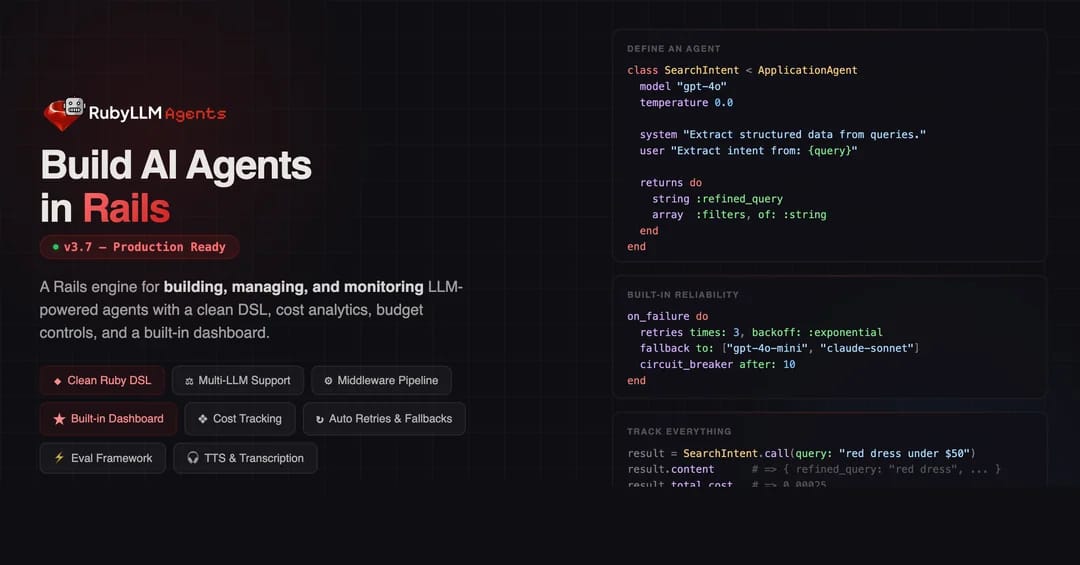
RubyLLM::Agents v3.7 Adham El-Deeb updated the Rails engine with a middleware pipeline for tenant resolution, budget enforcement, caching, a mountable dashboard with cost charts and execution tracking, and an eval framework for benchmarking agents with scorers.
MLX Ruby Alex Skryl released Ruby bindings for Apple's MLX array framework, bringing NumPy-like operations, automatic differentiation, neural network layers, and Metal GPU acceleration to Ruby with performance within 25% of the Python bindings. With the ONNX + WebGPU update, Alex also added ONNX export and WebGPU browser harness generation to run ML models in the browser.
WebMCP-Rails Jesse Waites released a Rails gem that extends form helpers with WebMCP support, a new standard that lets websites expose HTML forms as structured tools for AI agents. The gem adds a webmcp: option to form_with and input helpers to annotate forms with tool names, descriptions, and parameter metadata.
Real World Rails Steve Clarke published a curated collection of 200+ open source Rails applications as git submodules, designed for developers and AI coding agents to research architectural patterns across production codebases. The repo includes a Claude Code skill for querying all apps simultaneously.
RubyLLM::MCP v1.0.0 Patrick Vice released v1.0 of the MCP client for RubyLLM, supporting tools, resources, prompts, OAuth authentication, client interactivity, and an adapter pattern compatible with the official MCP gem. The release adds MCP extensions, JRuby support, and hardened transports for building AI agents.
Recuerd0 Mario Chavez launched a context management tool for dev teams that serves curated project knowledge to AI coding tools via REST API. Built with Rails 8, SQLite, and Solid Queue, it uses full-text search instead of embeddings, with self-hosting available under the O’SASSY license.
RuboCop MCP Server Koichi ITO added a built-in MCP server to RuboCop, enabling AI coding agents to invoke analysis and autocorrection as structured tools via the official MCP Ruby SDK. [h/t to Short Ruby News for surfacing this.]
RapidRails Ahmed Nadar launched Rapidfy, an agentic CLI that generates full Rails 8 applications using ViewComponents with Turbo and Stimulus. The tool generates models, controllers, migrations, and UI for apps, positioning itself as a Rails-native alternative to v0 and Lovable.
Hotwire Club AI Tooling Now Open Source Julian Rubisch open-sourced The Hotwire Club's AI tooling: an agentic skills pack providing six Claude skills for Hotwire patterns extracted from 45+ tutorials, and an MCP server for searching the Hotwire Club knowledge base.
Awesome Ruby AI Extended Saroj Maharjan published a curated list of Ruby AI/ML resources including API clients, agent frameworks, RAG/embeddings, MCP tools, and learning resources.
Daily Vibe Valentino Stoll launched a Rails app that gathers local news for cities worldwide, analyzes sentiment, and generates AI-created artwork and songs with lyrics to match each day's mood.
LLM.rb v4.1.0 Robert (0x1eef) announced a new release of the zero-dependency Ruby toolkit for LLMs. The gem provides chat with streaming, tool calling, structured output, multimodal input, embeddings, audio, image generation, and stateful agent sessions.
VibeRails Brendan Carroll launched an AI-powered full-codebase review tool with Ruby support that scans projects file-by-file across detection categories including security, performance, and maintainability.
Rails Diff MCP Server Alex Zeitler released an MCP server that exposes Rails version diffs as tools, allowing AI agents to list versions, compare file changes, and retrieve patches between any two Rails releases. The server is meant to pair well with Claude Code skills like skill-rails-upgrade for AI-assisted Rails upgrades.
News Curator Ashish Rao built a Ruby application that uses Claude to automatically curate news, fetching articles from GNews and selecting the top 2 most significant stories on foreign policy and diplomacy. The tool includes MCP for a /news command in Claude Code, a feedback loop for improving selections, and scheduled runs.
Rails + Claude Code Is a Crazy Unlock Irina Nazarova built Evil Martians' internal planning, HR, and financial system in two weeks using Rails, SQLite, Claude Code, and Vladimir Dementyev's Layered Rails skills, arguing that Rails' convention-over-configuration approach gives LLMs a compound advantage.
Code on Incus Maciej Mensfeld updated his container runtime for sandboxing AI coding agents in isolated Incus containers with session persistence, network filtering, and multi-slot parallel sessions. The latest changes add anomaly detection with automatic container pausing, network monitoring, and OpenCode support.
RubyOnVibes Eric Arnold launched the beta of a Rails-native cloud vibecoding platform that generates full-stack web applications from chat descriptions, with built-in authentication, payments, file storage, and deployment to live HTTPS URLs.
Splitwise MCP Aman Kumar built a Ruby MCP server exposing Splitwise API operations, enabling AI assistants to manage expenses, groups, and friends through natural language. The server supports receipt image parsing, fuzzy name matching, and built-in arithmetic tools to prevent hallucinated calculations when splitting bills.
Add to_markdown to Action Text Mike Dalessio submitted a PR for markdown conversion for Action Text, mirroring to_plain_text, motivated by HTML being verbose for LLM agents.
Vanilla Rails Skills for Claude Code Iuhoay released a collection of Claude Code skills for Rails development including vanilla-rails for designing apps the Basecamp way with thin controllers and rich models, plus rails-deps for dependency management and ruby-lsp integration.
TaskYou Bruno Bornsztein released a Kanban board for managing AI coding agents running in parallel via git worktrees and tmux. The worktree setup allows Rails apps to run multiple tasks in parallel with isolated databases and ports.
How I Became a (Rails) One-Man App Studio A reddit user shared a portable Rails AI Playbook living in ~/.claude/ that starts each project with a 15-question interview, generates structured documentation, and produces a phased roadmap for Claude Code to execute across a Rails/Inertia/React stack.
Learn Ruby & IDE - CoddyKit Mehmet Canker released an Android app for learning Ruby with AI-powered tutoring, two built-in Ruby editors, an integrated compiler, and a structured curriculum from basics to advanced topics including Rails.
Articles
Ruby Is the Best Language for Building AI Apps Carmine Paolino argued that most AI app development is web engineering not model training, making Ruby and Rails a better fit than Python, citing RubyLLM's simpler API compared to LangChain, Rails' full product stack, and Ruby's fiber-based concurrency for network-bound LLM workloads.
RubyLLM 1.12: Agents Are Just LLMs with Tools Carmine also introduced a class-based Agent DSL for defining reusable agents with declarative model, tools, and temperature settings, plus Rails-backed persistence, ERB prompt templates in app/prompts/, and AWS Bedrock and Azure Foundry support. [New Agentic Docs]
AI Agent Orchestration on Rails Jesse Waites described building Jarvis, a Rails platform where an orchestrator agent delegates tasks to specialized sub-agents with constrained tool access using RubyLLM, Hotwire for real-time updates, and Solid Queue for background jobs.
Introducing Agent Gateway for Ruby on Rails Jesse also released Agent Gateway, a Rails engine that gives AI agents secure, read-only access to production data through a single JSON endpoint with two-layer authentication and an allowlist DSL for declaring which models, fields, and aggregations to expose.
As Complexity Grows, Architecture Dominates Material Scott Werner argued that AI agent chains multiply failure rates and proposed "prompt objects" where recovery emerges from arrangement rather than explicit error handling, demonstrating the approach with an ARC-AGI solver using Claude Haiku 4.5.
The Great Zipper of Capitalism Scott additionally explored how falling AI development costs enable hyper-niche software, illustrating with "Where Is Everyone," a tool he built for the Artificial Ruby community to track attendance patterns across Luma and Mailchimp after his meetup unexpectedly grew from 20 to 60 attendees.
Agents as Teammates at ZAR Obie Fernandez described deploying autonomous AI agents as full organizational participants, built on knowledge graph and agent orchestration Rails apps. Agents autonomously triage production errors, clean technical debt, and communicate via Slack with their own identities and budgets.
It Might Be Time to Say Goodbye to HTML Inputs Obie also wrote about replacing all create and edit forms in a Rails app with MCP prompt bubbles that users paste into Claude Code, turning the web interface into a read-only layer updated in real time via Turbo Streams.
AI Agents in Ruby: Why Is It So Easy? Fernando Martinez argued that Ruby's expressiveness makes it ideal for AI agent development and demonstrated with Detritus, a 250-line coding agent built with RubyLLM featuring file editing, bash commands, web search, and subagent tools.
Evaluating LLM Prompts in Rails Patricio Mac Adden introduced RubyLLM::Evals, a Rails engine for testing, comparing, and improving LLM prompts with support for exact match, regex, LLM judges, and human judge evaluation types, plus integration with RubyLLM::Monitoring for production tracking.
SchnellMCP: Ruby Native MCP Server Experience Josef Šimánek created SchnellMCP, a Ruby library that transforms YARD-documented methods into MCP servers by adding a single @mcp.tool annotation, enabling the same Ruby script to serve as an MCP server for AI assistants, a CLI tool, and a library.
From Context Engineering to Recuerd0 Mario Alberto Chávez described how maintaining layered documentation across multiple tools for AI-assisted development led him to build Recuerd0, a versioned knowledge base server built on Rails 8 with SQLite FTS5 that centralizes project context for AI tools via a REST API.
Your AI Has No Memory. Your Rails Codebase Does. Marcin Ostrowski used the film Memento as a metaphor for how AI coding assistants start fresh each session, arguing that well-documented Rails conventions serve as "tattoos" that guide AI toward consistent, maintainable code.
My Tmux + Rails + AI TUIs Development Setup Alexander Zeitler shared his tmuxinator configuration for Rails development with dedicated windows for dev server, Neovim, Rails & Kamal, the opencode AI agent TUI, and sqlite database management.
How I Built 60-Second VPS Provisioning for OpenClaw Hosting Daniel Samer detailed building ClawHosters, a managed hosting platform for the OpenClaw AI agent framework, using Rails with pre-baked Hetzner snapshots and a prewarmed VPS pool to achieve sub-60-second provisioning.
ActiveRecord Neighbor Vector Search with Per-Document Max Jonathan Rochkind solved the RAG document diversity problem using PostgreSQL CTEs with the neighbor gem, applying ROW_NUMBER() window functions partitioned by document to limit vector search results to a maximum number of chunks per source document.
I Didn't Want AI to Be Good at This Robby Russell argued that AI-assisted development has made custom builds economically viable where SaaS previously dominated, illustrating with a Slackbot replacement built in half a day and a custom band CRM handling unstructured data.
From 6 Codebases to 1: How We Rebuilt PrayAI on Rails 8 + Turbo Native Jonathan Spooner rebuilt PrayAI, an AI-powered prayer app using GPT-4 mini, from four repositories with 15+ services and 35,000 lines of CloudFormation code into a single Rails 8 app with Turbo Native, SQLite, and 184 lines of infrastructure code.
Checkset: A Ruby Gem for Repeatable Verifications Using Playwright Andrea Fomera released Checkset, a Ruby gem for running repeatable browser-based verification checks against development, staging, and production environments using Playwright, with support for AI-assisted checks via Claude with Playwright MCP.
Setting Up Your Ruby on Rails Monolith for AI Development Colin Soleim outlined five strategies for preparing large Rails monoliths to work with AI coding tools: namespace-level .context.md files, fast test feedback with Guard, incremental Sorbet type annotations, Replit sandboxes for design iteration, and service object architecture with explicit interfaces.
AI Coding Assistants for Rails: What Actually Works and What Wastes Your Time Roger Heykoop shared a practical evaluation after six months of using Copilot, Cursor, and Claude with Rails. Test generation showed the highest impact while complex ActiveRecord queries, business logic, and security-sensitive code remained unreliable, with effectiveness correlating to how conventional the task is.
How I Went from One Button to Building Entire Rails Apps in 10 Seconds Ahmed Nadar described building Rapidfy, an AI agent trained on his RapidRails component library that generates complete Rails 8 applications with models, migrations, and Turbo/Stimulus UI in about 10 seconds from a prompt.
FrankMega: A Self-Hosted Mega Clone Built with Rails 8 in One Day Fabio Akita built a self-hosted file sharing service with Rails and Claude Code in 3 hours. Fabio argued that "AI is the mirror of your own competence," detailing the security fixes the initial AI-generated code required including OTP replay attacks and race conditions.
Stop Overcomplicating Claude Code: 3 Rules That Actually Work Vince Canger distilled effective Claude Code usage into three rules: full-stack debugging visibility, LLM-friendly documentation via llms.txt files (which use less context than MCP servers), and opinionated framework selection including Rails.
How I Came to Understand the 100x Claim Brandon Casci described building an agent orchestration system to manage multiple codebases including Rails deployments and a litestream-ruby fork. Brandon concluded the gains aren't literally 100x but make solo operation of multiple production systems feasible.
The Four Most Common Security Risks When Vibe Coding Your App Nina Torgunakova identified exposed API keys, weak authentication, insecure dependencies, and unvalidated user inputs as the top security vulnerabilities in vibe-coded applications, with practical mitigations for each.
Neither Too Much nor Too Little: A Touch Base on the Current State of AI Giménez Silva Germán Alberto presented a balanced critique of AI's probabilistic nature, noting that while testing multiple LLMs during Ruby gem development, AI worked for brainstorming and prototyping but rarely produced production-ready code.
Ruby on Whales: Dockerizing Ruby and Rails Development Vladimir Dementyev and Travis Turner updated their Docker development environment guide, replacing Webpacker with Vite and adding Claude Code CLI integration that runs inside the container with access limited to project files.
Getting Nondeterministic Agents into Deterministic Guardrails Łukasz Reszke described using automated workflows and pre-commit hooks to constrain AI agents working on a legacy Rails codebase, running checks through a /verify command that provides structured feedback when agents ignore instructions.
The Death of the Software Craftsman David Bryant Copeland argued that AI code generation challenges the value of traditional software craftsmanship since stakeholders only care about outcomes. David outlined three paths forward: rejecting AI tools entirely, going all-in, or positioning as a specialist who understands AI's gaps.
Claude Code Skills: Automating FDA-Required Documentation for Software as a Medical Device Thoughtbot built a Claude Code skill to generate FDA software design specifications. The skill produced useful first drafts but made factual errors like referencing Devise instead of the actual has_secure_password implementation, reinforcing that AI-generated regulatory documentation requires human review.
Lightweight Markdown Publishing Inside Rails Mark Holton described building a database-free publishing system within an existing Rails app using git-stored Markdown files with YAML frontmatter, CommonMarker, Nokogiri and Rouge for post-processing, and Redis caching for automatic invalidation across container deploys.
RubyMine MCP and the Rails Toolset Daniel Domjan explained how RubyMine's built-in MCP server provides AI models with processed Rails project data including models, controllers, and routes, using offset-based pagination and property-based filtering to handle large codebases within context window limits.
Ruby on Rails for IoT Application Development Nikhil Singh explored using Rails as a backend for IoT systems, covering API-first device communication, WebSocket real-time updates, and background job processing across smart home, healthcare, manufacturing, and fleet logistics use cases.
Videos
Building CreatorSignal: AI Agent Teams Build Features in Parallel In part 2 of his live stream, Damian Galarza live-coded a Rails app using Claude Code's Agent Teams to run multiple AI agents in parallel via Git worktrees, shipping features from plan to merged PR in ~15 minutes.
Building a "Lovable" for Rails Apps Chad Pytel and Richard Newman from Thoughtbot mapped out an MVP for a Rails-powered AI web app generator inspired by Lovable. They debated key architectural decisions including local vs. cloud execution, container strategies, and Claude integration for generating a production-ready app.
Hello World: Our AI App Generator Comes to Life Chad Pytel and Rob Whittaker from Thoughtbot began building ReadySetGo, an AI-powered Rails app generator that takes an app idea, scaffolds a new Rails application using Suspenders with Clearance and Roux, and uses an LLM to build out a unique feature complete with tests.
Podcasts
The Ruby AI Podcast: Innovating Development: The Future of GitHub Agents and AI in Rails Joe Leo and Valentino Stoll interviewed Kinsey Durham Grace from GitHub's Coding Agent Core Team about Agent HQ, which assigns coding tasks to Claude and Codex models directly from GitHub issues. Discussion covered building custom language-specific agents, persisting decisions for agent reference, and ensuring Ruby remains competitive in AI tooling.
Strictly From Nowhere: A Night Out at Artificial Ruby Justin Abrams and Mike Rispoli attended the Artificial Ruby meetup in NYC organized by Scott Werner, reflecting on community networking, the Valentino Stoll, and Andrew Denta demos, and how AI is changing the shape of work rather than solving its fundamental challenges.
Giant Robots Smashing Into Other Giant Robots: Refactoring with AI and Call of Duty Zombies Chad Pytel and Sami Birnbaum discussed refactoring Rails code with AI, what MCP servers actually do, and whether LLM tools are making engineers faster or just busier.
Giant Robots Smashing Into Other Giant Robots: The Product We Are Going to Build Chad Pytel and Sami Birnbaum discussed Thoughtbot's new AI-powered Rails app generator in pre-production, with Chad outlining how it will differ from existing tools and Sami asking hard questions about accessibility and target audience.
Dev Propulsion Labs: Harjot Gill of CodeRabbit on AI Growth, Going Viral in Japan, and Using Open Source for Marketing Victoria Melnikova of Evil Martians interviewed Harjot Gill, co-founder of CodeRabbit, about why AI code generation makes code review more important, not obsolete.
Token Ruby #7: Back from the Break and Building Yatish Mehta covered agentic AI development patterns, CLAUDE.md configurations for Rails projects, and a development workflow using Zed and Claude Code for parallel agent orchestration.
Static Ruby Monthly Issue 13 Andrey Eremin covered the latest in Ruby static typing including Dmitry Pogrebnoy's ruby-agent-skills repo for turning AI agents into dependable typing partners that write better RBS signatures.
Discussions
What Do You Do to Stop AI Agents from Piling Up Tech Debt? A r/rails Reddit discussion where developers shared strategies for managing AI agent code quality, with top responses on using plan mode before coding, enforcing TDD, heavy CLAUDE.md constraints, and treating agent output like junior developer PRs requiring review.
Advice for an Aspiring Junior Developer In this r/rails Reddit discussion, advice diverged between mastering Ruby/OO fundamentals first and embracing agentic coding tools. Top-voted advice emphasized candidates should learn why Ruby was designed the way it was, while others argued juniors should focus on learning agent orchestration.
Appreciation for RubyLLM A r/rails Reddit appreciation post for RubyLLM praised its handling of document uploads, streaming, and structured responses across multiple providers.
Events
Previous
RubyConfTH: Ruby Is the Best Language for Building AI Web Apps Carmine Paolino delivered the keynote at RubyConf Thailand 2026 in Bangkok, making the case for Ruby as the best language for building AI-powered web applications.
Paris.rb: FastMCP Yorick Jacquin presented on the FastMCP Ruby gem for building MCP servers at the October 2025 Paris.rb meetup hosted at Algolia.
Paris.rb: AI, Offline Chris Hasiński presented on running AI models offline in Ruby at the October 2025 Paris.rb meetup.
Paris.rb: Claude Swarm Eric Proulx presented on Claude Swarm, a multi-agent orchestration tool for Claude Code, at the October 2025 Paris.rb meetup.
SF Ruby: December 2025 Meetup Evil Martians hosted the monthly meetup at Intercom featuring Noel Rapping on Ruby 4.0, Irina Nazarova on a JS runtime for Rails, and Justin Bowen on Rails AI with Active Agent.
Upcoming
March 4th - Meetup: ChicagoRuby will meet on March 4th in Chicago at Vibes, and will include a presentation by Jason Swett on Building a CI platform on Rails with AI leverage.
March 7th - Workshop: I will be leading a workshop for Philly.rb for Introduction to Generative AI Programming with RubyLLM on March 7th in Philadelphia at CultureWorks. The session will cover RubyLLM fundamentals from basic chatbots to advanced techniques including tool calling, RAG, and multi-agent systems.
March 12th - Meetup: KRUG Meetup at Ruby Community Conference 2026 Visuality announced a KRUG meetup on March 12 in Cracow, Poland at the Zendesk Office, the day before Ruby Community Conference 2026, featuring Andrzej Krzywda, José Valim, and Piotr Dąbrowski. No conference ticket required.
March 13th - Conference: The Ruby Community Conference Winter 2026 in Cracow, Poland will have a heavy focus on Ruby and AI, with presentations and workshops including:
Obie Fernandez: Ruby & AI Conversation
Irina Nazarova: Startups on Rails and AI Integration Patterns
Carmine Paolino: Building AI Apps in Ruby and Rails with RubyLLM
Paweł Strzałkowski: Model Context Protocol in Ruby on Rails
March 25h - Meetup: ArtificialRuby is hosting a Ruby AI meetup on March 25th at Betaworks in New York City. If you are interested in speaking at the event, please fill out this form.
Open Source Updates
Code Spotlight

Hive Mentality released Hivemind, a self-hosted Rails platform for deploying teams of specialized AI agents that collaborate through shared chat interfaces with @mentions. The platform includes 34 built-in tools (shell execution, web browsing, email, Jira, cloud storage, image vision, text-to-speech), a skills system compatible with OpenClaw SKILL.md files, and integrations with Discord, Slack, WhatsApp, Telegram, and Signal. Agents support sub-agent orchestration via synchronous delegation, asynchronous spawning, or conversational team chat, with an autonomous heartbeat mode for periodic unsupervised execution.
New Gems
Links to the RubyGems page, newest releases are first:
earl-bot - A Mattermost bot that spawns Claude Code CLI sessions
rspec-ai-formatter - AI-friendly RSpec formatter with minimal token usage
rralph - A self-improving task orchestrator for AI-assisted development
activerabbit-cli - CLI for ActiveRabbit.ai — monitoring and issue analysis
buttercut - Video Editor XML generator with Agent skills for analyzing video, creating rough cuts and sequences.
agent_settings - Discover config locations for Claude Code, OpenCode, and Codex
weft-sdk - Unified Weft SDK for the Weft API and x402 Facilitator
tokenr-ruby - Automatic LLM cost tracking for OpenAI, Anthropic, and more
botiasloop - Minimal agentic AI application with ReAct loop
claude-office - A TUI companion for Claude Code — animated kaomoji agents in a virtual office
dickless - Official Ruby SDK for the dickless.io API platform
nous - Crawl websites and extract readable markdown for LLM workflows
origen_llm - This plugin enables a simple LLM connector for Origen
supermemory - Ruby SDK for the Supermemory API - Memory API for the AI era
ticktick-mcp-server - MCP server for TickTick task management
agent_gateway - Rails engine exposing app data as a single AI-agent-friendly JSON endpoint
ruby-mana - Embed LLM as native Ruby — write natural language, it just runs
revox - Ruby library to access the Revox API
rails-llm-structured - Rails DSL for LLM structured outputs
ai_record_finder - Natural language to safe ActiveRecord::Relation queries
kodo-bot - Security-first AI agent framework
summarize-ruby - Ruby wrapper for the summarize CLI
dexter_llm - Unified LLM agent core (providers, tools, sessions, compaction)
marketing_mario - A marketing meta-prompting and context engineering system for Claude Code
ai-bros - Everything AI but brought into the ruby world.
aivory_monitor - Runtime exception monitoring agent for Ruby applications
promptmenot - Detect and sanitize prompt injection attacks in user-submitted text
ai_safety_rails - LLM guardrails and evaluation harness for Ruby
rails_chatbot - AI-powered chatbot system with knowledge base integration for Rails applications
ruby_llm-text - ActiveSupport-style LLM utilities for Ruby
webmcp-rails - WebMCP attributes for Rails forms
commitcraft - AI-powered git commit message generator
agent-client-protocol - Ruby schema/runtime helpers for the Agent Client Protocol (ACP)
kairos-chain - Memory-driven agent framework with blockchain auditability
panda-mcp - MCP server for Panda CMS
sage-rb - Unified LLM adapter for Ruby
vestauth - Auth for agents – from the creator of dotenv and dotenvx
llm_capabilities - 4-tier capability detection for LLM models
llm_providers - Multi-provider LLM client for OpenAI, Anthropic, Google, OpenRouter
mlx - Ruby bindings for the native MLX library
agent-chat - Chat messaging tool for inter-agent communication
rspec-agents - RSpec testing framework for AI agent conversations
copilot-sdk-supercharged - Ruby SDK for the GitHub Copilot CLI
linear-toon-mcp - Token-efficient MCP server for Linear using TOON format
muxi - MUXI Ruby SDK
x-aeon_agents_skills - AI agents skills to be used for X-Aeon projects
broadlistening-viewer - Standalone viewer for Broadlistening analysis results
spaghetti_rails - Productivity boosting tools powered by LLMs
monarchic-agent-protocol - Monarchic Agent Protocol protobuf types
New Open Source
Links to the Github repository:
Rubyagents - Code-first AI agent framework where LLMs write and execute actual Ruby code in a sandbox rather than JSON tool calls
Kodo - Security-first AI agent framework that runs locally and communicates through messaging platforms, with encrypted memory storage and multi-LLM support
Recurgent - Agent framework that synthesizes tool implementations at runtime based on method calls, with self-delegating sub-agents and contract-driven validation
Similarity Search - Semantic document storage and search API using vector embeddings with hybrid BM25/cosine search, LLM reranking, and a RAG pipeline
BotiasLoop - ReAct-loop AI agent framework with shell access, SearXNG web search, multiple LLM providers, and bot interfaces
OpenFang - Personal AI assistant that wraps Claude Code CLI as an agent runtime with dashboards, heartbeat monitoring, scheduled tasks, and MCP tools
Fracture - MCP server that provides Discord tools for guild management, messaging, role administration, and channel organization via the MCP Ruby SDK and discordrb
Spurline - Rails-inspired framework for building production AI agents with prompt injection controls, streaming-first architecture, and structured audit logs
Gmail MCP - Local MCP server that exposes Gmail as read-only tools for AI agents, providing email listing, search, and unread counts via the Google Gmail API
AI Agent Fleet - SaaS platform for managing fleets of AI agents with monitoring, execution tracking, and policy-based behavior controls built on Rails and Hotwire
girb-mcp - MCP that gives agents access to running Ruby processes through the debug gem, enabling runtime inspection of variables, call stacks, and breakpoints
AgentGridOS - Self-hosted platform for deploying AI agents with individual identities, persistent memory, tool access, and Docker sandbox execution environments
Steward - Multi-agent AI platform where each agent runs as a separate Telegram bot with its own personality, layered memory architecture, and tool execution
Voice Agent - Phone agent system with pluggable VoIP, SIP, and voice components that supports multiple personalities, voice cloning, and local voice processing
SOT MCP Server - Source of Truth server built with Sinatra and SQLite that provides REST and MCP interfaces for AI agents to manage structured data
Clawkit - Tool for managing OpenClaw agent workspaces across remote hosts using SSH and rsync, with Git-based change detection and interactive review workflows
AI Code Review Assistant - Rails-based code review platform that provides structured feedback on issues with real-time conversational follow-up
Companies That Use MCP - Scanner that probes domains for MCP servers and fingerprints their SDK type, authentication, transport protocols, and available tools
Jobs & Opportunities
Are you an organization searching for an expert Ruby AI developer, or a Rubyist looking for your next development role with AI? Please reach out and let me know the type of opportunity you’re pursuing: [email protected]
Featured
FRDM AI is hiring a Full Stack Software Engineer (AI + LLM Integration Focus), a remote position ($130k–$150k + equity) requiring Ruby on Rails backend experience and hands-on LLM integration skills. The role involves building supply chain intelligence tools that use LLMs from OpenAI, Anthropic, and AWS Bedrock to help companies identify modern-day slavery, child labor, and environmental risks in their global supply chains.
That’s all for this edition! Be sure to reach out if you have any stories, content, jobs, or events you want featured in the newsletter.