- RoboRuby
- Posts
- Ruby AI News - January 27th, 2026
Ruby AI News - January 27th, 2026
A deep dive into RubyLLM's big developments in 2026

Matt Solt
January 27, 2026

Welcome to the 23rd edition of Ruby AI News! This edition features tons of content and a look at the big year ahead for RubyLLM, with library updates, a maturing ecosystem, and my upcoming workshop on the Introduction to Generative AI Programming with RubyLLM.
Contents
Top Stories
RubyLLM’s Big 2026
After keynoting the San Francisco Ruby Conferenece and showcasing the power and simplicity of using RubyLLM to build generative AI applications, Carmine Paolino has started off 2026 strong with a fresh batch of updates. He announced several RubyLLM releases, starting with 1.9.2. RubyLLM version 1.9.2 switched from Parsera to models.dev for the model registry, providing consistent pricing and capabilities across providers. Version 1.10 added extended thinking support with streaming and Rails integration, full Gemini 3 Pro/Flash support with thought signatures, and Ruby 4 compatibility. The most recent version, Version 1.11, introduced first-class xAI / Grok provider integration. And now the RubyLLM documentation page includes a "Copy page" button on every guide, making it that much easier to build Generative AI applications with Generative AI!
Carmine also sat down with Michael Dominick on Coder Radio, a weekly talk show focusing on the art and business of software development and the world of technology, for RubyLLM with Carmine Paolino. The episode explores how Ruby developers can efficiently work with LLMs and challenge Python's lead in AI tooling, along with a discussion on AI coding tools and industry predictions for 2026.
Carmine’s ChatWithWork, an AI-powered document assistant, now runs on Ruby 4 and RubyLLM 1.10, and free invite-only accounts are open. The resulting reduction in the AI system prompt means faster responses and lower costs, with full Google Drive query power including date filters, folder search, and boolean operators. Take it for a test drive today!
The Maturing RubyLLM Ecosystem

RubyLLM Agents
This month, Adham El-Deeb created ruby_llm-agents, a production-ready Rails engine for building AI agents built on top of RubyLLM. The engine provides a declarative DSL for defining agents with built-in reliability patterns (retries, exponential backoff, model fallbacks, circuit breakers), cost tracking with budget controls, multi-tenancy support, and a Turbo-powered real-time monitoring dashboard. The v1.0.0-beta update expanded beyond chat agents to include transcription, text-to-speech, image generation and analysis, vector embeddings with caching, and content moderation capabilities. The tutorial on Dev.to covers the complete architecture including workflow orchestration with Pipeline, Parallel, and Router patterns for complex agent choreography.
RubyLLM Monitoring
Patricio Mac Adden from Sinaptia released ruby_llm-monitoring, a Rails engine that automatically instruments RubyLLM requests and provides a built-in dashboard for tracking costs, response times, and error rates across providers. In Monitoring LLM Usage in Rails with RubyLLM::Monitoring, Patricio explained how the engine stores metrics in your database with no external services required, offering time-series graphs, provider breakdowns, and customizable alert rules via Slack or email notifications.
RubyLLM Instrumentation
Patricio followed RubyLLM::Monitoring with the release of ruby_llm-instrumentation, a gem that uses ActiveSupport::Notifications to automatically emit events for all RubyLLM operations, decoupling monitoring from business logic. The gem supports chat completions, embeddings, image generation, moderation, and transcription with custom metadata that can be attached via block syntax for request-level context tracking. In RubyLLM::Instrumentation: The Foundation for RubyLLM Monitoring, Patricio discusses how the gem was built without changing RubyLLM, with an architecture that enables separate tools to build dashboards and analytics on top of the instrumentation layer.
RubyLLM Tribunal
Florian Lamache of Alqemist Labs created ruby_llm-tribunal, an LLM evaluation framework for Ruby powered by RubyLLM, inspired by George Guimarães' Tribunal for Elixir. The gem provides deterministic assertions (substring, regex, JSON validation), LLM-as-judge evaluation for faithfulness and hallucination detection, safety testing for toxicity and bias, and red team capabilities for adversarial prompt generation. As Carmine Paolino noted, the Ruby version appeared the same day as the Elixir announcement, demonstrating the rapid pace of development within Ruby AI.
RubyLLM Template
Daniel Friis recently highlighted ruby_llm-template, a gem that organizes AI prompts like Rails views using ERB templates in an app/prompts directory. In his Reddit post, Daniel explained how this approach separates prompt text from Ruby logic, with support for system/user/assistant message files, dynamic variable injection, and RubyLLM::Schema integration for type-safe outputs.
RubyLLM Skills
Kieran Klaassen released ruby_llm-skills, a gem implementing the Agent Skills specification for RubyLLM. The specification defines a directory-based format with SKILL.md frontmatter containing name, description, and optional metadata, plus scripts, references, and assets directories for progressive context loading. The gem extends RubyLLM with support for loading skills from filesystem or database, single-file slash commands, and includes Rails generator integration.
Introduction to Generative AI with RubyLLM

And finally I will be leading Introduction to Generative AI Programming with RubyLLM on March 7th, 2026 at CultureWorks Greater Philadelphia, hosted by Wale Olaleye and RailsFever. The workshop progresses from basics such as building an interactive chatbot, text/image generation, transcription, and data extraction, through intermediate topics like tool calling and the Model Context Protocol, with further discussion on advanced concepts including Retrieval Augmented Generation for custom datasets, prompting strategies, cost optimization, monitoring, multi-agent systems, and deployment. The session runs from 10:00 AM to 1:30 PM ET with networking, a presentation, and hands-on coding, designed for technical founders, software engineers, and students interested in AI integration. The session is free but the host is asking for a small donation to help cover costs. Come by and check it out to get started with RubyLLM and learn about the latest developments and strategies in Ruby AI engineering!
Need to Know AI News
Big Ideas 2026 ARK Invest released their annual research report, with sections covering AI infrastructure buildout, AI as a consumer operating system collapsing discovery and commerce, and AI productivity reshaping how software is built and sold.
Cowork Anthropic launched Cowork, bringing Claude Code-style execution to knowledge work through a macOS desktop app that connects files and tools, letting Claude complete non-technical tasks with greater agency than standard chat mode.
New Tech and Tools for Retailers to Succeed in an Agentic Shopping Era Google announced the Universal Commerce Protocol, an open standard developed with Shopify, Etsy, Wayfair, Target, and Walmart that enables AI agents to communicate across every step of the shopping journey.
ClawdBot (now renamed to Moltbot) Peter Steinberger’s open-source personal AI assistant that runs locally with persistent memory, browser automation, and integrations has taken over the AI discussion since its release. Shruti Mishra and Brian Roemmele highlighted its potential for autonomous AI workflows and multi-agent systems.
Code and Let Live Fly.io introduced Sprites, durable cloud computers that persist state between AI agent sessions instead of ephemeral sandboxes, enabling agents to maintain development environments with checkpoint/restore functionality and automatic pause during inactivity.
Why We Built Our Background Agent Ramp Engineering explained how they built Inspect, a background coding agent with sandbox access to their testing infrastructure, monitoring tools, and feature flags.
How to Write a Good Spec for AI Agents Addy Osmani outlined five principles for AI agent specifications: starting high-level before expanding, structuring like formal PRDs, breaking into modular tasks, building in quality safeguards with three-tier boundaries, and treating specs as living documents that evolve through iteration.
Announcements
Classifier Lucas Carlson released an update to his text classification gem from 2005, adding five algorithms (Bayesian, Logistic Regression, LSI, KNN, TF-IDF), native C extensions for speedups, incremental Latent Semantic Indexing, and streaming support.
ClaudeMemory Valentino Stoll released a Ruby gem that gives Claude Code long-term memory across conversations by automatically extracting facts from transcripts and storing them in SQLite via MCP tools and hooks.
Agentation Chris Sonnier released a Ruby gem that ports Benji Taylor's visual feedback tool for AI agents to Rails, enabling developers to annotate web page elements and export structured selectors that coding agents can use to locate and fix UI issues.
Nukitori Victor Afanasev released a Ruby gem for HTML data extraction that uses an LLM once to generate reusable XPath schemas, then extracts structured data from similarly structured pages using plain Nokogiri for repeated scraping.
Raif 1.4.0 Ben Roesch released Raif 1.4.0 with an adapter for Gemini models, typed message classes for conversation history, and web admin improvements for token cost tracking, while replacing ReActAgent with NativeToolCallingAgent for better cross-provider tool support.
Mutant 0.14 Markus Schirp released version 0.14 of the mutation testing framework to help verify AI-written code, with Ruby 4.0 compatibility, bitwise operator mutations, and a visual progress bar while dropping Ruby 3.1 support.
FactDb Dewayne VanHoozer released a Ruby gem implementing the Event Clock concept for capturing organizational knowledge through temporal facts with validity periods, entity resolution, and LLM-powered extraction via the RubyLLM gem.
RobotLab Dewayne also released a Ruby gem for building multi-agent AI systems where specialized robots collaborate through network orchestration, hierarchical shared memory, and MCP connectivity using RubyLLM extensions.
SimpleACP And finally Dewayne created a Ruby gem implementing the Agent Communication Protocol (ACP), an open standard for AI agent communication with support for sync, async, and streaming modes plus pluggable storage backends.
FastEmbed Ruby Chris Hasiński ported FastEmbed from Python to Ruby, enabling local text embeddings via ONNX Runtime at 500+ documents per second on a Macbook CPU with support for dense models and reranking.
LEANN Chris also ported a Python vector index to Ruby that achieves 85-96% storage savings by storing only graph structure and computing embeddings on-the-fly during search, with built-in RubyLLM integration for RAG workflows.
SigLIP2-rb Chris continued with a Ruby wrapper for Google's SigLIP2 model, providing natively multilingual image and text embeddings via ONNX for semantic image search and content matching without manual tagging.
AiBouncer And finally Chris created an experimental Rails middleware using a small ML model with embeddings to detect SQL injection, credential stuffing, bot scanning, and 11 other attack types in real time with ~2ms inference.
RubyML RJ Robinson is launching a comprehensive course teaching machine learning in Ruby on Rails using Andrew Kane's gems, covering semantic search, recommendations, forecasting, and LLM integration without requiring Python.
Upgrading Rails Apps with AI MagmaLabs released a free ebook providing a practical, engineering-first guide to adopting AI safely for upgrading Ruby on Rails applications without breaking tests.
Agent Browser Skill Kieran Klaassen integrated Vercel's agent-browser CLI into his compound engineering plugin as a Claude Code skill, replacing Playwright MCP with a simpler ref-based element selection approach optimized for LLM workflows.
Rails Claude Code Plugins Mario Alberto Chávez Cárdenas adapted Anthropic's open-sourced code simplification tool for Rails, providing Claude Code agents for refactoring code following 37signals patterns, assisting Rails version upgrades, and generating consistent UI components.
Minerva Jorge Alvarez released a Rails 8 MCP server that functions as a knowledge base for AI agents, providing RAG capabilities through document management, PDF processing, website scraping, and vector similarity search via pgvector.
Rails AI Agents Thibaut Baissac updated his suite of skills and specialized agents for AI-driven Rails development, providing deep knowledge modules for Hotwire patterns, caching strategies, authorization, Action Cable, and other Rails-specific expertise to help AI write idiomatic Rails code.
Ruby Skills: Teaching Claude Code About Ruby's Tooling and Ecosystem Stan Lo released ruby-skills, a Claude Code plugin that detects Ruby version managers (rbenv, chruby, asdf, mise, etc.) to activate the correct environment and provides authoritative documentation for Ruby's typing ecosystem.
skill-rails-upgrade Rob Zolkos released a Claude Code skill that automates Rails upgrade assessments by detecting version differences, fetching official upgrade guides and railsdiff configurations, and generating complexity-rated summaries with deprecations, breaking changes, and recommended steps.
Conductor Workspace Setup Scripts John Nunemaker shared scripts for managing multi-workspace development environments in Conductor, solving port allocation by deriving all service ports from a single CONDUCTOR_PORT variable and symlinking shared configuration files.
RbToon: Toon Decoder for Ruby Taichi Ishitani released a Ruby gem that decodes Toon, a structural text format optimized for LLM input, into Ruby objects using a Racc-based parser.
Ruby JSON TOON Jitendra Neema released a gem for bidirectional JSON-to-TOON conversion that achieves 30-60% token reduction for LLM context optimization by eliminating structural overhead while preserving data integrity.
aws-sdk-http-async Thomas Witt released a fiber-friendly async HTTP handler plugin for the AWS SDK for Ruby, solving the reactor stall issue when using fibers with DynamoDB and other AWS services alongside gems like RubyLLM.
VCMatch.ai Avi Flombaum launched an AI-powered fundraising intelligence platform built on Rails that analyzes pitch decks and matches startups with relevant VCs from a database of 2,150+ investors.
Claude Code in AviNYC Avi also shared a collection of Claude Code plugins for Ruby, Rails, and SaaS development including rspec-writer for generating tests, rails-frontend for Hotwire/Tailwind, and rails-expert for POODR-based code discussions.
README Generator Skill Josh Pigford shared a Claude Code skill for generating thorough README documentation that covers local setup, architecture, and deployment for Rails projects with PostgreSQL, Inertia.js, Solid Queue, and Kamal.
Code on Incus Maciej Mensfeld released a tool for running Claude Code and other AI coding agents in isolated Incus containers, enabling unsupervised execution with sudo and Docker while keeping host credentials protected through session persistence and multi-slot support.
Terminalwire Brad Gessler added an AI-friendly Markdown file combining all documentation chapters after watching Kieran Klaassen demo Terminalwire with Claude Code at SF Ruby without access to a consolidated docs file.
RailsFast Javi Rameerez made all documentation for his AI SaaS template available as Markdown in LLMs.txt format, enabling developers to feed the docs to any AI coding assistant for faster development.
Humanizer Siqi Chen released a Claude Code skill that detects and removes 24 patterns of AI-generated writing based on Wikipedia's "Signs of AI writing" article, making text sound more natural and authentic.
RubyShell Albert Álef released a gem that enables writing shell scripts using Ruby syntax, allowing shell commands to be called as Ruby methods with command chaining, piping, directory scoping, and structured error handling.
Running Notebooks the Ruby Way: From PoC to Production with RubyPyMill Giménez Silva Germán Alberto introduced RubyPyMill, a lightweight tool that enables Ruby to orchestrate Jupyter notebook execution via Papermill, bridging data science prototypes with Ruby-driven production workflows for batch scheduling, CI/CD integration, and automated reporting.
Ruby GSoC 2026 Ideas List The Ruby Organization called for mentors and project ideas for Google Summer of Code 2026, with Google spotlighting AI, Security, and Machine Learning this year. Ideas must be submitted by February 1st.
SF Ruby Irina Nazarova updated the community website following the conference, now featuring Ruby jobs, monthly meetups, Ruby startups, and talk videos for the San Francisco Bay Area community.
Articles
Which Programming Languages Are Most Token-Efficient? Martin Alderson analyzed 19 languages using RosettaCode data, finding a 2.6x efficiency gap between Clojure and C. Lucian Ghinda highlighted the article noting Ruby is well-positioned as the third most token-efficient language for LLM workloads.
Why Ruby Might Be the Most AI-Friendly Language Nobody's Talking About Ivan Turkovic expanded on the token efficiency report, arguing that Ruby's expressiveness and minimal boilerplate make it the third most token-efficient mainstream language for LLMs, ideal for AI-assisted development as context windows become the new bottleneck.
Why Ruby Shines in the Age of AI-Powered Development Davide Santangelo also argued that Ruby's syntactic conciseness, dynamic typing, and semantic density make it ideal for AI-powered development, using 15-25% fewer tokens than Python while enabling longer context windows and lower API costs.
What If We Took Message-Passing Seriously? Scott Werner proposed reimagining AI agents through Smalltalk-style "prompt objects" that communicate via natural language with semantic late binding, arguing this captures Alan Kay's vision of computing as a living, reshapable environment.
Helmsman: Adaptive Instructions for AI Agents Abdelkader Boudih released a Rust-based MCP server that serves model-aware instructions to AI coding agents, providing minimal guidance for capable models like Opus while giving verbose step-by-step instructions to less capable ones like Haiku.
Building Enterprise Vector Search in Rails Part 1: Architecture & Multi-Tenant Implementation and Part 2: Production Resilience & Monitoring Mijo Kristo demonstrated building a production-grade vector search system, covering self-hosted embeddings for GDPR compliance, Qdrant integration with tenant isolation, circuit breakers, and rate limiting to maintain availability during a traffic spike.
Vectra: The Unified Vector Database Client for Ruby Mijo also released version 1.1.0 of the unified vector database client with Rack-style middleware for logging, retry logic, APM instrumentation, PII redaction, and cost tracking across Pinecone, Qdrant, Weaviate, and pgvector.
The Inference Pattern: Tracking AI Usage with Polymorphic Models in Rails Jesse Waites demonstrated using a polymorphic Inference model to track AI usage across multiple providers, enabling native charting, cost attribution by customer, and latency monitoring without external SaaS tools.
Chroma for Ruby Philip Thomas built an official Ruby client for Chroma vector search, leveraging new features like sparse vectors and hybrid search to improve keyword and semantic search in his Booklet project without custom layers.
Why My Second RAG System Was Built in Rails, Not Python's FastAPI Ganesh Navale compared building identical RAG systems in both frameworks, completing the Rails version in 24 hours versus weeks with FastAPI due to built-in infrastructure like Sidekiq and ActiveRecord rather than AI-specific advantages.
Your Guide to the Prompt-Chaining Framework Kim Nguyen of Gusto introduced the RTRI framework (Role, Task, Rules, Input/Output) for structuring LLM prompts, demonstrating how to chain multiple prompts together for complex tasks like generating the article itself.
I Taught AI to Write End-to-End Tests in Rails Pasha Kalashnikov created an AGENTS.md file for his Tramway Rails plugin that provides RSpec + Capybara patterns for CRUD features, enabling AI tools to generate consistent end-to-end tests automatically.
Use AI to Describe Images as a Background Job in Ruby on Rails Frank Rietta demonstrated using a state machine pattern with Sidekiq background jobs to generate image alt text via LLM APIs, emphasizing idempotency guards, soft failure detection, and human-in-the-loop review for AI-generated content.
Claude on Incus: All the Autonomy, Securely Maciej Mensfeld explained how his claude-on-incus tool isolates Claude Code in Incus containers, protecting host credentials while allowing full autonomy for installing dependencies and running Docker without privileged mode workarounds.
Claude Skill for Maquina Components Mario Alberto Chávez Cárdenas created a Claude Skill that teaches the AI to generate Rails UI code using the Maquina Components library, reducing back-and-forth corrections by providing structured documentation for components, forms, layouts, and Turbo integration.
Introduced git-wt Koichi Ito adopted git-wt for managing Git worktrees in parallel development workflows, configuring it to store worktrees in a .worktrees subdirectory within repositories rather than alongside them in the repository root.
Code Quality Skill for AI-Assisted Development Vitalii Elenhaupt introduced a Claude Code skill that enforces SOLID principles, named constants, and single-responsibility patterns while preventing drive-by refactoring during AI-assisted development.
Integrating AI into Ruby on Rails the Right Way Burraq Ur Rehman outlined production-ready patterns for Rails AI integration including mandatory background jobs, service object abstractions, LLM provider decoupling, and confidence threshold handling.
We Have to Re-Learn to Walk Alone Julik Tarkhanov argued that LLM-assisted development requires shifting consensus decisions to high-level stakeholders while granting individual developers autonomy to micromanage AI through precise directives, with quality enforced through automated tooling rather than human review cycles.
Fast Claude @file Suggestion in Big Repos Martin Emde shared a custom script using git ls-files, ripgrep, and fzf that reduces Claude Code's file suggestion latency from 1000ms to 62ms in large repositories.
It Is 2026; Where Were We? Victor Shepelev reflected on his 2025 writing including the Ruby 4.0 annotated changelog and shared skepticism about AI's industry transformation while comparing it to early 20th-century industrialization.
Building an AI-Powered Mobile App with Ruby on Rails and DigitalOcean Augusto Ruibal of 10 Grounds described an architecture where Rails serves as the source of business logic while AI acts as a supporting capability for a cooking app, emphasizing pragmatic engineering choices on DigitalOcean's infrastructure.
Why Ruby on Rails Dominates Vibe Coding Leo Trieu argued that Rails' convention-over-configuration philosophy produces cleaner code that LLMs understand better, making it ideal for AI-assisted development with faster iteration cycles.
From a Stalled Map to an Async AWS SDK Thomas Witt explained how the official AWS SDK for Ruby isn't fiber-friendly and shared his solution: a new gem that provides async-http transport for true concurrent I/O with DynamoDB and other AWS services under Falcon.
Gemini Nano in Production: 41% Eligibility, 6x Slower, $0 Cost Mike Buckbee documented implementing Chrome's built-in Gemini Nano AI into SendCheckIt's Email Subject Line Tester, revealing 6x slower inference than server-based alternatives, but maintained the feature for privacy benefits and Rails Turbo integration despite discovering prefetching inadvertently triggered multiple concurrent AI calls.
ChatGPT Agent: Experimenting with QA Automation Chad Pytel, Michelle Taute, and Yaser Mahmoud explored using ChatGPT's agent mode to identify visual and functional issues across FrontrowMD's embedded widgets, finding it viable for one-off audits but limited by lack of programmable APIs for production scaling.
Prevent the Robocalypse with TDD Louis Antonopoulos demonstrated using Test-Driven Development with Claude Code, showing how the Red-Green-Refactor cycle prevents AI-assisted development pitfalls by maintaining clear changesets and developer ownership of commits.
Rapid Prototyping with Claude Code Chad Pytel, Kevin Kwon, and Michelle Taute explained how Thoughtbot transformed their design sprint process by using Claude Code to generate functional prototypes in hours instead of static Figma mockups in days.
Building Programmable QA with AI Chad Pytel, Clarissa Borges, and Michelle Taute built a scriptable QA solution using Playwright MCP, discovering that letting Claude generate its own detection strategy produced better results than manually-crafted instructions.
Code Audits Using Thoughtbot Best Practices with Claude Skills Jose Blanco created a Claude Skill for auditing Rails applications that leverages thoughtbot resources like Ruby Science and Testing Rails to identify code smells, security issues, and testing gaps.
Humans in the Loop Robby Russell described how the Oh My Zsh project updated its CONTRIBUTING.md to address AI-assisted contributions, requiring contributors to understand every line they submit and be able to explain their changes, emphasizing that review remains the bottleneck and stewardship stays a human job.
A Software Library with No Code Drew Breunig introduced whenwords, a relative time formatting library that ships only specifications and tests rather than code, designed to be implemented on-demand by AI coding agents like Claude.
Videos
AI on Rails: Custom Tool Calls with LangChain.rb Pete Hawkins of Rapid Ruby demonstrated creating custom tools with LangChain.rb, starting with a simple date and time tool to unlock AI capabilities in Rails applications.
AI on Rails: Process File Uploads Pete also demonstrated using LangChain.rb helpers to process file uploads and extract text summaries in Rails applications.
Vibe Coding a Rails Travel App: Modeling Travel Preferences and Frequency Rhiannon Payne continued building a Rails travel map app using GitHub Codespaces, Copilot, and Claude Opus 4.5, focusing on data modeling decisions to represent travel frequency and what makes a place a favorite.
AI로 Rails 웹 프레임워크 사용한다면? (Ruby on Rails AI Agent) WeekdayCode demonstrated building an AI agent with Ruby on Rails, referencing ThibautBaissac's Rails AI project on GitHub.
Debug Production Errors in 5 Minutes with Claude AI Damian Galarza demonstrated using Claude Code with the Sentry MCP to investigate and fix production errors in a Rails application, walking through installation, prompting Claude to investigate issues by ID, and using TDD to verify fixes before deploying.
Podcasts
The Ruby AI Podcast: Real vs. Fake AI with Evan Phoenix Joe Leo and Valentino Stoll interviewed Evan Phoenix about distinguishing genuine AI implementations from marketing buzzwords, discussing how AI transforms codebase analysis, the potential resurgence of monolithic systems, and ambient agents in development workflows.
Ruby Rogues: Autogenetic AI Agents and the Future of Ruby Development Charles Max Wood interviewed Valentino Stoll about self-generating AI agents, exploring his experimental Agentic gem, plan-and-execute workflows, and how LLMs are pushing Ruby developers up the abstraction ladder toward systems thinking and architecture.
The Code[ish] Podcast: Building Agentic Apps with RubyLLM Julián Duque interviewed Freedom Dumlao, CTO of Vestmark, about how AI assists advisors managing $1.7 trillion in assets and why all their new products are being built using Ruby.
Technology for Humans: Kinsey Durham Grace: Talking to a GitHub Copilot Developer Errol Schmidt of reinteractive interviewed Kinsey Durham Grace about her role on the GitHub Copilot team, discussing the impact of AI tools on developer productivity, her transition from DevOps to user-facing product development, and advice for new developers utilizing AI tools effectively.
Code and the Coding Coders who Code it: Episode 60: Jeremy Smith Drew Bragg interviewed Jeremy Smith about organizing Blue Ridge Ruby, covering CFP strategy, accessible venue selection, and voice-first AI workflows for Rails development using Whisperflow and LLMs.
The Bike Shed: Large Language Misadventure Sally Hall and Aji Slater examined AI's dual nature, discussing where LLM tools deliver genuine value versus their limitations and harms, including differences between AI-generated and human-written code quality.
X/Twitter Broadcast: AI Talk with Avi, Nate, and Kieran Kieran Klaassen, Avi Floumbaum, and Nate Berkopec discussed their perspectives on AI coding in a live conversation.
Rails Business: Striving for Ideal Code Brendan Buckingham and Ryan Frisch discussed the tension between aspirational coding standards and business realities, covering AI's effectiveness for writing tests versus architectural decisions and the importance of well-defined code boundaries for agentic coding.
Rooted & Reaching: Building with Intention: Craft, Code, and Community with John Nunemaker Marty Mechtenberg interviewed John Nunemaker about his entrepreneurial journey as Partner at Fireside.fm, discussing flexibility, curiosity, choosing passion over profit, and the importance of community and mentorship in the tech ecosystem.
Next Token: DHH: Why AI Isn't Writing My Code (Yet) Ryan Carson and Thorsten Ball interviewed David Heinemeier Hansson about AI's real-world usage at 37signals, where 95% of the code for their new Fizzy project was still written by humans. Discussion covered AI as a learning tool versus code generator, the danger of "vibe coding" eroding developer competence, and their savings from leaving the cloud.
David Senra: My Conversation with Tobi Lütke, Co-Founder and CEO of Shopify David Senra interviewed Tobi Lütke about building Shopify from a Ruby on Rails snowboard shop to a $200B company, covering his approach to hiring founders, engineering company culture from first principles, and views on AI's impact beyond 2026.
Follow Your Curiosity: My Unexpected Path into AI Engineering Landon Gray recounted his career transition from traditional software engineering to AI engineering, describing how he combined Ruby expertise with AI knowledge through talks, certification, and a focus on RAG systems to establish himself in the Ruby AI community.
Static Ruby Monthly Issue 12 Andrey Eremin covered RBS 3.10.1's new pure C parser and Ruby 4.0 signature support, the growing TRuby project, editor tooling improvements, and the convergence of static typing with AI/LLM agent workflows.
Four Line Fridays: Agent Hooks, Agent-Native Applications, Ruby 4.0 and gRPC, and 1080p Smart Glasses Nate Berkopec shared agent security hooks for intercepting destructive commands, discussed agent-native application architecture, flagged gRPC's Ruby 4.0 compatibility challenges, and reviewed Viture Luma Ultra XR smart glasses for mobile coding.
Discussions
With Agentic Coding, Would You Still Choose to Build with Hotwire over React? The Reddit Rails community discussed whether AI tooling favors React over Hotwire, with commenters arguing that Hotwire's backend-focused approach keeps business logic simpler, reduces bug surface area, and avoids the Node ecosystem regardless of AI assistance.
LLM Skills for Ruby/Rails Lucian Ghinda asked the community for links to LLM skills specifically designed for Ruby on Rails projects to generate commit messages.
Events
Previous
San Francisco Ruby Conference: Building Agents with Rails Workshop Justin Bowen presented a hands-on workshop for building AI agents using Active Agent, Rails, and modern AI tools at the San Francisco Ruby Conference 2025.
XO Ruby Portland: I Know Kung Fu! RubyGems for AI Renée Hendricksen explored whether AI can take an app from idea to production faster than a human, finding the answer was no but identifying gaps in context loading that could help level up AI assistants for complex Ruby tasks.
XO Ruby Austin: RAG Demystified Landon Gray shared how a side project to find local events evolved into a full AI-powered event recommendation engine built with Ruby, demonstrating practical RAG implementation.
XO Ruby New Orleans: The State of the Ruby AI Toolbox Thomas Carr provided a builder's guide to the leading Ruby AI gems in 2025, exploring libraries for LLM integration, agent-based automations, and helping teams make informed decisions about which frameworks fit their projects.
Upcoming
January 29th - Meetup: The Sibiu Web Meetup will host Lucian Ghinda for a presentation on Good Enough Testing: AI-assisted, human-approved testing strategies that balance AI speed with human validation in Sibiu, Romania on January 30th.
January 31st - Conference: RubyConf Thailand is hosting a conference on January 31st and February 1st in Bangkok, Thailand featuring presentations by Irina Nazarova, Marco Roth, Alex Timofeev on Ethical AI, and a closing keynote by RubyLLM author Carmine Paolino.
February 25th - Meetup: SF Ruby is hosting a meetup on February 25th in San Francisco at Sentry featuring talks on startup demos, open-source contributions, and real-world engineering stories.
February - Meetup: ArtificialRuby will host their next event sometime in late February in New York City, more details to follow soon.
March 7th - Workshop: I will be leading a workshop for Philly.rb for Introduction to Generative AI Programming with RubyLLM on March 7th in Philadelphia at CultureWorks. The session will cover RubyLLM fundamentals from basic chatbots to advanced techniques including tool calling, RAG, and multi-agent systems.
March 13th - Conference: The Ruby Community Conference Winter 2026 in Cracow, Poland will have a heavy focus on Ruby and AI, with presentations and workshops including:
Obie Fernandez: Ruby & AI Conversation
Irina Nazarova: Startups on Rails and AI Integration Patterns
Carmine Paolino: Building AI Apps in Ruby and Rails with RubyLLM
Paweł Strzałkowski: Model Context Protocol in Ruby on Rails
Open Source Updates
New Gems
Links to the RubyGems page, newest releases are first:
agent-harness - Unified interface for CLI-based AI coding agents
rubocop-claude - AI-focused Ruby linting via StandardRB plugin
google-apis-threatintelligence_v1beta - Client for Threat Intelligence API
itak - Audio editing tool for podcasters
gtcrn - Denoises audio
skills - The open agent skills ecosystem
agentation - Visual feedback toolbar for annotating web pages
cc-sessions - Bookmark and resume Claude Code sessions with tags
dristi-client - Ruby client for Dristi error tracking
choose-your-bed - High-quality integration for https://supermaker.ai/blog/how-to-make-the-viral-choose-your-bed-videos-with-ai/
bundleup-sdk - Official Ruby SDK for BundleUp
wralph - Human-In-The-Loop AI Factory
kling-26-motion-control - High-quality integration for https://supermaker.ai/blog/how-to-use-kling-26-motion-control-ai-free-full-tutorial-ai-baby-dance-guide/
pardon-dance - High-quality integration for https://supermaker.ai/video/blog/unlocking-the-magic-of-pardon-dance-the-viral-video-effect-taking-over-social-media/
tesla-api-sdk - Tesla API SDKs
vagrant-claude-sandbox - Vagrant plugin for Claude Code sandbox environment
human-attestation - Official SDK for HAP (Human Attestation Protocol)
simple_acp - Simple Agent Communication Protocol (ACP) implementation for Ruby
wakatime-mcp - WakaTime MCP server implementation in Ruby
eleven_rb - Client for the ElevenLabs Text-to-Speech API
shakaflow-cli - CLI client for ShakaFlow API
tork-governance - Ruby SDK for Tork AI Governance Platform
tapo - Ruby client for TP-Link Tapo smart devices
bluescroll-hap - Official HAP (Human Attestation Protocol) SDK for Ruby
gliner - Schema-based information extraction (GLiNER2) via ONNX Runtime
aws-sdk-http-async - Async HTTP handler plugin for AWS SDK for Ruby
ai-french-kiss-video-generator - High-quality integration for https://supermaker.ai/video/ai-french-kiss-video-generator/
bot_verification - Verify legitimate search engine and AI bots by IP
imago - A unified Ruby interface for multiple image generation AI providers
dsa_visualizer - Learn DSA from Zero to Hero with Ruby and C++ comparisons
acp_client_rb - Ruby client library for Agent Client Protocol (ACP)
branch_db - Automatic per-branch PostgreSQL databases for Rails development
ai_bouncer - AI-powered HTTP request classification for Rails
robot_lab - Ruby framework for building and orchestrating multi-robot LLM workflows
siglip2 - Google SigLIP2 embeddings using ONNX models
agent_runtime - Deterministic, policy-driven runtime for safe LLM agents
prompt_objects - LLM-backed entities as first-class autonomous objects
blish-image-captions - AI supported image captions for Alchemy images
nano-banana-pro-prompt - High-quality integration for https://supermaker.ai/blog/nano-banana-pro-prompt-use-cases-ready-to-copy-paste/
ai-snow-trend - High-quality integration for https://supermaker.ai/blog/how-to-make-ai-snow-trend-photos-for-tiktok-free-tutorial/
ai-twerk-generator - High-quality integration for https://supermaker.ai/blog/how-to-make-ai-twerk-video-with-supermaker-ai-free-online/
grok-image-generator - High-quality integration for https://supermaker.ai/blog/-grok-image-generator-model-on-supermaker-ai-twitterready-images-made-simple/
ruby_llm-skills - Agent Skills extension for RubyLLM
ruby_llm-tribunal - LLM evaluation framework for Ruby
kling-motio-control - High-quality integration for https://supermaker.ai/blog/what-is-kling-motion-control-ai-how-to-use-motion-control-ai-free-online/
cf-mcp - MCP server providing documentation tools for Cute Framework
grok-video-generator - High-quality integration for https://supermaker.ai/blog/grok-ai-video-generator-the-ultimate-guide-to-creating-ai-videos-2025/
ruby_llm-monitoring - Monitoring engine for RubyLLM
legnext-ruby-sdk - Legnext.ai Midjourney API Ruby SDK
ollama-client - An agent-first Ruby client for Ollama (planner/executor + safe tool loops)
fluxtokens - Official FluxTokens Ruby SDK
rubber_duck - RubberDuck is a Developer error helper gem to help you analyze errors with AI in Rails
traylinx_auth_client - Traylinx Sentinel Agent-to-Agent Authentication Client
its-showtime - Interactive data visualization UI framework for Ruby
claude_agent - Ruby SDK for building AI agents with Claude Code
openclacky - A command-line interface for AI models (Claude, OpenAI, etc.)
renamed - Official Ruby SDK for renamed.to API
rbtoon - Toon parser for Ruby
kie-ruby - Ruby client library for Kie.ai API
rb-edge-tts - Ruby gem for Microsoft Edge's online text-to-speech service
fact_db - Temporal fact tracking with entity resolution and audit trails
fastembed - Fast, lightweight text embeddings for Ruby
archsight - Enterprise architecture visualization and modeling tool
sm-tomusic-ai - High-quality integration for https://tomusic.ai/
ai-homeless-man - High-quality integration for https://supermaker.ai/blog/how-to-do-ai-homeless-man-to-prank-your-friends-family-tiktok-viral-tutorial/
ai-soulmate-sketch-filter - High-quality integration for https://supermaker.ai/image/blog/ai-soulmate-drawing-free-tool-generate-your-soulmate-sketch/
ai-minecraft-image - High-quality integration for https://supermaker.ai/image/blog/how-to-turn-your-image-into-minecraft-skin/
torch-dl - Multi-GPU training for torch.rb
firestore-https-ruby - Model Context Protocol server for Google Cloud Firestore.
firestore-mcp-server - Model Context Protocol server for Google Cloud Firestore.
mcp-https-ruby - Model Context Protocol server implemented in Ruby.
vectra-client - Unified Ruby client for vector databases
New Open Source
Links to the Github repository:
AI Trading Agent - Trading agent combining LLM reasoning via Ollama with real-time DhanHQ market data using a planner-based architecture for options trading analysis
Agent Kit - Toolkit providing shared guardrails, helper scripts, and an automated memory capture system for AI agents to document task outputs in Markdown
MCP UI Rails - Rails engine that renders MCP UiResources into HTML fragments with auto-scaffolding and HTMX support for AI-driven UI composition
MCP Interchange - Bidirectional conversion layer between Rails ViewComponents and MCP::UiResource for serving and consuming UI components across distributed systems
Insight Blog - Rails 8 blogging application featuring a hybrid AI system for content summarization and writing assistance
Agentic UI - UI component system enabling AI agents to dynamically control interfaces through declarative configuration with agents driving real-time styling and behavior
Rails Personal Money Manager - MCP-first personal finance application with double-entry bookkeeping that enables AI assistants to manage finances
Minesweeper for AI - Spectator-only Minesweeper game with an authenticated API designed for AI agents to play through MCP server integration
Rails AI Front - Gem enabling zero-cost AI inference by running LLMs directly in users' browsers using WebGPU and WebAssembly with bidirectional WebSocket orchestration
Azkaban - Autonomous LLM-powered agent that writes code, executes commands, and iterates until tasks complete with OpenAI-compatible APIs
SUSHI Self-Maintenance MCP Server - MCP server providing AI-assisted development support for the SUSHI bioinformatics framework
Prism - Automates i18n file translation using ChatGPT, detecting source language changes and updating target language files via pull request or direct commit
MCP Dev Workflows - MCP for Claude Code that automatically installs packages, generates configuration files, and updates CLAUDE.md with workflow guidelines
Coding Agent - Controlled code-modification agent with read-only exploration, patch-based edits, and linter-verified correctness using Ollama
AI Analytics Demo - Convert natural language questions into SQL queries using GPT-4o-mini for a law firm management system with interactive chart visualizations
Granola CLI - CLI for reading Granola AI meeting notes directly from the local cache with document listing, markdown export, and transcript retrieval
Jobs & Opportunities
Are you an organization searching for an expert Ruby AI developer, or a Rubyist looking for your next development role with AI? Please reach out and let me know the type of opportunity you’re pursuing: [email protected]
Featured
Senior Software Engineer, AI Fleetio is hiring a remote senior engineer to build AI-enabled features for their fleet management platform, requiring 5+ years of Ruby on Rails experience with backend architecture expertise, React/TypeScript proficiency, and demonstrated success building AI-enabled solutions.
One Last Thing
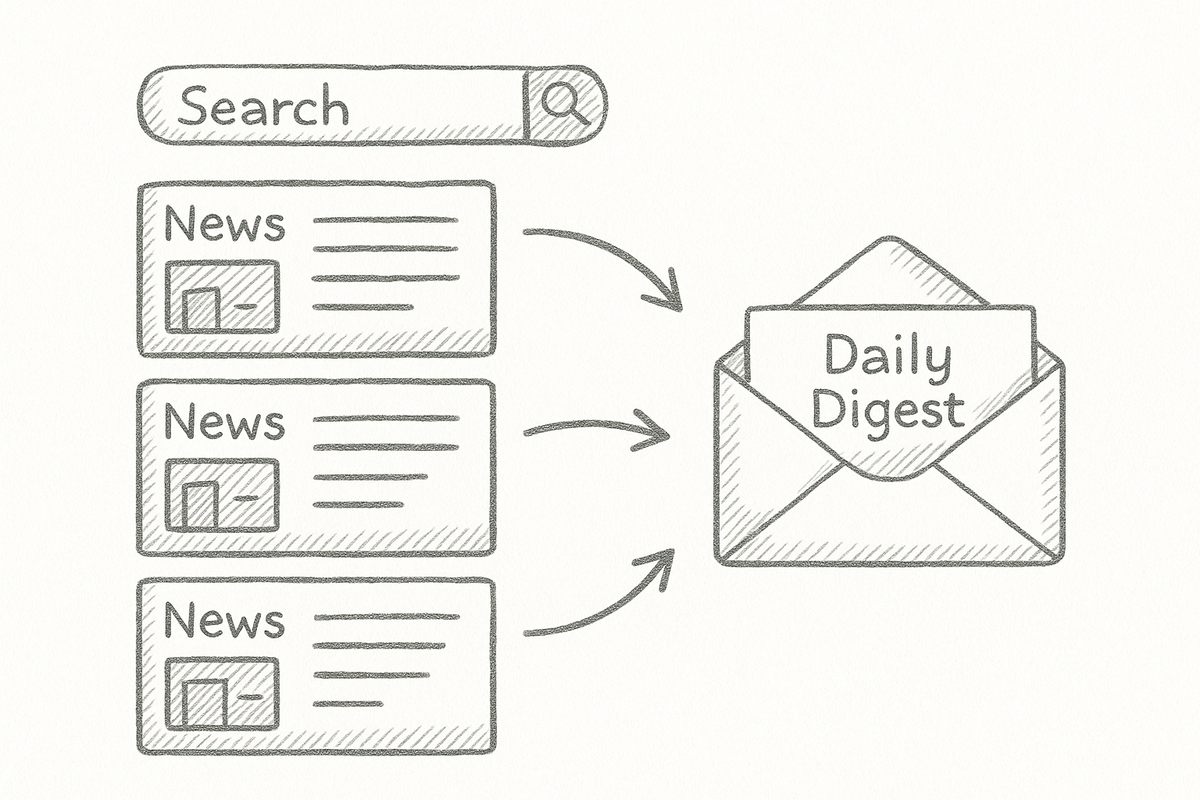
Braden Roth of SerpApi demonstrated Building a Naver News Watchlist with Ruby on Rails, creating an API-driven Rails 8 application that automatically monitors South Korea's dominant search portal for keyword-matching articles and delivers daily email digests. The implementation covers service layer isolation for SerpApi interactions, Gmail SMTP configuration, background jobs for scheduling, and comprehensive error handling with admin notifications.
That’s all for this edition! Be sure to reach out if you have any stories, content, jobs, or events you want featured in the newsletter.