- RoboRuby
- Posts
- Ruby AI News - January 7th, 2026
Ruby AI News - January 7th, 2026
Time to get to work on building the context graph for Ruby

Matt Solt
January 07, 2026

Happy New Year! Welcome to the 22nd edition of Ruby AI News! This edition features a look at the exploding trillion-dollar context graph opportunity, the upcoming Ruby Community Conference, a “Charm”-ing new Ruby CLI library, and much more.
Contents
Top Stories
The Context Graph
Over the holidays, a discussion exploded on AI's Trillion-Dollar Opportunity: Context Graphs. Jaya Gupta and Ashu Garg of Foundation Capital argued that AI agents need more than access to existing systems of record. They argued that while existing systems of record like Salesforce, Workday, and SAP store what happened, they fail to capture why decisions were made. The authors distinguish between rules (what should happen in general) and decision traces (what happened in this specific case, including exceptions, approvals, and precedents that currently live in threads, knowledge bases, and people's heads). Jaya and Ashu introduce "context graphs" as a new category of system of record that persists how decisions were made, enabling organizations to audit autonomy and turn exceptions into searchable precedent. This presents a huge opportunity for agent orchestration startups to have a structural advantage over incumbents in the emerging AI ecosystem.
Ashu Garg expanded on the context graphs thesis, arguing that organizational hierarchies reveal where next-generation systems of record will emerge by highlighting roles that exist because software failed. He points to "glue" functions like RevOps, DevOps, and Security Ops as signals, specific roles created to carry context that software doesn't capture. Ashu suggests that the next big opportunity is for "learned ontologies" built bottom-up from how work actually happens, as opposed to previous success with prescribed ontologies.
Animesh Koratana followed up on the context graphs article, addressing misconceptions that emerged from the response. Animesh clarified that context graphs are not graph databases, vector stores, or knowledge graphs because they require a fundamentally different approach to schema and representation. The thread explains why teams reaching for familiar tools like graph databases are using the wrong primitives for making agents smarter.
Animesh then detailed How to Build a Context Graph, a technical deep-dive that introduces the "two clocks problem": we've built trillion-dollar infrastructure for the state clock (what's true now) but almost nothing for the event clock (what happened, with what reasoning). He proposes using agents as "informed walkers" through organizational state space, borrowing from graph representation learning where schema emerges as output rather than input, building agent trajectories that discover structure through problem-directed traversal. The key insight is that context graphs should become organizational world models enabling simulation and counterfactual reasoning: "If your context graph can't answer 'what if,' it's just a search index." This reframes continual learning as an AI workflow where models don't need to update weights if the world model they reason over keeps expanding.
Daniel Davis of TrustGraph published The Context Graph Manifesto, a technical deep-dive into the foundations underlying the recent context graphs discussion. Drawing on two years of building TrustGraph, Daniel explains the progression from RAG through GraphRAG to context graphs, covering RDF, triplestores, property graphs, and ontologies. He identifies temporal context as the next frontier and outlines a progression toward self-describing information stores and autonomous learning systems. Daniel then expanded on his Context Graph Manifesto in What Is a Context Graph?, walking through property graphs, temporal relationships, graph analytics techniques, and ontologies to define what context graphs actually are for AI systems.
Kirk Marple of Graphlit published Building the Event Clock, a practitioner's response to the context graphs discussion drawing on his experience building Graphlit. Kirk validates the "two clocks" framing but extends it: time is just one axis in a multi-dimensional index that also includes geospatial coordinates, full-text search, vector embeddings, and graph relationships. He proposes three layers (Content as immutable evidence, Entities with identity resolution, and Facts as temporal assertions with valid at / invalid at timestamps) and argues that facts must be first-class queryable data. Kirk refines the "agents as informed walkers" concept, arguing you need to build the map before agents traverse it because entity resolution can't wait for thousands of agent runs to "discover" concrete facts.
To close it out, Obie Fernandez wrote up a detailed experience report about building context graph knowledge bases inspired by the Jaya Gupta and Ashu Garg piece in What Used to Take Months Now Takes Days. The report is a comprehensive look at building Nexus, an organizational knowledge distillation service. Nexus captures Claude Code transcripts, Slack threads, GitHub PRs, and Linear comments, using LLM distillation to extract decisions and learnings into a queryable RDF graph with semantic search via pgvector. The 13,000-line Rails 8 and Ruby 4 system includes an MCP server so AI agents can query organizational memory directly, demonstrating what Obie argues is a categorical shift in development productivity when senior engineering judgment meets Claude Code's implementation velocity.
Ruby Community Conference
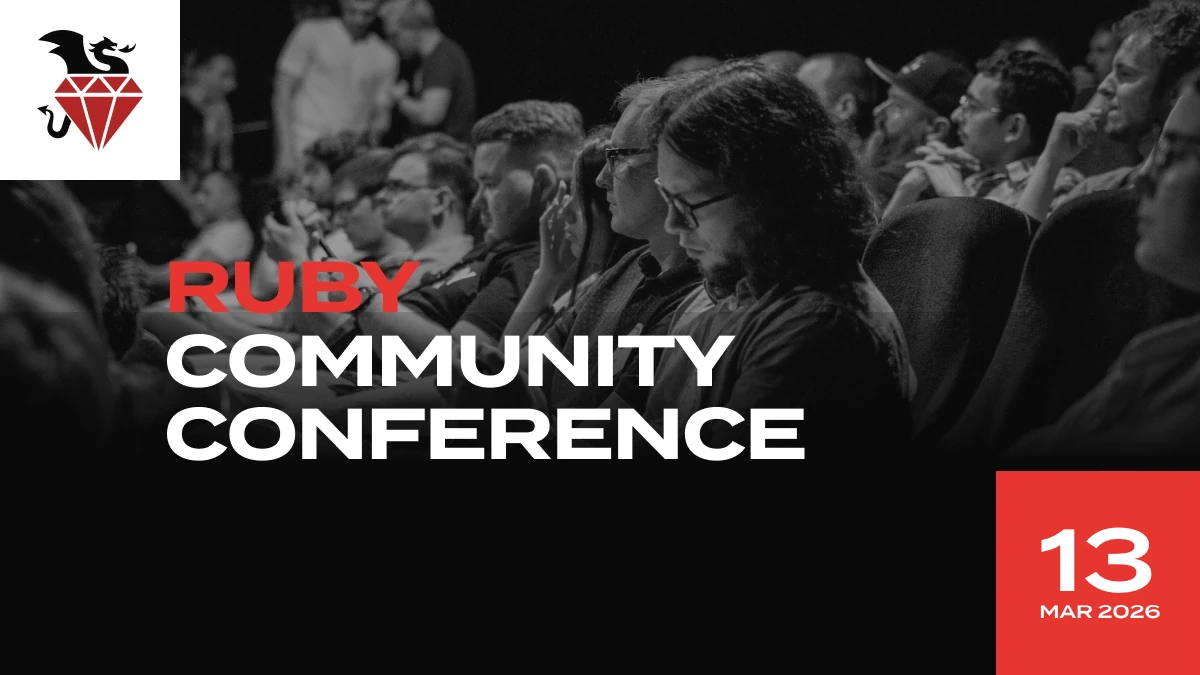
The Ruby Community Conference returns to Cracow, Poland on March 12th through the 14th at the Manggha Museum of Japanese Art and Technology with a strong Ruby AI focus. The lineup includes Obie Fernandez delivering a keynote on Ruby and AI, Carmine Paolino leading a RubyLLM workshop, and Paweł Strzałkowski's teaching Model Context Protocol integration with Rails. Additional sessions feature Irina Nazarova on AI startups with Rails, Ruby AI engineer Chris Hasiński, and Marco Roth on Herb. The event kicks off March 12th with a Kraków Ruby User Group (KRUG) meetup and pre-party, followed by workshops and sessions on March 13th, and a city tour on March 14th. Workshop registration opens February 27th. Get your tickets now!
Charmed

Marco Roth released Charm Ruby, a collection of gems that port Charm's popular Go-based terminal UI libraries to Ruby. The suite includes Bubbletea for Elm Architecture-style TUI applications, Lipgloss for styling and layouts, Glamour for markdown rendering, Bubbles for pre-built components like spinners and progress bars, and Huh? for terminal forms with validation. As announced on X, the release coincided with Ruby 4.0 and provides idiomatic Ruby APIs through a mix of native C extensions and pure Ruby implementations. Would love to see some Ruby AI command line interfaces built on top of this library!
Need to Know AI News
ClawdBot Peter Steinberger released an open-source personal AI assistant that runs locally on your own devices and connects to WhatsApp, Telegram, Slack, Discord, Signal, and iMessage, with extensible skills available through ClawdHub.
Welcome to Gas Town Steve Yegge released Gas Town, his orchestrator for running 10-30 parallel Claude Code instances, built on his Beads issue tracker with tmux as the UI, seven worker roles, and a "Molecular Expression of Work" (MEOW) stack for durable workflow execution across agent crashes and context exhaustion.
The Importance of Agent Harness in 2026 Philipp Schmid argued that while 2025 was the beginning of agents, 2026 will be about Agent Harnesses, the infrastructure layer that wraps around AI models to manage long-running tasks with prompt presets, human-in-the-loop handling, lifecycle hooks, and context durability to solve model drift.
Step-by-Step Guide to Get Ralph Working and Shipping Code Ryan Carson wrote a detailed guide on Ralph, Geoffrey Huntley's autonomous AI coding loop that runs Claude Code repeatedly in a bash loop, picking stories from a file, implementing them, running tests, and committing until all tasks pass with memory persisting through git commits and text files.
How I Use Claude Code Boris Cherny, creator of Claude Code, shared that his personal setup is surprisingly vanilla since Claude Code works great out of the box, emphasizing there is no single correct way to use it and that each team member uses it differently.
Announcements
A2UI Rails Vicente Reig released a Ruby implementation of Google's Agent-to-User Interface framework for LLM-driven UI generation with DSPy.rb and Turbo Streams. The library enables AI agents to produce structured data describing component types rather than executable code, with data binding via JSON Pointers and Stimulus controllers for reactive updates.
ExecuTorch Ruby Ben Garcia released Ruby bindings for Meta's ExecuTorch runtime to run exported PyTorch models (.pte files) directly in Ruby applications. The gem provides a lighter alternative to torch.rb for production inference while retaining model metadata and introspection capabilities that ONNX compilation loses.
SolidAgent Justin Bowen released a Rails engine extending ActiveAgent with a persistence layer including database-backed context management, declarative tool definitions for LLM function-calling, and real-time UI feedback via ActionCable during tool execution.
HTM Robots: Workers with Collective Memory Dewayne VanHoozer released v0.0.18 of the HTM memory gem with a refactored configuration system. The updated documentation explains the deliberate choice of "robots" over "agents," emphasizing workers with individual identity and working memory that share knowledge through a collective long-term "Hive Mind" stored in PostgreSQL.
AIA v0.10.2 Dewayne also released a breaking change that refactored configuration using anyway_config and added fiber-based parallel MCP server connections via simple_flow. The update introduced --tokens for usage tracking, --no-mcp for faster startup, enhanced logging with lumberjack across three separate logger instances.
TrakFlow Dewayne followed that with a distributed task tracking gem for AI agents featuring DAG-based workflow modeling, Git-tracked JSONL persistence, and content-hashed IDs to prevent merge conflicts in multi-agent environments.
CLAUDE.md for Rails + Inertia.js Josh Pigford shared his starter CLAUDE.md template for AI-assisted development, featuring Rails 8, Inertia.js, and React 19 with emphasis on "Always Works" principles, Minitest-only testing, and a reality check before marking tasks complete.
RailsPrompts Ritesh Chaudhary released a gem for managing AI prompts in Markdown files with ERB interpolation, centralizing prompt management outside business logic for easier version control and review in Rails applications.
Add PostgreSQLAdapter.register_type_mapping Abdelkader Boudih submitted a pull request for a public API for PostgreSQL type registration in Rails, allowing gems like PostGIS and Neighbor to register custom SQL types without monkey-patching internal methods.
Opus 4.5's Playwright Testing Superpower Kieran Klaassen highlighted Claude Code's playwright-test command for end-to-end browser testing during code reviews. The feature maps changed files to routes, navigates pages, captures snapshots, checks console errors, and verifies interactions while knowing when to pause for human input.
TraceBook David Paluy released a Rails engine for LLM interaction telemetry with automatic PII redaction, cost tracking, review workflows, and a Hotwire dashboard for auditing AI usage across providers.
Rails AI Agents Thibaut Baissac expanded his collection of AI development agents with 18 new prompts inspired by 37signals' Fizzy codebase, supporting both vanilla Rails patterns and standard Rails practices.
RubyOnVibes Eric Arnold launched a Rails-based app generator platform that transforms ideas into working applications. The service features an interactive form for specifying requirements with community templates coming soon.
Vanilla Rails Claude Code Plugin Chris Zempel distilled Basecamp's Recordables pattern into a Claude Code skills plugin featuring seven production-tested Rails conventions. The /vanilla-rails:shape command generates scoping and PR decomposition documents that can flow into planning and execution skills.
POSSE Party Rails Architecture Analysis Andy Waite used Claude Sonnet 4.5 to analyze the POSSE Party social media syndication app, finding it diverges from Rails conventions with primarily service objects instead of fat models. The analysis identified patterns including composition-based nested classes, platform adapter strategy implementations, and deliberate model minimalism with business logic fully delegated to services.
Task Master Keith Schacht built a voice-first to-do list that updates in real-time as you speak, using Rails with Turbo patterns and a Python LiveKit agent for voice processing. The architecture flows from WebRTC audio through LiveKit Cloud speech synthesis, executing tools via Rails API calls and broadcasting updates over ActionCable.
JsonMend Oleksii Vasyliev released a Ruby gem to repair malformed JSON strings generated by LLMs. The library handles common AI output issues including missing quotes, trailing commas, Markdown code block wrappers, Python-style booleans, and truncated structures that cause standard JSON.parse to fail.
PicoRuby Calculator Hamachan released a handheld Ruby REPL for the M5Stack Cardputer powered by PicoRuby. The device features real-time code execution, syntax highlighting, multi-line input with auto-indentation, and customizable themes.
Layered Design for Ruby on Rails Applications v2 Vladimir Dementyev announced the second edition of his book covering practical design patterns and modern abstractions for maintainable Rails applications, with additions on AI-related abstraction patterns for Rails.
BrowserPod launched a platform for in-browser code sandboxes using WebAssembly, with Ruby on Rails support coming soon alongside Node.js and Python. The service targets AI agents running code securely at scale, web-based IDEs, and educational platforms with full client-side execution requiring no server provisioning.
Pet Artist AI Mason Wang shipped their first side project in one week, building an AI pet portrait generator using Seedream for creative pet image generation. The tech stack included Rails with ruby-openai, Inertia, Sidekiq, Avo, Pay, and Kamal.
Starship Claude Martin Emde created a Starship prompt integration for Claude Code's status line that displays context window usage as a color-coded progress bar with warning thresholds.
The Ruby Runway Pitch Competition Ruby Central opened applications for RubyConf 2026's startup pitch competition offering up to $30,000 in prizes for Ruby-built products that have raised less than $500K, with regional semifinal winners advancing to live finals at the conference.
Working on ActionMCP for Rails David Heinemeier Hansson shared that he is developing “ActionMCP” for Rails with the help of AI-assisted coding agents.
Articles
AI Needs Its MVC Moment Vicente Reig suggested that LLM development lacks standardized patterns like MVC brought to web frameworks and prompt engineering should be treated as regular programming. Vicente presented DSPy.rb's approach using signatures, type safety, composable modules, and evaluation metrics to bring production-grade discipline to AI systems.
MIPROv2 Paper: How Stanford's Prompt Optimization Works in Ruby Vicente also explained the MIPROv2 algorithm implemented in DSPy.rb, which treats prompt engineering as a machine learning search problem using Bayesian optimization, instruction bootstrapping, and per-predictor tuning.
How I (Accidentally) Started a Newsletter Scott Werner reflected on building Works on My Machine in 2025, which evolved from AI tool demos into philosophical essays about software development in the post-LLM era.
Rails MCP Server 1.5.0: Security Hardening and Sandboxed Environment Support Mario Alberto Chávez Cárdenas released a major update adding centralized path validation, sensitive file filtering, and safer shell execution. The new --single-project flag enables operation in restricted containers like GitHub Copilot and Claude Code with automatic Rails app detection.
Promoting AI Agents David Heinemeier Hansson declared AI agents a paradigm shift, praising Claude Opus 4.5, Codex 5, and Gemini 3 for producing production-grade code while preferring autonomous agents that work like team members over in-editor autocomplete.
Building an AI Agent Inside a 7-Year Old Rails Application Catalin Ionescu demonstrated how LLM function calls can encode authorization logic, enabling secure AI agent integration within an existing multi-tenant Rails monolith. The implementation uses RubyLLM, Algolia search, Pundit policies, and Turbo Streams.
Resilient AI Workflows in Rails 8.1 with Active Job Continuations Islam Gagiev of JetRockets explained how Rails new ActiveJob::Continuable feature enables long-running AI pipelines to resume from checkpoints after interruptions, avoiding wasted LLM API calls. The article demonstrated a four-step report-generation workflow with text extraction, AI summarization, formatting, and delivery.
From Weeks to Days: Rebuilding My Blog with Rails 8 and Cursor AI Keith Wedinger rebuilt his personal blog in days by adopting an architect role while Cursor AI handled model, controller, and view implementation. The stack included Rails 8.1, SQLite3, Hotwire, Tailwind CSS, and Kamal deployment.
Implementing AI Features in Ruby on Rails with LLM APIs Pavel Pershko of Rubyroid Labs provided a comprehensive guide covering SDK selection, AI gem comparison, and production patterns for LLM integration. The article included a Gemini API example and common pitfalls like context overflow and prompt injection.
Exposing a Rails App to LLMs with Model Context Protocol (MCP) Manoj Mishra built a step-by-step tutorial showing how to connect a Rails JSON API to Claude Desktop using a Node.js MCP server as a translator layer. The architecture keeps AI logic separate from Rails while providing explicit permissions, typed inputs, and auditable access.
Stop Using AI to Go Faster. Start Using It to Go Bigger. Joe Leo argued the software industry is misusing AI by treating it as an efficiency tool rather than a transformation catalyst. Joe recommended auditing where manual heroics have the most business impact and targeting long-running cross-functional pain points to find opportunities that collapse entire workflows.
Composable Rules: How Small Teams Match Big Company Output Without the Bloat Brandon Casci demonstrated a modular approach to Claude Code conventions using markdown files with dependency frontmatter in .claude/rules/. His hustler-rails plugin detects project dependencies from Gemfile.lock and copies only relevant rules, enabling systematic knowledge accumulation across projects.
Speak to LLMs with Voice-to-Text Rich Steinmetz advocated for voice-to-text when prompting LLMs, citing brain dumping, speed advantages (80-95 WPM vs typing), and energy management as key benefits. Rich recommended WisprFlow and noted that LLMs can correct minor transcription errors.
How a Scotsman Saved Hours of My Time by Turning an LLM into My Virtual Assistant Rich followed with invoice extraction from a legacy bookkeeping app using Claude Desktop, after a colleague suggested browser automation over hiring a virtual assistant. Rich plans to transition to Playwright MCP server with Claude Code for more autonomous agentic workflows.
Sisyphus Versus the Conductor Obie Fernandez explored why AI feels like cheating to some people, contrasting "monadic" identities built on isolated struggle with "polyadic" selves that maintain coherence through coordination. Obie argued that LLMs collapse the cost of externalized cognition, threatening those who equate visible effort with authenticity while enabling others to focus on direction over execution.
It's Just Their Tokens: Code Review Etiquette in the Vibe Era Martin Emde argued that AI coding agents are straining traditional code review processes and reviewers should request significant changes since regenerating code is now feasible.
Rails + AI: Are You Using These Capabilities Yet? Pichandal Solarajan of RailsFactory outlined six AI capabilities Rails developers can add to applications: vector search with pgvector, personalized recommendations, conversational interfaces via LLM APIs, automated content generation, document intelligence, and predictive insights like churn detection.
Relocating Rigor: The Phoenix Architecture Chad Fowler argued that paradigm shifts from dynamic languages to AI don't eliminate discipline but relocate rigor closer to operational reality, advocating for "probabilistic inside, deterministic at the edges" where easier generation demands stricter judgment.
The Auditability Gap Vicente Reig argued that modern AI systems lack the ability to explain individual decisions, comparing the need for audit trails to Sarbanes-Oxley requirements in finance. Vicente demonstrated an evidence-based approach that traces matched candidates, rejection reasons, and confidence breakdowns to enable accountability.
Dictation Is the New Prompt Carmine Paolino advocated for voice input as a faster, more natural way to interact with AI and introduced Voxtype, a Rust-based local dictation tool using OpenAI's Whisper model that now ships with Omarchy 3.3.
Component Language Interface Brian Shirai proposed replacing JSON serialization between components with executable code as the interface, using Ruby examples to demonstrate how language-based interfaces could enable peer-to-peer architectures and dynamically generated connections produced by machine intelligence.
One Year of Bootstrapping a Profitable AI SaaS on a Side Kirill Shevchenko shared his journey building Roundups, an AI content generator for affiliate marketers, using Rails, Hotwire, OpenAI, and the Solid stack.
Back to the Starting Line Jorge Manrubia reflected on how AI has fundamentally reset programming expertise, suggesting that while traditional skills like editor mastery have diminished in importance, technical excellence and good design principles remain essential as developers learn to collaborate with agentic coding tools.
2025 Wrap Up from the Rails Foundation Amanda Perino summarized the Rails Foundation's year including Rails World 2025 in Amsterdam, the inaugural Rails at Scale Summit, and new educational content like the "On Rails" podcast. Marco Roth received the Rails Luminary Award, and Rails World 2026 was announced for Austin.
Videos
Building an Agent-Native CLI for Cora Kieran Klaassen live-streamed building a CLI for Cora in 90 minutes using Terminalwire for server-streamed updates, demonstrating his Compound Engineering workflow with parallel sub-agents for planning, implementation, review, and triage phases.
Vibe Coding Rails Travel App Series Part 1, Part 2, Part 3, Part 4. Rhiannon Payne streamed a four-part series building a Rails travel map app using AI-assisted "vibe coding" with GitHub Codespaces, Copilot, and Claude Opus 4.5 from initial deployment through UX improvements and feature additions. And don’t forget to check out Rhiannon’s other Ruby Around the World newsletters and interviews.
AI on Rails: Broadcasting Messages Live with Turbo Streams Pete Hawkins of Rapid Ruby refactored an AI chat application to use Turbo Streams for live message broadcasting, making the UI feel more responsive as messages are pushed in real-time.
AI on Rails: Give Your Agents Internet Access Pete also demonstrated using the Tavily search tool included with LangChain.rb to give AI agents web search capabilities and improve their knowledge.
Podcasts
Remote Ruby: Jumpstart Pro Evolution: Streamlining Rails Development Chris Oliver, Andrew Mason, and David Hill discussed Chris's Jumpstart refactoring to reduce merge conflicts and dependencies, AI-assisted coding pitfalls and practical applications, and new web security headers for CSRF protection.
Remote Ruby: Ruby Upgrades & RAM Shortages Chris, Andrew, and David’s next episode discussed the Ruby 4.0 preview release, celebrated Marco Roth's Rails Luminary award, and explored the challenges of self-hosting LLMs on Mac minis including RAM constraints and token costs versus cloud APIs.
Strictly From Nowhere Podcast: A Ruby Gem for Optical Character Recognition (OCR) The hosts discussed Active Storage OCR, a self-hosted Rails gem built with Rust that extracts text from images and PDFs without cloud APIs. The companion article by Justin Abrams provided implementation details and a live demo.
Discussions
Any Vanilla Rails Front-End Setup That Can Compete with ShadCN for LLM Code Generation? A Reddit user asked the r/rails community about frontend setups that work as well as ShadCN with LLMs like Opus 4.5. Top suggestions included InertiaJS with React/Svelte and Claude Code skills, DaisyUI with its MCP server, and Tailwind/Flowbite with ViewComponents.
Events
Previous
XO Ruby Chicago:
We Were Voyagers. We Can Voyage Again! Scott Werner presented at XO Ruby Chicago arguing that Generative AI offers Ruby developers a chance to reclaim the playful, creative spirit of the "Golden Age" era of why the lucky stiff, Camping, and Sinatra.
Ruby Warsaw Meetup:
Adding MCP in 5 Minutes Live Demo Paweł Strzałkowski delivered a lightning talk at PLRUG Ruby Warsaw Meetup demonstrating how to quickly add Model Context Protocol to a Rails application.
AI, Offline Chris Hasiński presented at PLRUG Ruby Warsaw Meetup on running AI capabilities without an internet connection.
San Francisco Ruby Meetup:
SF Ruby Meetup, October 2025 The October SFRuby meetup covered a graph-based Ruby DSL for Excel reporting, Ruby-Rust native extensions with the Fjall embedded key-value store, encrypted commit-safe secrets with dotenvx, LiveComponent for stateful ViewComponents on Hotwire, and AI-backed domain logic in Foobara.
San Francisco Ruby Conference:
32 videos were posted from the San Francisco Ruby Conference, some of the AI-related and relevant videos below:
Herb to ReActionView Marco Roth delivered the opening keynote concluding his 2025 journey on modernizing the Rails view layer with Herb, the HTML-aware ERB parser and tooling ecosystem including a formatter, linter, and language server.
Play with Your Code Rachael Wright-Munn explored why programming games are more fun than day jobs and how their lessons can improve the developer experience.
Real-Time Collaboration with Rails, AnyCable and Yjs JP Camara demonstrated how to add sophisticated collaborative editing features to Rails apps using AnyCable for performance and Yjs for CRDT-based conflict resolution.
Programming Language Evolution in the AI Era José Valim shared his pragmatic take on how web frameworks and developer tools need to evolve to meet the demands of AI-assisted development, drawing on experience as Elixir and Tidewave.ai creator.
The Role of Software Design in an AI World Sarah Mei shared insights at SF Ruby Conference from six months of working with code assistants in real Rails codebases, offering a perspective on using AI to enhance developer roles rather than replace them.
Rails X Vladimir Dementyev delivered the closing keynote presenting a vision for the future of Rails informed by developer surveys and his work with Ruby startups.
RubyLLM Keynote Carmine Paolino keynoted the conference arguing that complexity is a liability in AI development, explaining the design decisions behind RubyLLM's unified API for every model and vendor.
Upcoming
January 20th - Meetup: Scott Werner will present at Philly.rb on January 20th in Philadelphia exploring whether AI agents represent a new programming paradigm, drawing parallels to Alan Kay's original object-oriented concepts and demonstrating a minimal Ruby environment where markdown files are the program.
January 31st - Conference: RubyConf Thailand is hosting a conference on January 31st and February 1st in Bangkok, Thailand featuring presentations by Irina Nazarova, Marco Roth, Alex Timofeev on Ethical AI, and a closing keynote by RubyLLM author Carmine Paolino.
February: ArtificialRuby will host their next event sometime in early February in New York City, more details to follow soon.
March 13th - Conference: The Ruby Community Conference Winter 2026 in Cracow, Poland will have a heavy focus on Ruby and AI, with presentations and workshops including:
Obie Fernandez: Ruby & AI Conversation
Irina Nazarova: Startups on Rails and AI Integration Patterns
Carmine Paolino: Building AI Apps in Ruby and Rails with RubyLLM
Paweł Strzałkowski: Model Context Protocol in Ruby on Rails
Open Source Updates
Code Spotlight
Daniel Tenner is working on Helix Kit, a Rails 8 and Svelte 5 starter template designed with the philosophy that modern apps require heavy AI integration. The stack combines Inertia.js, TailwindCSS, and ShadcnUI on the frontend, with PostgreSQL and ActionCable for real-time synchronization on the backend. AI features include OpenRouter support, a prompt system, conversation management, and agentic systems with tools, alongside collaborative features like group chat with memory management. The template is marketed as "Claude Code Ready" with documented setup for AI-assisted development workflows.
New Gems
Links to the RubyGems page, newest releases are first:
semantic_chunker - Split long text into chunks based on semantic meaning.
first-last-frame - High-quality integration for https://supermaker.ai/video/first-last-frame/
copyright-free-songs - High-quality integration for https://supermaker.ai/music/copyright-free-songs/
ai-kissing - High-quality integration for https://supermaker.ai/video/ai-kissing/
openrouter_client - Ruby client for OpenRouter API
omniai-sdk - Official Ruby SDK for OmniAI API
nukitori - Generate reusable XPath schemas with an LLM, then scrape HTML without AI
ruby-json-toon - Convert JSON to TOON (Token-Oriented Object Notation)
ai-make-music - High-quality integration for https://supermaker.ai/music/ai-make-music/
ai-baby-generator - High-quality integration for https://supermaker.ai/image/ai-baby-generator/
bigfoot-video-generator - High-quality integration for https://supermaker.ai/video/bigfoot-video-generator/
ruby_llm-instrumentation - Rails instrumentation for RubyLLM
airbrake_mcp - MCP server for Airbrake error tracking
opencv-ruby - Modern Ruby bindings for OpenCV4
sm-chat - High-quality integration for https://supermaker.ai/chat/
seedance-ai-video - High-quality integration for https://supermaker.ai/video/seedance-ai-video/
chat-1 - High-quality integration for https://supermaker.ai/chat/
sora-ai-video - High-quality integration for https://supermaker.ai/video/sora-ai-video/
mcp_stdio_ruby - A Ruby based Model Context Protocol (MCP) server
reve_ai - Ruby client for the Reve image generation API
fastlane-plugin-ovo_onetrust - Fastlane plugin to upload mobile app builds to OneTrust and trigger automated SDK scanning
flowmyna - FlowMyna SDK
banana-prompts - High-quality integration for https://bananaproai.com/banana-prompts/
diffrhythm.ai - High-quality integration for https://diffrhythm.ai/
makeshot.ai - High-quality integration for https://makeshot.ai/
ruby_llm-responses_api - OpenAI Responses API provider for RubyLLM
trak_flow - A distributed task tracking system for Robots
crucible - MCP server for browser automation using Ferrum/Chrome
webxr - WebXR Device API bindings for Ruby
vaultkit - VaultKit CLI
executorch - Ruby bindings for ExecuTorch
larb - Linear algebra library for 2D/3D graphics in Ruby
pixoo - A Ruby client for Pixoo displays
gw - Git worktree manager with bare repository pattern
chromadb-experimental - Chroma Ruby client
rubyllm-semantic_router - Semantic routing for RubyLLM multi-agent systems
smart_domain - Smart Domain-Driven Design and Event-Driven Architecture for Rails
nano-banana-2 - High-quality integration for https://supermaker.ai/image/nano-banana-2/
veo - High-quality integration for https://supermaker.ai/video/veo/
wgpu - Ruby bindings for WebGPU via wgpu-native
a2ui-rails - A2UI for Rails - LLM-driven UI generation with Turbo Streams
sotavideo.ai-1 - High-quality integration for https://sotavideo.ai/
sotavideo.ai - High-quality integration for https://sotavideo.ai/
tomusic.ai-1 - High-quality integration for https://tomusic.ai/
bananaproai-com - High-quality integration for https://bananaproai.com/
copy_for_ai - Copy Rails error messages in AI-friendly format
devex - Ruby CLI framework with unified dx command for development tasks
tencentcloud-sdk-cloudmate - Tencent Cloud SDK for Ruby - CLOUDMATE
tabula-rb - Extract tables from PDF files (Ruby port of tabula-java)
sm-ai-pose-generator - High-quality integration for https://supermaker.ai/image/ai-pose-generator/
ai-pose-generator-3 - High-quality integration for https://supermaker.ai/image/ai-pose-generator/
ai-pose-generator-1 - High-quality integration for https://supermaker.ai/image/ai-pose-generator/
ai-pose-generator - High-quality integration for https://supermaker.ai/image/ai-pose-generator/
nano-banana-1 - High-quality integration for https://supermaker.ai/image/nano-banana/
ai-twerk-video-generator - High-quality integration for https://supermaker.ai/video/ai-twerk-video-generator/
adk-ruby - Agent Development Kit (ADK) for Ruby
opencode_client - OpenCode Ruby Client Gem
pobo-sdk - Official Ruby SDK for Pobo API V2
tensorrt - Minimal TensorRT bindings for Ruby using Rice
invoiceai - Official Ruby SDK for the InvoiceAI API
signalbox - DCC model railroad automation framework with sensor-driven control
supermaker-ai-image-master-2 - High-quality integration for https://supermaker.ai/image/
rails_claude_skills - Rails generators for Claude AI skills and agents
supermaker-ai-image-master-1 - High-quality integration for https://supermaker.ai/image/
qy-soulmate-drawing-generator - Professional AI Soulmate Drawing Generation Integration
qy-minecraft-skin-generator - Professional AI Minecraft Skin Generation Integration
Anti-gravity-qy - High-quality integration for https://antigravity.google/
qualspec - RSpec DSL for qualitative LLM-judged testing
ag-ui-protocol - Ruby SDK for AG-UI protocol
luciq-cli - Luciq CLI for developers
supermaker-ai-video-downloader - A lightweight utility library for managing and generating dynamic links with tracking parameters
supermaker-ai-image-master - A lightweight utility library for managing and generating dynamic links with tracking parameters
activestorage-ocr - OCR support for Rails Active Storage
claude_usage - Track Claude Code token usage and costs in Rails applications
json_mend - Repair broken JSON
langsmith-sdk - Ruby SDK for LangSmith tracing and observability
riffer - The all-in-one Ruby framework for building AI-powered applications and agents
simple_inference - A lightweight, Fiber-friendly Ruby client for OpenAI-compatible LLM APIs
daytona - Ruby SDK for Daytona
daytona_toolbox_api_client - Daytona Daemon API Ruby Gem
decision_agent - Deterministic, explainable, auditable decision engine for Ruby
New Open Source
Links to the Github repository:
HyperSense - Autonomous AI trading agent for cryptocurrency markets using Claude AI with multi-agent architecture, technical analysis, and real-time risk management
Orion - Distributed automation platform combining workflow orchestration with AI-powered generation, fiber-based concurrency, and multi-language plugin support
Aura - Declarative programming language for AI/ML pipelines that transpiles to Ruby, combining model training and web deployment in a single human-readable syntax
Debrief PWA - Voice memo progressive web app that records audio, transcribes via Groq Whisper, and pushes transcripts to Claude Code for processing
SaneProcess - Enforcement framework for Claude Code that prevents AI failure loops through circuit breakers, structured rules, and persistent memory tracking
Decision Agent Example - Demo showcasing the decision_agent gem with rule-based evaluation, A/B testing, versioning, and use cases like loan approval and fraud detection
Ruby Agent Skills - Claude Code plugin providing five auto-activated skills for generating, validating, and maintaining RBS type signatures
AICR - Automated code review tool combining RuboCop static analysis with LLM intelligence to review only changed lines and post suggestions to GitHub PRs
MindMush - Rails platform for creating and sharing AI-generated HTML5 Canvas games from natural language prompts using Groq
Reddit MCP - MCP server that provides Reddit search, post retrieval, and trending content tools for Claude Code and other MCP-compatible clients
Blazer Querygen - Blazer extension that generates SQL queries from natural language using OpenAI while only transmitting schema metadata for security
TaAgent - CLI-based technical analysis agent for Indian stock markets with multi-timeframe trend analysis and optional LLM-powered insights via Ollama
PlacesAgent - AI-powered gem combining Google Places API with LLM intelligence to discover and rank businesses through natural language queries
Page Migration - CLI tool for extracting, exporting, and migrating organization page content using the Dust AI API with a Rails dashboard for monitoring
Rails Project Templates - Automated menu system that generates and configures common Rails features including AI support, Data.gov API ingestion, and default views
Output Workflows Rails - Rails SDK for Output.ai enabling AI workflow execution via webhooks, background polling, or synchronous blocking with database tracking
Voice Gen BE - Rails API for AI-powered text-to-speech generation using ElevenLabs with S3 storage, Pusher real-time updates, and email notifications
Systools Ruby MCP - MCP server providing Claude Code-style tools with reduced token overhead for file operations, shell commands, code search, and LSP integration
Banana AI Assistant - Rails 8.1 chat interface for Azure DevOps project management using Llama 3 via Groq to summarize work items, sprints, and team workloads
Store MCP Server - Experimental Rails app demonstrating MCP server integration with product CRUD tools and AI-powered summaries via Claude SDK
AI Voice Tutor - Real-time voice conversation system enabling natural dialogue with AI using AssemblyAI, Gemini, and Cartesia with full-duplex bidirectional communication
SUSHI Self-Maintenance MCP Server - MCP server providing AI-assisted development support for the SUSHI bioinformatics framework
Rails Error to Clipboard - Development gem that adds a "Copy for AI" button to Rails error pages, formatting stack traces as Markdown for AI assistants
Jobs & Opportunities
Are you an organization searching for an expert Ruby AI developer, or a Rubyist looking for your next development role with AI? Please reach out and let me know the type of opportunity you’re pursuing: [email protected]
One Last Thing
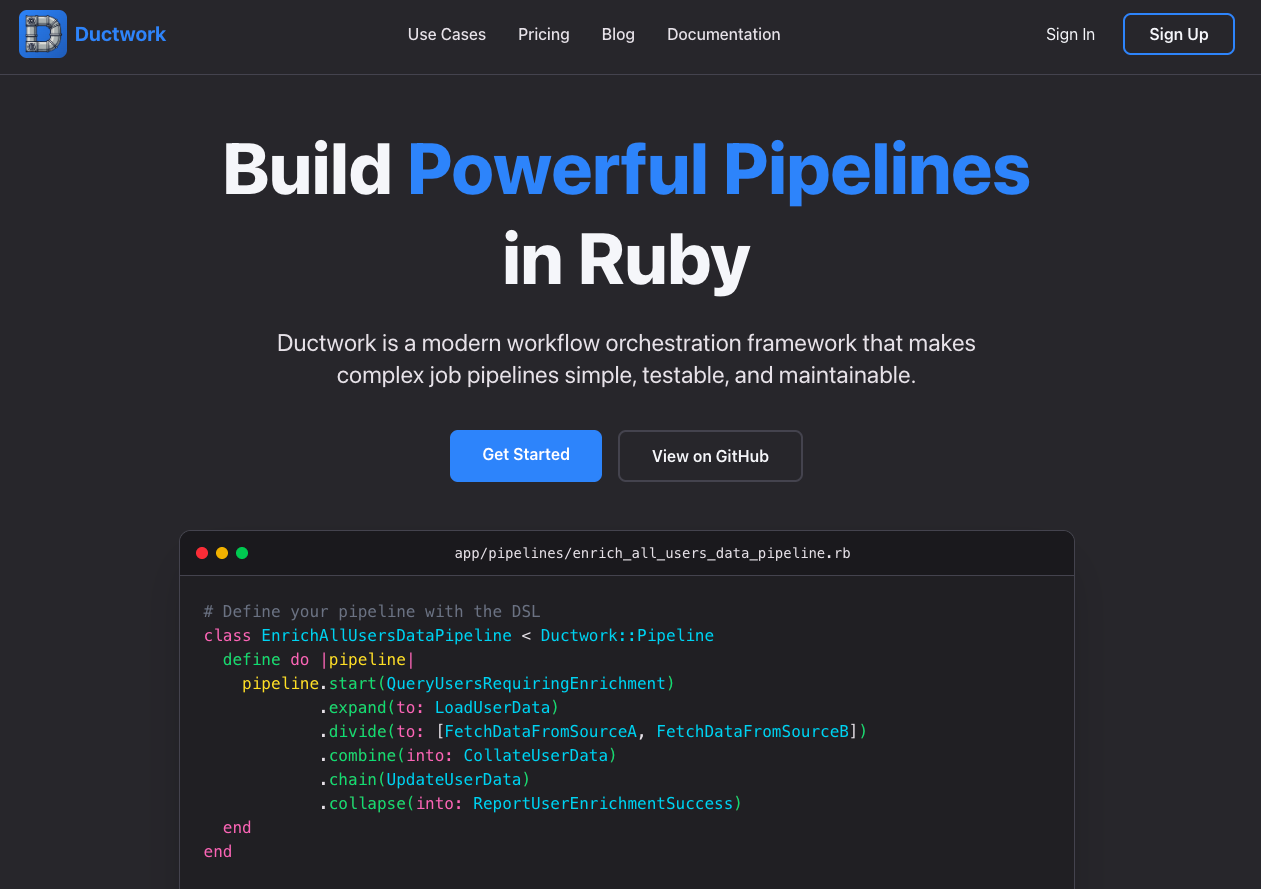
Tyler Ewing introduced Beyond Job Queues: Introducing Ductwork for Ruby, a framework for orchestrating multi-step background job pipelines that addresses the limitations of traditional queues like Sidekiq and GoodJob. Ductwork provides a declarative DSL for defining workflows as a single visible unit with self-contained, testable steps and automatic data coordination. The framework supports sequential chains, parallel branches via Expand/Collapse and Divide/Combine patterns, and database-backed execution state for monitoring. A paid tier adds concurrency controls, timeouts, delays, and priority support.
That’s all for this edition! Be sure to reach out if you have any stories, content, jobs, or events you want featured in the newsletter.