- RoboRuby
- Posts
- Ruby AI News - March 12th, 2026
Ruby AI News - March 12th, 2026
Ruby’s AI superpowers are powering a renaissance

Matt Solt
March 12, 2026

Welcome to the 26th edition of Ruby AI News! This edition features the realization of Ruby’s AI superpowers, a safe “enclave” for running AI-generated Ruby code, how Autoresearch is the new Vibe in AI, and much more.
Contents
Top Stories
Ruby’s AI Superpowers are Real

Everyone is waking up to Ruby’s AI superpowers. Yusuke Endoh, a Ruby core committer, published a benchmark measuring which programming language works best with Claude Code. He had Opus 4.6 implement a “mini-git” across 15 languages, each run 20 times. Ruby came out on top across three categories - fastest, cheapest, and most stable with a perfect test case pass rate. Python was close behind, but the real story was the gap: statically typed languages were one and a half to two and half times slower and more expensive, and adding type annotations to Ruby via Steep ballooned the time to more than two and a half times slower than plain Ruby. The source code of his experiment is open for anyone to replicate.
The Rails Foundation has taken note as the Ruby on Rails homepage was updated with a new tagline: "Ruby on Rails scales from PROMPT to IPO. Token-efficient code that's easy for agents to write, and still beautiful for humans to review." Rails Foundation Executive Director Amanda Perino noted that the foundation board discussed how their pillars of documentation, education, marketing, and events are being affected by agentic coding, and how their strategy needs to shift. She also sat down with Errol Schmidt of Reinteractive for a deeper conversation about this in The Future of Rails in the Age of AI. Meanwhile, as many of you already know, Y Combinator president Garry Tan posted: "I think people are sleeping a bit on how much Ruby on Rails + Claude Code is a crazy unlock - I mean Rails was designed for people who love syntactic sugar, and LLMs are sugar fiends."
The sentiment is echoing across the community. Carmine Paolino argued that since developers aren't training LLMs but calling APIs over HTTP, Ruby and Rails provide superior infrastructure for production AI apps with battle-tested patterns for authentication, billing, background jobs, and streaming UI, areas where Python's machine learning advantages are irrelevant. He delivered this message as a keynote at RubyConf Thailand, alongside Irina Nazarova's keynote on startups choosing Rails in 2026. Developers who had left are returning: Ender Ahmet Yurt wrote that Ruby's convention-over-configuration is exactly what AI tools need to generate accurate code on the first attempt, while Mark Dastmalchi-Round documented his return to Rails after years away, finding Rails 8's Solid libraries, SQLite production support, and Kamal deployment had eliminated the complexity that once drove him to other stacks. More and more developers are making the case that Rails is the strongest framework in the AI era, and arguing that React is the worst framework for coding agents because agents waste context window navigating unstructured codebases, while Rails' conventions mean everything has a predictable place.
Private equity and venture capital should take note: Abhishek Parolhar published a PE fund thesis arguing that "RubyOnRails + AI creates the thinnest tech stack for rapid iteration" and that "convention-over-configuration is exactly what LLMs need to generate production-ready code." His agents built an open-source fund thesis around Rails-based businesses, noting that firms like GitHub and Shopify made conscious technology choices that are now paying dividends. And Wale Olaleye captured the takeaways from my recent talk Introduction to Generative AI Programming with RubyLLM: "Python is the best language for training models, Ruby is the best for building products." One recent startup in the Rails AI space, EverAI has scaled to 28 million users and one petabyte of traffic monthly with just Rails and Postgres. This combination is literally all you need to build a billion dollar AI company.
A Safe Enclave for Ruby
Brad Gessler’s new Ruby gem, Enclave, tackles one of the biggest problems in AI-powered applications: how do you let a model do real work in code without handing it the keys to your application? Enclave embeds MRuby as a separate sandboxed virtual machine inside a Ruby process, giving a large language model a place to write and run Ruby against only the methods you explicitly expose. That changes the shape of tool use. Instead of building a growing catalog of one-off functions for every possible customer question or data request, you can let the model compose its own logic in Ruby while staying inside a tightly constrained environment. According to the project documentation, the sandbox has no filesystem, no network, and no access to the host Ruby runtime, so attempts to reach for things like File or ENV fail because those objects are simply are not there.
The gem integrates with RubyLLM and includes resource limits for timeout and memory. You can watch a full walkthrough of Enclave in action, including a demo that boots a Rails app with customer service data and lets Claude query it through sandboxed Ruby. Brad wrote about this in Enclave: Sandboxed Ruby for AI Agents, explaining how to use the gem to let LLMs execute Ruby code safely. Developers define a tool classes exposing specific methods with their data, then create a Enclave::Sandbox with those tools. The LLM writes Ruby expressions that execute inside an isolated environment. The article demonstrates integration with RubyLLM's chat.with_tool(Enclave::Tool.new(tools)) to wire it all together, and shows that sandbox escape attempts fail with NameError because dangerous classes do not exist in the virtual machine.
Brad is no stranger to building tools at the intersection of Ruby and the AI-enabled developer experience. Through Beautiful Ruby he has been publishing and shipping thoughtful Ruby tools, with projects like Sitepress, a static site generator, and Terminalwire, a framework for building CLIs for SaaS apps, that show the same instinct for giving developers higher-level, more adaptable building blocks. Terminalwire has its own AI angle: when Andrej Karpathy tweeted that CLIs are exciting because "AI agents can natively and easily use them," Brad pointed to Terminalwire as a way to hook Rails apps up to AI models with something "humans and AI can use in production in under an hour." Enclave is another excellent contribution from Brad and represents a practical approach to one of the harder problems in Ruby AI - letting agents execute AI-generated code safely.
Autoresearch is the New Vibe
Speaking of Andrej Karpathy, he recently released autoresearch, a short, open-source script that automates the scientific method with AI agents. The OpenAI co-founder and person who coined the term "vibe coding," released the library with a simple concept: give an agent a training script and a fixed compute budget, and it reads the code, forms a hypothesis, modifies it, runs the experiment, evaluates the results, and loops. If validation loss improves, the change sticks; if not, it reverts and tries again. In one overnight run, autoresearch completed 126 experiments. After leaving it running for two days on a depth-12 model, it processed approximately 700 autonomous changes and found roughly 20 improvements that all transferred to larger models, dropping the "Time to GPT-2" leaderboard from 2 to 1.8 hours, an 11% gain on a project Andrej thought was already well-tuned. "Seeing the agent do this entire workflow end-to-end and all by itself... is wild," he wrote. The agent caught oversights in attention scaling, value embedding regularization, and weight decay schedules that he had missed across two decades of manual tuning.
The repo exploded on Github and the implications rippled far beyond machine learning. Chris Worsey applied the loop to financial markets, running AI agents that debate macro, rates, and stocks daily, with the worst-performing agent's prompt rewritten by the system. "Same loop, prompts are the weights, Sharpe is the loss function." After hundreds of iterations and dozens of prompt modifications, the system made a 22% return in 173 days in simulated testing. Brian Roemmele scaled to 2,048 autonomous agents running autoresearch on his "Zero-Human Company" platform, generating over 6 terabytes of AI output overnight. Matt Stockton captured the broader significance: "With a loss function, we can do hill-climbing in a loop with plain English now... we can generalize that to do just about anything." Andrej himself stated that "all LLM frontier labs will do this" and that any metric with an efficient evaluation function "can be autoresearched by an agent swarm."
For Rubyists, Andrej Karpathy's educational projects have been a recurring source of inspiration. Chris Hasiński built nanogpt-rb, a Ruby port of Andrej's nanoGPT using torch.rb that lets you train GPT-2 style models from scratch in Ruby. Ian Heraty ported micrograd, Karpathy's tiny autograd engine, to Ruby. And Dylan Socolobsky created rubygpt, also inspired by nanoGPT. These ports reflect a pattern in the Ruby AI community: taking foundational ML concepts and making them accessible through Ruby's expressive syntax, ensuring Rubyists can learn how LLMs work by building them in the language they love.
Need to Know AI News
Everything Is Context: Agentic File System Abstraction for Context Engineering A new paper proposed treating all AI context as files in a unified persistent repository, inspired by Unix's "everything is a file" philosophy. The framework includes three layers for history, memory, and scratchpad with token-aware compression.
Stop Calling Tools, Start Writing Code (Mode) Jeremiah Lowin introduced FastMCP 3.1's Code Mode, which replaces sequential MCP tool calls with sandboxed Python scripts that compose multiple tools in a single execution. This eliminates context bloat from large tool catalogs and reduces token waste from round-trip intermediate results.
Can AI Agents Build Real Stripe Integrations? Carol Liang and Kevin Ho of Stripe built a benchmark of real-world integration scenarios to test whether AI agents can autonomously construct Stripe payment integrations.
Impeccable Paul Bakaus released a design skills toolkit for AI coding assistants that provides commands like /polish, /audit, and /distill to give developers designer-level vocabulary when prompting.
QMD 2.0 Tobi Lütke released version 2.0 of his hybrid search tool that combines BM25, vector, and LLM-powered query expansion with local models. The update introduced a stable library interface, with the CLI, MCP server, and HTTP interfaces now built on top.
Announcements

New RubyLLM Tailwind-based Chat UI
RubyLLM 1.13.0 Carmine Paolino released v1.13 with safer tool calls, explicit tool control via choice and calls parameters, structured output for Anthropic and Bedrock, and improved error handling with retries. Carmine also rewrote the Agentic Workflows guide using the new Agent DSL, covering sequential, routing, parallel, fan-out/fan-in, and RAG patterns in plain Ruby. And a Tailwind Chat UI generator is coming in 1.14!
Roast 1.0 Obie Fernandez announced the 1.0 release of Shopify's AI workflow framework, rebuilt around a Ruby DSL replacing the previous YAML configuration. The new version features composable "cogs" (chat, cmd, agent, ruby, map, repeat) for chaining multi-provider LLM workflows with parallel processing support.
ClaudeMemory v0.6.0 Valentino Stoll released a major update to his long-term memory gem for Claude Code, adding native vector search via sqlite-vec, async hooks, database maintenance commands, and comparative benchmarks showing it outperforms QMD on cross-category multi-fact reasoning queries.
Ruby LSP Plugin for Claude Code Omar Bahareth contributed the Ruby LSP plugin to Claude Code's official marketplace, enabling Claude Code to use Ruby LSP for language intelligence on Ruby files. The addition was noted on Reddit as a significant step for Ruby's AI tooling support.
AG-UI Protocol Ruby SDK Antonio Neto and the Buk team made a community Ruby SDK for the AG-UI Protocol, providing Sorbet-validated typed events, camel case serialization, and SSE-ready encoding for building agent-user interaction frontends in Ruby and Rails.
Zvec Ruby Dewayne VanHoozer released an embedded vector database gem wrapping a C++ engine via Rice bindings. It provides in-process vector storage and similarity search with HNSW/IVF/Flat indexes, filtered queries, and persistent on-disk storage without requiring an external database server.
KBS Decompiler Dewayne also added a YARV bytecode decompiler to the KBS rule engine gem, motivated by the need to inspect dynamically generated code in running processes. It reconstructs readable Ruby source from procs and lambdas by simulating the YARV stack machine.
Benchmarking Tool Pre-Filtering for RubyLLM Additionally, Dewayne benchmarked five Ruby approaches to pre-filtering LLM tools before passing them to RubyLLM: KBS (RETE), TF-IDF, Zvec, sqlite-vec, and LSI/SVD. LSI achieved the fastest filter time at 1ms using the classifier gem.
OpenTrace Ruby Adham El-Deeb released a Rails observability gem that auto-captures SQL queries, N+1 detections, view renders, ActiveJob events, and exceptions with built-in PII scrubbing. Data is sent to a self-hosted Go+SQLite server that exposes 75+ MCP tools, letting AI assistants like Claude Code query metrics and take actions such as resolving errors and setting alerts.
CovLoupe v5.0.0 Keith Bennett announced a major update to his SimpleCov coverage analysis toolkit with renamed MCP tool prefixes file_project_), single-letter CLI abbreviations, and a new screencast demonstrating the CLI, MCP integration with AI assistants, and CI gatekeeping features.
RailsForge Matt Quinto released a CLI toolkit that generates Rails components (services, queries, jobs, forms, policies), analyzes code for security and performance issues, and provides auto-refactoring that detects large controller actions and extracts service objects. Built as an AI-assisted development experiment.
Ariadna Jorge Alvarez and Mario Alvarez Navarro built a Ruby gem that structures Claude Code into a plan-execute-verify workflow for Rails projects, spawning specialized parallel agents for backend, frontend, and testing with persistent memory and wave-based concurrent execution.
Rails AI Kit Rohit Kushwaha announced an AI-first toolkit for Rails providing guardrails (toxicity detection, PII identification, prompt injection prevention) and vector classification using pgvector embeddings that requires no ML expertise to use.
Zuzu Abhishek Parolkar released a JRuby framework for building AI-native desktop apps that run entirely offline. It uses llamafile for local inference, a SQLite-backed sandboxed filesystem for agents, and ships as a single .jar for privacy-sensitive environments like healthcare and auditing.
Vibe on Rails Abhishek also launched a curated resource collecting articles, essays, talks, and community voices arguing that Rails is well-suited for AI development, citing convention-driven code generation, token efficiency, and two decades of quality training data in LLMs.
HiTank Alan Alves released a Ruby gem that manages Claude Code skills as installable packages. Each skill is pure Ruby using only stdlib, keeping token costs low. Includes 40+ integrations for Stripe, Jira, Slack, Heroku, and more.
Claude Console Bruno Bornsztein created a Ruby gem that lets developers pair with Claude directly inside Rails console. It shells out to Claude Code with console history as context, enabling natural language requests and iterative code execution without leaving the REPL.
Uberblick is an MCP-first Rails app for small teams that surfaces AI planning documents as shared specs. Product managers write requirements while developers use Claude Code or Cursor to generate implementation plans, building persistent institutional knowledge outside of ephemeral chat sessions.
BooRails Abraham Kuri released a set of security-focused Claude/Codex skills for auditing Rails applications. The scripts scan for XSS, SQL injection, CSRF, and command injection vulnerabilities while running diagnostics, safety checks, and quality gates before shipping.
Claude Skills Toolkit Sergey Moiseev released an updated version of his Claude Code plugin for creating, testing, and packaging skills. The update renamed skill-creator to skill-refiner and streamlined the interview process to avoid redundant questions.
Lapidary 蒼時弦也 introduced a Ruby knowledge graph builder that uses LLMs to extract contributor and maintainer relationships from bugs.ruby-lang.org issue discussions. Built with Falcon and SQLite, it visualizes Ruby community collaboration patterns via Cytoscape.js.
Rails Simplifier Mario Alberto Chávez released a Claude Code plugin that refactors Rails codebases toward 37signals's vanilla Rails philosophy. It converts service objects into model concerns, refactors custom actions into RESTful CRUD, detects N+1 queries, and enforces Rails conventions.
Mechanical Turk Trevor Turk launched an LLM-authored blog "by bots, for bots" to reduce the friction of sharing technical learnings. Topics include Ruby async with Falcon, mono-repo Rails architecture, Claude Code workflows, and AI agent permissions.
Rails Agent Server Andy Waite created a gem that lets AI agents execute Rails commands without the boot-time overhead of rails runner. It maintains a persistent background server via Unix sockets, delivering near-instant responses after initial startup.
OpenTIL: A Blogging Platform Built for AI Agents A Rails 8 platform where AI agents are the first author and humans are the editor. Agents autonomously discover and publish learning moments via skill injection and MCP protocol, with support for active recording, passive suggestions, and conversation extraction.
ru.Bee v2.7.0 Oleg added a built-in CLI assistant called "Bee" to his Puma-based Ruby web framework. The assistant is fed by the README and answers questions about the framework to help onboard new adopters. ru.Bee features contract-driven development, React integration, and WebSocket support.
Security for Rails Developers Greg Molnar, an OSCP-certified penetration tester, published his Rails security course with all video and text content now available. An AI security section is planned as a future addition.
Rage::Deferred Roman Samoilov announced zero-setup background job processing built into the Rage web process, eliminating the need for separate workers and message brokers. Jobs use fibers for concurrent execution and a write-ahead log for durability across server restarts. Very nice to quickly setup asynchronous AI agents.
Articles

Building a Managed Hosting Platform: Tech Deep Dive Daniel Samer detailed the architecture of ClawHosters, a Rails 8 managed hosting platform for OpenClaw AI agents. The post covered Docker orchestration with Traefik routing, SSE streaming challenges across five proxy layers, per-token LLM billing, ZeroTier networking, and crash loop prevention for 50+ paying customers on Hetzner VPS instances.
Building a RAG Tool in Ruby Robby Russell walked through building Clarion, an internal CLI tool at Planet Argon that uses RAG to surface historical Jira context when analyzing tickets. The tool uses OpenAI embeddings with Pinecone, applies relationship boosting and temporal decay scoring, and integrates with Claude Code via MCP.
TDD and BDD in Ruby on Rails: How AI Is Changing the Game Georg Keferböck argued for test-first development in Rails, comparing RSpec, Minitest, and Cucumber while advocating "human-directed, AI-assisted testing" where AI handles edge-case discovery and scaffolding but developers retain responsibility for test strategy.
Building Semantic Search with AI and Vector Embedding in Rails Joao Gilberto Saraiva showcased implementing semantic search in Rails using RubyLLM, pgvector, and OpenAI embeddings. The tutorial covered chunking, batch embedding, hybrid scoring, and HNSW indexing without a separate vector database.
Why I Built Active Canvas Giovanni Panasiti introduced ActiveCanvas, a Rails engine that adds CMS capabilities directly into Rails apps with drag-and-drop page building via GrapeJS, AI-powered content generation, Tailwind CSS integration, and page versioning without requiring a separate CMS deployment.
Chat Bot Per-User Rate Limits Steve Polito demonstrated implementing per-user rate limiting for Rails chatbot applications using RubyLLM, Redis fixed-window tracking for both RPM and TPM, and a queue-based fallback with background job retries to prevent individual users from exhausting organizational API limits.
Cursor and Modern Rails: From Zero to Production Joseph Combs documented building a Rails 8 app from scratch to production using Cursor as an AI pair programmer. The walkthrough covered native auth, Minitest, Kamal deployment on Hetzner, Cloudflare DNS, Amazon SES email, and inbound email routing.
Rails Testing on Autopilot: Building an Agent That Writes What Developers Won't Maxime Langelier and Mathis Grosmaitre described how Mistral AI built an autonomous RSpec test generation agent using their Vibe coding assistant. The agent achieved 100% pass rate across 275 files through context engineering, file-type-specific skills, and SimpleCov-integrated self-correction loops.
Claude Code + Ruby LSP = Senior Dev Pairing Stéphane Paquet explained how Ruby LSP integration gives Claude Code IDE-level language intelligence including go-to-definition, references, type info, and diagnostics. This results in more accurate code understanding, lower token usage, and better handling of large Rails monorepos.
The Hidden Cost: AI's Time Complexity Trap Ender Ahmet Yurt warned that AI-generated code often contains hidden performance costs like O(N²) array operations, N+1 queries, and nested loop inefficiencies. The article included Ruby examples and a review checklist for catching these issues before they reach production.
Faster Bug Triaging with AI LLMs via MCP Enrico Teotti demonstrated using Claude Code with MCP-connected production database replicas to debug a Rails app. The AI agent diagnosed a comment ordering bug caused by missing ORDER BY clauses in minutes, though human oversight was needed to correct an initial misanalysis.
Building an AI Chat Agent with RubyLLM and Groq Henrique Cardoso de Faria built a conversational AI agent for his personal site using RubyLLM with Groq's free tier, streaming responses via Hotwire and Turbo Streams. The agent uses custom tool classes for search and content lookup, skipping RAG in favor of llms.txt.
Rails Audit Claude Skill Chard Gonzales released a Claude Code skill that performs comprehensive Rails application audits across code quality, security, testing, architecture, and performance. Invoked via /rails-audit, it generates PDF health reports with severity-scored findings and prioritized recommendations.
Neither Too Much nor Too Little: A Touch Base on the Current State of AI Giménez Silva Germán Alberto shared experiences testing AI tools while developing Ruby gems, finding them useful for brainstorming but unreliable for production code.
Dear Future Me: How to Write Code You Won't Hate in 6 Months Zil Norvilis outlined a documentation strategy for Rails developers, recommending a DECISIONS.md for technical choices, a SCRATCHPAD.md session journal, and commenting the "why" rather than the "what" to preserve context across sessions.
The Prompt Is the Least Important Part David Paluy launched part 1 of a 10-part series on Claude Cowork for knowledge workers, arguing that context files matter more than prompts. The article explained how three plain-text workspace files enable autonomous agents to deliver client-ready work from ten-word task descriptions.
Building with AI Agent Bots in Ruby on Rails Ravi Prakash wrote a step-by-step guide to integrating AI agent bots like OpenClaw and ClawdBot into Rails workflows for code generation, test writing, refactoring, and database analysis using service objects connected to AI agent APIs.
MCP Is Dead, Long Live the CLI Eric Holmes argued that MCP is unnecessary because LLMs already excel at using command-line tools. He notes CLI advantages in debuggability, composability, authentication, and operational simplicity over MCP servers that require background processes and JSON transport.
Open Source, SaaS, and the Silence After Unlimited Code Generation Scott Werner argued that AI code generation has broken open source feedback loops as the cost of self-sufficiency dropped below the cost of communication. Developers now fork and customize privately rather than contribute upstream, eliminating the signals maintainers rely on to improve their projects.
From Nodes to Stories: Fiction as a Tool for Thinking and The Long Freight Scott also launched Near Zero, a speculative fiction publication exploring a world where software development costs have collapsed. The companion story followed a software critic and safety reviewer navigating an economy where natural language precision replaced coding as the critical skill.
Software Is Never "Done" and ai-jail: Sandbox for AI Agents Fabio Akita used four personal projects to debunk the "one-shot prompt" myth, showing that post-deploy iteration is inevitable even with AI-generated code. In a companion post, he evolved his AI agent sandbox from a bash script into a proper tool using bubblewrap for system-level isolation of Claude Code and other agents.
I Built a Data Mining System for My Influencer Girlfriend Fabio also built a Rails and SQLite influencer analytics platform with LLM tool calling for autonomous database queries, Chrome headless scraping, Discord bot integration, YAML-based composable prompts, and scheduled jobs collecting metrics across social platforms.
Capybara Without the Browser Tax Sam Ruby proposed transpiling Ruby system tests to JavaScript and running them in jsdom via Vitest, eliminating Selenium overhead. The approach achieved a 5x speedup, arguing that system tests failed because of tooling, not the testing concept itself. Should be useful for running browser agents.
Generating Postman Collections with AI Sami Birnbaum introduced a Claude Code skill at Thoughtbot that automatically generates Postman API collections from Rails codebases by scanning controllers, routes, and RSpec request specs. The skill can be integrated into CI pipelines to keep API docs current without manual curation.
Quality You Can't Generate: AI Is Only as Good as Your Constraints Dave Mosher of Test Double argued that AI has commoditized code output, shifting value to the taste, judgment, and constraints developers encode into their systems, emphasizing designing architecture boundaries, tests, and feedback loops.
AI Made Writing Code Easier. It Made Being an Engineer Harder. Ivan Turkovic argued that AI tools silently raised output expectations while expanding engineer responsibilities. He cited studies showing 83% of workers reported AI increased their workload and 67% spend more time debugging AI-generated code than writing it.
Using Claude Code with Heroku AI Heroku published a guide for configuring Claude Code to use Heroku Managed Inference as a backend, covering addon setup, API token configuration, and environment variable settings to route Claude Code requests through Heroku's inference endpoint.
10 AI Prompts to Speed Your Team's Software Delivery Chandler Gibbons shared ten AI prompts targeting the 80% of software delivery beyond coding, covering code review, security scanning, documentation generation, epic breakdown, test coverage gaps, and pipeline debugging within GitLab's workflow.
Videos
How to Setup a Code Mode MCP Server for Your API with Stainless CJ Avilla of Stainless walked through generating a code mode MCP server from an OpenAPI spec, connecting it to Claude Code, and deploying a hosted MCP endpoint. The tutorial demonstrated how code mode enables multi-step API workflows in a single execution with less context clutter than one-tool-per-endpoint approaches.
CovLoupe: Semantic Querying of SimpleCov Ruby Test Coverage Data Plus CI Gatekeeping Keith Bennett demonstrated CovLoupe, a tool for semantically querying SimpleCov coverage data via MCP server, CLI, or Ruby library. He showed how AI assistants can analyze code coverage and how custom validation criteria can enforce minimum test coverage in CI pipelines.
Hello World: Our AI App Generator Comes to Life Thoughtbot's Chad Pytel and Rob Whittaker livestreamed building ReadySetGo, an AI-powered Rails app generator that takes an app idea, scaffolds a new Rails application using Suspenders with Clearance and Roux, then uses an LLM to build out a unique feature complete with tests.
Podcasts
The Ruby AI Podcast: CRMs Don't Have to Suck: Rebuilding Business Software with AI and Ruby Joe Leo and Valentino Stoll interviewed Thomas Witt about building an AI-native CRM where conversations replace rigid form fields as the primary data source. Discussion covered hybrid vector search with OpenSearch, async Ruby with Falcon, multi-model LLM orchestration, and prompt tracing with Langfuse.
Rails Business: John Nunemaker on AI Development Brendan Buckingham and Ryan Frisch interviewed John Nunemaker about his team's AI workflow including Claude Code reviews before PRs, an internal knowledge system built, and isolated worktrees with Conductor for parallel development. John also wrote a companion blog post summarizing his recommendations for tech leaders adopting AI tooling.
Strictly From Nowhere: Building Better Software with Rails Mike Rispoli interviewed Evil Martians CEO Irina Nazarova about the Rails renaissance driven by AI and agentic coding, how AnyCable monetizes open source infrastructure, and why smaller teams can now be more ambitious.
The Pragmatic Engineer: Mitchell Hashimoto's New Way of Writing Code Gergely Orosz interviewed the HashiCorp co-founder and Ghostty creator about constantly running AI agents in the background for research while coding. Mitchell discussed why open source is shifting from "default trust" to "default deny" and why Git and GitHub may need redesigning for the agentic era.
The Opinionated Thoughtbotter: Linting Is Non-Negotiable Svenja Schäfer and Rémy Hannenquin discussed team code consistency through automated linting, formatting entire codebases at once, naming "time bombs," and maintaining PR review sanity.
Static Ruby Monthly Issue 14, March 2026 Andrey Eremin discussed how static typing has become essential infrastructure for AI-assisted Ruby development. Highlights included Stripe's Minions agents using Sorbet types, experimental type systems like T-Ruby and Typewriter, and MCP tools like rails_mcp_engine that feed type information to AI agents.
FastRuby.io News issues #147 and #146 The FastRuby team covered test suite optimization, 37signals' Upright monitoring tool, Ruby 3.2 EOL, Heroku's shift to sustaining engineering, Delayed Job to Solid Queue migration, RubyLLM agents, prompt caching, and RubyConf 2026 tickets going on sale.
RubyCrow Alex Kovalevsky launched a community-powered Ruby and Rails newsletter that automatically syncs RSS feeds from hundreds of registered blogs. The weekly digest features a Crow's Pick standout article, newly released gems, and community discussions with zero filler or tracking.
Pragmatic Programmers Newsletter Dave Thomas reframed the Luddite movement, arguing they weren't anti-technology but sought proper training during transitions. He urged AI developers to enhance human capabilities rather than replace workers, drawing parallels between mechanical knitting machines and modern AI adoption.
Discussions
Is Anyone Doing True TDD with AI for Ruby on Rails Projects? Marc Köhlbrugge asked the Ruby on Rails community whether writing tests first with AI produces better results than writing tests after, sparking a discussion with 26 replies on the topic of AI-assisted test-driven development workflows.
AI: How to Adapt or Die A Ruby developer asked Reddit’s r/ruby how teams are using Claude and similar tools in day-to-day engineering work. The 77-comment thread revealed a spectrum from developers who haven't written a line of code manually all year to those using AI only for commit messages and pre-review checks.
Current State of How I Use AI as an Engineer Adrian Marin (Avo HQ) shared his four-week AI workflow combining Claude Code with tweaked CLAUDE.md files and a pseudo-monorepo pattern, Cursor for completions and Bugbot PR reviews, and Chief for large PRD-style tasks with Ralph loops.
Events
Previous
Artificial Ruby: Chaos to the Rescue Valentino Stoll pushed the boundaries of Ruby by hooking it up to the meta-generator it was built for with chaos_to_the_rescue, a Ruby gem that uses RubyLLM to dynamically generate missing methods and provide AI-powered fix suggestions for Rails exceptions in development.
Artificial Ruby: Realtime AI Agents in Ruby Also at the Artificial Ruby February meetup, Andrew Denta walked through his open source Pokemon-playing AI agent built in Ruby, discussing the challenges of implementing realtime AI agent interactions.
SF Ruby: January 2026 Meetup at Persona SF Ruby hosted talks by Samuel Giddins on Ruby object performance optimization, Enrique Mogollán on fixing nil-related bugs, Vitor Oliveira on what to expect from Ruby 4.0, and Todd Kummer on customizing Rails form and tag helpers.
SF Ruby: February 2026 Meetup at Sentry SF Ruby hosted talks by Neil Manvar introducing Sentry Seer, Sohil Kshirsagar on why coding agents need a harness, Mike Dalton on turning images into calendar events with AI, and Vladimir Dementyev on whether architecture still matters when AI writes the code.
Ruby Australia: Moving from RSpec to Minitest for an AI-Friendly Codebase Alex Finkel discussed rewriting a production test suite from RSpec to Minitest to make it cleaner, more discoverable, and better suited for AI-assisted development.
RubyConf Thailand: Making Canvas Prints from Artwork Photos: Pipeline Constraints and Upscaling Models Alex Timofeev presented at RubyConf TH 2026 on building an image processing pipeline for converting artwork photos into canvas print-ready formats, covering pipeline constraints and AI upscaling models.
Upcoming
March 13th - Virtual: From Prompt to Production: What is Agentic Engineering? Reinteractive announced a virtual webinar on March 13th from 11am to 12pm AEDT with Kane Hooper and Errol Schmidt covering how Rails reduces AI token waste and creates blueprints for agents, defensive coding with guardrails, and shipping from concept to live URL in 48 hours.
March 13th - Conference: The Ruby Community Conference Winter 2026 in Cracow, Poland will have a heavy focus on Ruby and AI, with presentations and workshops including:
Obie Fernandez: Ruby & AI Conversation
Irina Nazarova: Startups on Rails and AI Integration Patterns
Carmine Paolino: Building AI Apps in Ruby and Rails with RubyLLM
Paweł Strzałkowski: Model Context Protocol in Ruby on Rails
March 15th - Hackathon: The Big Philly Meetup MashUp Indy Hall announced a one-day hackathon on March 15th in Philadelphia themed "Good Neighbors," bringing together nineteen local meetup communities including Philly.rb to build projects that improve the city, with teams judged on creativity and Supabase usage.
March 25th - Meetup: Artificial Ruby is hosting a Ruby AI meetup on March 25th at Betaworks in New York City. If you are interested in speaking at the event, please fill out this form.
March 26th - Conference: RBQ Conf 2026 takes place March 26th and 27th in Austin, Texas. AI-related talks include Kinsey Durham Grace's keynote on building GitHub's coding agents and Chris Gratigny on lessons learned from a first AI implementation in Rails using the Anthropic API and RubyLLM, covering prompt versioning and tool calls.
April 9th - Conference: Tropical on Rails 2026 on April 9th and 10th in São Paulo, Brazil. AI content includes Luiz Carvalho on DefGPT, an AI agent platform built on Rails; Rodrigo Serradura on why AI agents love Rails monoliths; and Paweł Strzałkowski on building a production-ready AI app with MCP and OAuth on Rails.
Open Source Updates
Code Spotlight

Nathan Jones’s Sage is a Rails engine that adds LLM-powered natural language reporting on top of Blazer. Sage translates plain English requests into SQL queries using Anthropic Claude or OpenAI, with database schema introspection and Rails model scope awareness for more accurate query generation. Requires Rails 7.1+ with Turbo and Stimulus.
New Gems
Links to the RubyGems page, newest releases are first. Due to an influx of low quality submissions to RubyGems the past few weeks, over 90 spam AI-related gems have been omitted from this edition.
skillrouter - Official Ruby client for the SkillRouter API
rails_agent_server - Persistent Rails server for AI agents that avoids boot overhead for repeated queries
orkestr - Rails Engine for workflow orchestration
oopsie-ruby - Ruby client for Oopsie error reporting
langdetect-ruby - Language detection for Ruby using n-gram profiles
loader-ruby - Document loader library for Ruby RAG pipelines
prompter-ruby - Prompt template engine for Ruby
ner-ruby - Named Entity Recognition for Ruby using ONNX models
keyword-ruby - Keyword extraction for Ruby using RAKE, YAKE, and TF-IDF
gorgias-ruby - Ruby client for the Gorgias REST API
claude-matrix - Privacy-first TUI analytics dashboard for Claude Code
trafilatura - Extract readable content, comments, and metadata from web pages
onnxruntime-torch-tensor - Torch::Tensor support for ONNX Runtime
rails_console_ai - AI-powered Rails console assistant
kakugosearch-rails - Rails integration for the KakugoSearch AI-enhanced search engine
ndav-torch-tensor - N-Dimensional Array View for Torch::Tensors
ndav-ort_value - OnnxRuntime extension for MemoryView exporters and pointers
ndav - N-Dimensional Array View
sastrawi-ruby - Indonesian language stemmer for Ruby
altertable - Altertable Product Analytics Ruby SDK
gemlings - Code-first AI agent framework for Ruby
ai_sentinel - Lightweight AI task scheduler with conditional actions
opa-ruby - A Ruby library for generating Open Prompt Archive (OPA) files
uncaught - Local-first, AI-ready error monitoring for Ruby
reranker-ruby - Cross-encoder reranking for Ruby RAG pipelines
eval-ruby - Evaluation framework for LLM and RAG applications in Ruby
guardrails-ruby - Input/output validation and safety framework for LLM applications
smart_brain - Agent memory runtime and context composer
rag-ruby - RAG pipeline framework for Ruby and Rails
onnx-ruby - Ruby bindings for ONNX Runtime
smart_rag - A hybrid RAG system with vector and full-text search
agentf - Ruby multi-agent workflow engine with Redis memory
jrubyagents - A radically simple, code-first AI agent framework for Ruby & JRuby
duckdb-polars - This module provides Polars table adapter for duckdb
rails_ai_kit - AI-first toolkit for Rails: embeddings, vector search, and classification
chunker-ruby - Text chunking/splitting library for Ruby, designed for RAG pipelines
tokenizer-ruby - Ruby bindings for HuggingFace tokenizers
pattern-ruby - Deterministic pattern detection and intent matching engine for Ruby
zvec-ruby - Ruby bindings for zvec vector database
jekyll-third-audience - Generate clean Markdown versions of Jekyll posts for AI agents
omaship - Omaship command-line interface
anima-core - A personal AI agent with desires, personality, and personal growth
xero-apimatic-sdk - SDK for Xero by APIMatic
lara-sdk - Official Lara SDK for Ruby
claude-agent-server - HTTP server wrapping the Claude Agent Ruby SDK
collavre_completion_api - OpenAI-compatible chat completions API for Collavre
zuzu - JRuby framework for AI-native desktop apps
rails_mcp_code_search - Semantic codebase search for Claude Code via MCP
baid - CLI for Baid - AI agent skill management for development teams
hindsight-ruby - Standalone Hindsight API client for Ruby
pylonite - SQLite-backed kanban board for agents and humans
hitank - Claude Code skills written in Ruby
skillme - Claude Code skills written in Ruby
superthread - Unofficial Ruby client and CLI for Superthread project management
traductor - AI-powered locale file translator for Ruby applications
onde-inference - On-device AI inference for Ruby, powered by Rust
agentic-guild - Reserved for agentic:guild
tomos - Token-aware text chunking for RAG pipelines, powered by Rust
ruby-ai-gem-context - Generate AI context files for Ruby projects
nanobot - Ultra-lightweight personal AI assistant framework
claw-tools - OpenClaw Skills & MCP
cm-cli - CLI tool for pulling Claude Skill and MCP resources
searxng - SearXNG Ruby client and MCP server
driftgate-sdk - DriftGate canonical V4 envelope SDK
datagrout-conduit - MCP client with mTLS, OAuth 2.1, and semantic discovery
girb-mcp - MCP server for Ruby runtime debugging
seedream6-ai - Seedream 6.0 AI image generator
copilot3d-ai - Copilot 3D platform for AI 3D generation
bingimagecreator-ai - Bing Image Generator for AI image creation
seedance3-ai - Seedance 3.0 AI video generator
acp_ruby - Ruby SDK for the Agent Client Protocol (ACP)
rubycode_agent - Deterministic AI-powered code modification agent
ares-runtime - Deterministic Multi-Agent Orchestrator
mddir - Local personal knowledge base - save web pages as markdown
mentant - Mentant: Secure Rails agent
rubycode - AI coding assistant with autonomous task execution
agentmail - Lightweight Ruby client for the AgentMail API
mlld - Ruby wrapper for the mlld CLI
claude_console - Pair with Claude Code in your Rails console
mlx-ruby-lm - LLM inference and fine-tuning on MLX for Ruby
ocak - Autonomous GitHub issue processing pipeline using Claude Code
console_agent - AI-powered Rails console assistant
codebase_index - Rails codebase extraction and indexing for AI-assisted development
zvec - Ruby bindings for Alibaba zvec vector database
llm_meta_client - Engine for integrating multiple LLM providers into your application
flowengine-cli - Terminal-based interactive wizard runner for FlowEngine flows
flowengine - Declarative flow engine for building rules-driven wizards and intake forms
torchcodec - Media encoding and decoding for Torch.rb
enclave - Sandboxed Ruby for AI agents
active_canvas - A mountable Rails CMS engine for managing static pages
searchapi-ruby - Ruby client for SearchAPI.io - 49 search engines in one gem
chat_manager - Rails engine for managing LLM chat conversations with CSV export and auto-titling
prompt_navigator - Rails engine for managing and visualizing LLM prompt execution history.
action_prompter - Rails-native conventions for integrating Large Language Models
New Open Source
Links to the Github repository:
PatchCaptain - Rails gem that automatically captures exceptions and generates GitHub pull requests with AI-proposed fixes
Rails Markup - Point-and-click annotation tool that lets users highlight view elements in the browser and route feedback to AI agents via MCP
rubocop-harness - Custom RuboCop rules enforcing architectural patterns with fix instructions readable by AI coding agents
Riteway Ruby - Testing library enforcing simple, readable, and explicit unit tests optimized for AI-driven development
MFP Basecamp - Comprehensive MCP server providing 146 tools covering the entire Basecamp 4 API surface for use with AI clients
Ruby Voice Agent - Demo application for building conversational voice agents using Deepgram's Voice Agent API
Budget AI - Personal finance app that imports transactions from Emma via Google Sheets and provides AI-powered insights through a local LLM
AI Search Assistant - Secure AI-powered search assistant with structured tool calling, a tool registry, multi-step agent loops, and prompt injection mitigation
Wayfinder - Rails 8 app that ingests family and school artifacts, runs AI-powered extraction and classification, and exposes a child artifact timeline
Project Tracker - Claude Code autonomous agent system with a dashboard, MCP server, and cron orchestrator for managing development work
Anchor - Web app that deploys GitHub repositories to Google Cloud Run with automatic framework detection and AI-powered repo analysis
LocalVault - CLI secrets manager that stores encrypted credentials locally with an MCP server for AI agent access
Guild Board - AI-powered Kanban board where human developers and AI coding agents collaborate on shared project tasks through an MCP server interface
Jobs & Opportunities
Are you an organization searching for an expert Ruby AI developer, or a Rubyist looking for your next development role with AI? Please reach out and let me know the type of opportunity you’re pursuing: [email protected]
Featured
AI Operations Engineer at Veracross Veracross is hiring their first AI Platform Engineer to build agentic AI products for K-12 school operations. The role involves integrating AI into Ruby on Rails applications, operating LLM systems on AWS Bedrock, and designing safety guardrails for EdTech. Fully remote.
One Last Thing
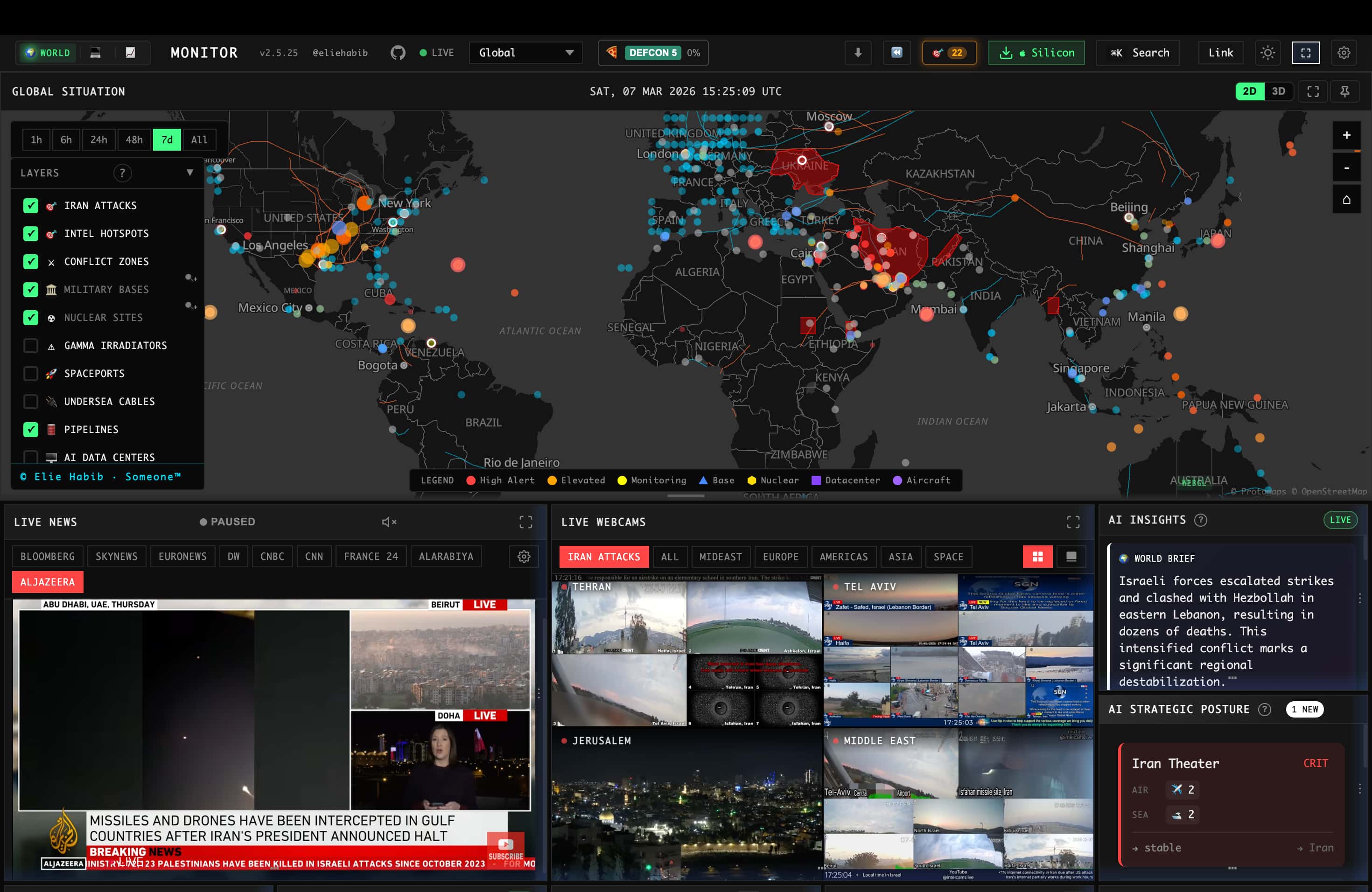
Elie Habib released World Monitor, an open-source real-time global intelligence dashboard built with TypeScript. The app aggregates 435+ news feeds across 15 categories into a unified interface with interactive 3D/2D maps, 45 toggleable data layers, and AI-synthesized briefs. AI features include LLM-powered world briefs with local Ollama support, geopolitical deduction and forecasting grounded in live headlines, and a browser-local RAG system using ONNX embeddings for semantic headline queries. Available as a web app, PWA, and native desktop app for macOS, Windows, and Linux.
That’s all for this edition! Be sure to reach out if you have any stories, content, jobs, or events you want featured in the newsletter.