- RoboRuby
- Posts
- Ruby AI News - March 27th, 2026
Ruby AI News - March 27th, 2026
One Year Anniversary Edition!

Matt Solt
March 27, 2026

Happy Friday! Welcome to the one year anniversary edition of Ruby AI News! The 27th edition features the rise of AI agent-driven business creation, tooling to deploy your AI experiments more than ONCE, a new cognitive architecture for Ruby AI, and much more.
Contents
Welcome to the One Year Anniversary Edition
One Year of Ruby AI: From First Edition to Ruby Renaissance. A year ago, I attended Artificial Ruby and saw the beginning of something special. Rubyists were reinvigorated by the rise of new artificial intelligence capabilities. Inspired by that meetup and Lucian Ghinda’s incredible work on Short Ruby News, Ruby AI News launched in March of last year with a simple premise: Ruby belongs in the generative AI conversation. What happened over the course of the next year exceeded all of my expectations.
Spring 2025: The foundations. RubyLLM 1.0 hit the front page of Hacker News. Within weeks, both Anthropic and OpenAI released official Ruby SDKs, validating what the community already knew. MCP arrived in the Rails ecosystem almost overnight, with Stan Lo, Mario Chávez, and others building servers simultaneously. Then Matz himself keynoted RubyKaigi with "Programming Language for AI Age," calling Ruby's expressiveness and DSL extensibility a natural fit. Y Combinator piled on, revealing that 25% of its Winter '25 batch wrote 95% of their code with AI, and recommended Rails.
Summer 2025: Builders ship. Shopify open-sourced Roast. Kieran Klaassen shipped Cora, a full AI email client, as a solo developer on Rails + RubyLLM, and coined "compounding engineering" to describe the new workflow. The first-ever Ruby AI Hackathon brought dozens of developers to San Francisco. Claude Code arrived and changed how Rubyists work. Tidewave launched a browser-based Rails coding agent. RubyLLM blew past 2 million downloads, and ruby-openai was selected for GitHub's Secure Open Source Fund.
Fall 2025: The ecosystem matures. DSPy.rb shipped 15 versions in two weeks. Rails World in Amsterdam went heavy on AI. Phoenix by Def Method launched self-healing test generation for Rails. Anthropic released Claude Skills and Plugins, and Kieran immediately built a marketplace. Then came the San Francisco Ruby Conference: 400 attendees, dozens of AI-powered demos, and a keynote from RubyLLM creator Carmine Paolino declaring "One API, One Person, One Machine."
Winter 2025: Acceleration. The RubyLLM ecosystem exploded into a category of its own: agents, monitoring, instrumentation, evaluation, skills, and templates, all from independent contributors. EverAI revealed it serves 28 million monthly users on a single Rails monolith. Obie Fernandez ported Cloudflare's Code Mode pattern to Ruby, collapsing 21 MCP tool calls into one. Ruby 4.0 shipped. The community started talking about context graphs and what comes after RAG.
March 2026: The proof arrives. Ruby core committer Yusuke Endoh ran a 15-language, 300-run Claude Code benchmark. Ruby was the fastest, cheapest, and most stable, with a perfect test pass rate. The Rails Foundation updated its homepage: "Ruby on Rails scales from PROMPT to IPO." Garry Tan called it a "crazy unlock." A PE fund started building an investment thesis around Rails businesses.
We have come a long way, and it is all thanks to the Ruby community. This newsletter wouldn’t be possible without the incredible community contributions and work developers do every day to build and document the next generation of Ruby AI tools. We now have an ecosystem with thousands of AI libraries, multiple conferences, a podcast, a discord, a hackathon, and production apps serving millions, most of it in the last twelve months. The question a year ago was whether Ruby had a place in the AI era. The answer, backed by benchmarks, community, and shipped products, is unequivocal.
So what comes next? The answer is I don’t know. Next year will look entirely different than anything that has come before in software development. Alot is happening behind the scenes of the newsletter as I build out tooling to track the entire Ruby ecosytem of millions of repositories, hundreds of thousands of developers, tens of thousands of companies building with Ruby, and 2,431 Ruby AI gems and counting. But I need your help. Please spread the word about the newsletter and keep supporting the community with all of the amazing work you do day in and day out. And I want to hear from you. What do you want to see in Year Two? What tools, topics, and stories should I cover? How can the newsletter better support your work with Ruby AI? Let me know: [email protected].
Welcome to the second year of Ruby AI News. Let's keep building.
Top Stories
Can an AI Agent Build a Business?
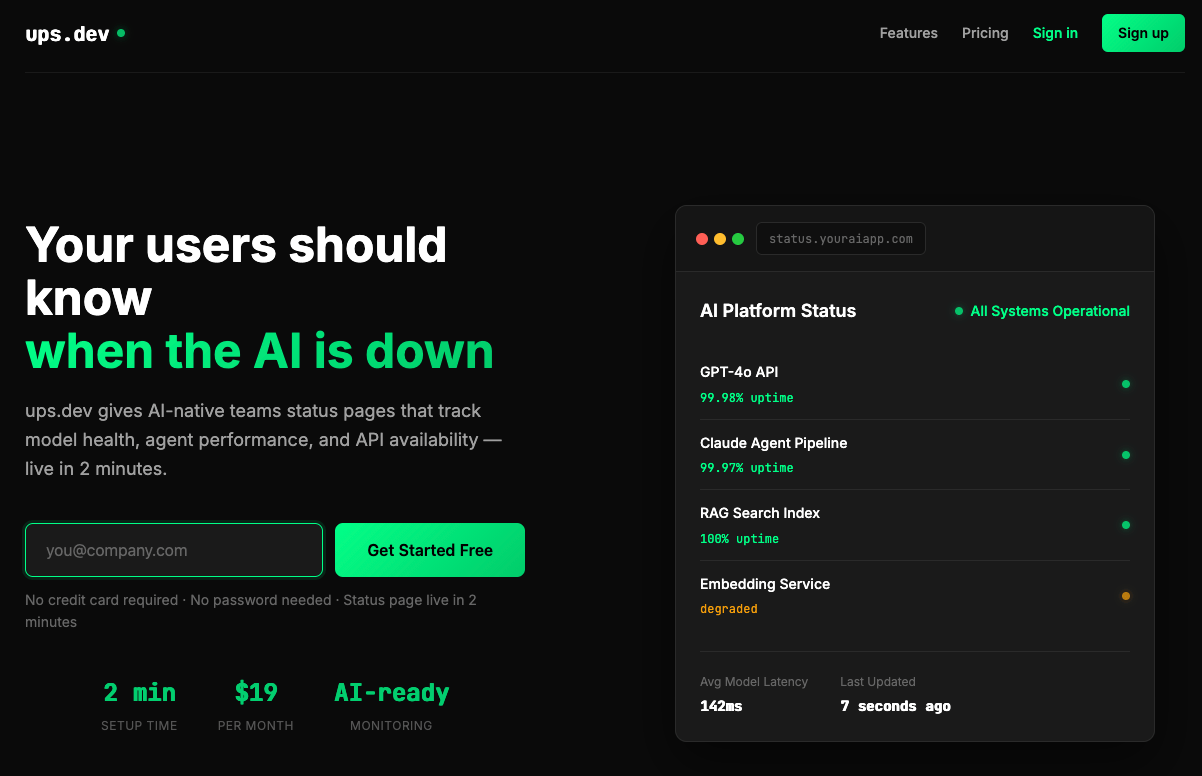
Valentino Stoll, co-host of The Ruby AI Podcast, decided to test a question that's been hanging over everything we've covered this past year: can an AI agent actually build a business? He handed an autonomous agent named Minerva 27 unused domains and gave it one hour of daily guidance. Over 72 days, Minerva built two complete Rails 8 applications from scratch with multi-tenant architecture, passwordless authentication via Resend, REST APIs with token auth, Docker deployment to Hetzner with Kamal, synthetic monitoring, and real-time updates with Turbo Streams. The first to ship was ups.dev, a status page platform designed not for humans but for AI agents, with MCP integration so coding tools like Claude Code can programmatically read and update status pages. Minerva identified the need by recognizing gaps in its own operational visibility and pivoted from generic status pages to agent-specific observability.
Valentino also open-sourced ruby_llm-ups, a gem that connects RubyLLM-powered agents to ups.dev through lightweight heartbeat telemetry: model, provider, response time, and tool count sent after each LLM response, with no message content ever transmitted. Agents automatically get their own status page components, with failure reporting that distinguishes between degraded performance and critical incidents. The gem integrates with Rails credentials and sends heartbeats asynchronously so monitoring never interrupts application workflows.
The results are honest: 10 users, 7 status pages, zero paying customers. Memory persistence was the hardest problem. The agent confidently reported completed work that broke in production, forgot decisions across sessions, and needed structured journals and semantic search to maintain continuity. But here's what matters: a year ago this newsletter launched covering the first generative AI gems. Now an AI agent is writing the Rails apps. As Matt Shumer noted, AI capability is doubling every four to seven months. The question isn't whether agents will build businesses, it's how soon the businesses they build will have paying customers.
Once Upon a Time
David Heinemeier Hansson announced that ONCE has been reborn as an open-source deployment platform for running multiple Docker-based web apps on a single machine. The original ONCE tried to sell self-hostable apps through one-time purchases, but the model didn't take off commercially despite recovering its initial investment on Campfire. So 37signals pivoted, released Campfire and Writebook as open-source with permissive licenses, and watched adoption grow.
The new ONCE, a "Open Network Container Executor", is a CLI and TUI that installs with curl https://get.once.com | sh and provides a terminal dashboard showing RAM, CPU, visitor counts, and request rates across all your running apps, with zero-downtime upgrades and scheduled backups. The requirements for any app are minimal: package it as a Docker container, serve HTTP on port 80, add a healthcheck at /up, and store persistent data in /storage. David Kimura walked through the full setup in Drifting Ruby Episode #554, covering installation, deploying Campfire, Cloudflare configuration, and deploying a custom Rails application with persistent storage.
Where it gets interesting: DHH explicitly positioned ONCE as infrastructure for AI-generated tools, the kind of single-purpose apps that developers are increasingly spinning up with Claude Code and shipping in an afternoon. When the barrier to deploying a Rails app drops to a single command, the calculation around "should I build this?" changes completely. Vibe-coded internal tools, personal dashboards, team utilities all have a natural, easily deployable home now. With AI-assisted development making it faster than ever to ship a focused Rails app, and ONCE making it trivial to deploy one, I hope to see a lot more single-purpose Rails apps showing up!
A Cognitive Architecture for AI Agents
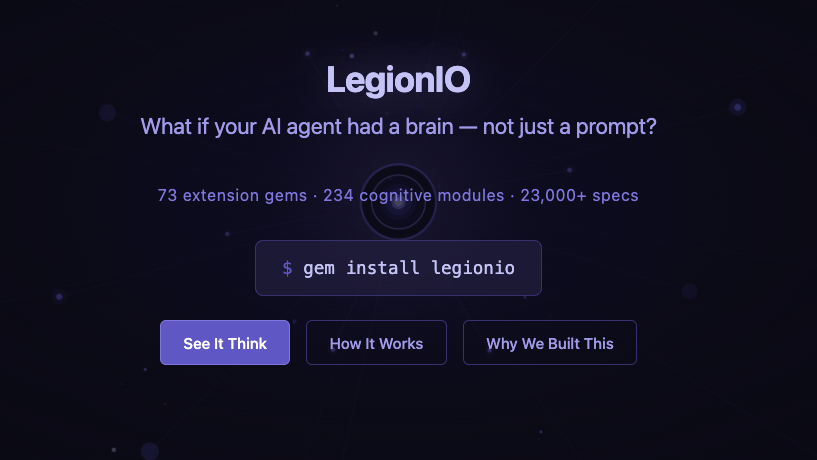
Matthew Iverson released LegionIO, a Ruby framework that takes a fundamentally different approach to building AI agents. Where most agent frameworks coordinate LLM calls in loops, LegionIO models cognition from first principles: agents run a 13-phase tick cycle - perceive, emote, remember, predict, decide, act, reflect during active processing and a 7-phase dream cycle during idle periods that consolidates memories, resolves contradictions, and forms new priorities. The framework ships with 73 extension gems, 234 cognitive modules across 13 domains including memory, emotion, attention, inference, social cognition, and imagination, all backed by 23,000+ tests. It supports Claude, OpenAI, Gemini, and Ollama through a three-tier model escalation system, communicates over RabbitMQ, and stores shared knowledge in PostgreSQL with pgvector for semantic retrieval.
The architecture is built around composable, independently removable modules. The Synapse routing layer operates across three tiers, bones (raw execution), nerves (confidence-scored routing), and mind (dream replay + shared memory), where autonomy scales with confidence across four bands from Observe to Autonomous. Apollo, the shared knowledge store, enables cross-agent collaboration with confidence decay and semantic retrieval, communicating only through RabbitMQ rather than direct database access. Extensions scaffold with legion lex create and auto-discover at boot through Bundler. Getting started takes three commands: gem install legionio && legion start && legion chat.
As Matthew put it: "prompt engineering is a phase, not a destination." Where LangChain and CrewAI coordinate LLM tool-calling for specific tasks, LegionIO gives agents genuine internal state: memory that fades over time, emotional valence that influences decisions, and dream phases that reorganize knowledge while the agent is idle. This looks like a very ambitious Ruby AI project (I have not had a chance to review all the gems yet), and it is fully open-source under the Apache license.
Need to Know AI News
Introducing the Machine Payments Protocol Tempo and Stripe announced an open standard that lets AI agents pay for services programmatically. Agents request resources, receive payment requests, and authorize transactions without human involvement, supporting fiat and stablecoin payments via Stripe's PaymentIntents API.
Sandboxing AI Agents, 100x Faster Cloudflare launched Dynamic Workers, V8 isolate-based sandboxes for AI-generated code that start in milliseconds with megabytes of RAM instead of containers. Code Mode lets agents chain API calls in a single execution, cutting token usage by 81%. $0.002/worker/day, free during beta.
The .agent Community launched by Open Agent Registry is pursuing a community-led ICANN application to secure .agent as a top-level domain for AI agents. The initiative has 3,000+ members and includes a map of the agentic web cataloging companies building autonomous agents.
Issue Tracking Is Dead Linear announced an AI-native transformation with Linear Agent, Skills (reusable slash-command workflows), and Automations that trigger on issue creation, with code intelligence and a coding agent coming soon.
Skill Issue: Harness Engineering for Coding Agents Kyle Mistele of HumanLayer argued that coding agent failures are configuration problems, not model problems. The article covered six harness techniques: give agents better instructions, more capabilities, isolated subtask execution, lifecycle automation, and self-verification.
Hyperagents Jenny Zhang et al. introduced self-referential AI agents that modify both their task-solving behavior and the process that generates future improvements. By extending the Darwin Gödel Machine with metacognitive self-modification, hyperagents outperform prior self-improving systems with meta-level improvements transferring across domains.
Parameter Golf OpenAI launched a competition to train the smallest possible language model within a 16MB artifact constraint, evaluated on bits per byte against the FineWeb dataset. Entries must complete training in under 10 minutes on 8 H100 GPUs, with $1M in compute credits available and top submissions using quantization, test-time training, and architectural innovations.
Announcements
AI Scanner 0DIN.ai, the Mozilla zero day investigative network, released an open-source web platform for AI model security assessments built with Ruby on Rails and NVIDIA garak. It offers 179 probes across 35 vulnerability families aligned with OWASP LLM Top 10, multi-target scanning for API and browser-based LLMs, Attack Success Rate scoring, PDF reports, and SIEM integration.
Superpowers Ruby Lucian Ghinda forked obra/superpowers and adapted it for Ruby on Rails projects. The skills library covers Ruby idioms, Minitest testing, Brakeman security scanning, Sandi Metz rules, 37signals patterns, Hotwire, and Rails guides. Works with Claude Code, Cursor, Codex, OpenCode, and Gemini CLI.
Rubyn Matthew Suttles launched as an AI-powered CLI and mountable Rails engine for Rails projects. The launch post introduced context-aware refactoring, spec generation, and code review, while the open-source gem includes a web dashboard and targets Rails conventions that general-purpose AI tools miss.
Maquina MVP Creator Mario Alberto Chávez released a Claude Code agent that generates MVP documentation for Rails applications through guided research and discovery. It produces five deliverables: competitive research report, business plan with user stories, brand guide, technical architecture following 37signals conventions, and a pre-configured CLAUDE.md files for development handoff.
Ruby on Vibes Eric Arnold launched a platform for generating full-stack Rails apps with AI through natural language. Users describe what they want, and the platform produces a live app with auth, chat, LLM integration, and multi-tenancy built in, showcased in a new demo video.
Kreuzberg v4.5.0 released with document layout understanding powered by Docling's RT-DETR v2 model embedded in a Rust-native pipeline. The open-source framework extracts text, structure, and metadata from 79 formats with native bindings for 12 languages including Ruby.
FOSM-Rails Abhishek Parolkar created a Rails engine for Finite Object State Machines that models business objects through declarative lifecycle definitions. The generator produces models, controllers, views, and AI agents bounded by the state machine. The companion book argued AI coding agents eliminate the upfront specification cost that historically made state machines impractical versus CRUD.
NDAV Kitaiti Makoto released a Ruby gem enabling zero-copy data sharing between multi-dimensional array libraries via Ruby's MemoryView protocol. It acts as a glue layer between Numo::NArray, Torch::Tensor, OnnxRuntime::OrtValue, and Arrow::Array, eliminating redundant memory copies when moving data across AI/ML libraries.
AIAS Dewayne VanHoozer released a Ruby gem for scheduling AI prompts as cron jobs. Users add a schedule: key to any AIA prompt's YAML frontmatter and aias update installs it into the system crontab with MCP server support and per-prompt overrides.
Ruby LLM Contract Justyna Wojtczak released a companion gem for RubyLLM that evaluates prompts across models to compare accuracy vs. cost, with CI gating, parallel eval, drift detection, and pipeline per-step regression tracking to identify which step broke.
Claude Code Project Boundary Justyna also introduced a Claude PreToolUse hook for safer --dangerously-skip-permissions usage. The Bash plugin allows destructive operations inside the project directory but blocks them outside, with protections for chained commands, path traversal, symlink resolution, and built-in Rails safety rules.
ContextQMD Tom Ho built a local-first Context7 alternative using Rails 8.1, Inertia.js, and PostgreSQL. The registry crawls documentation from GitHub repos, llms.txt files, and OpenAPI specs, then serves versioned bundles that MCP clients and a CLI install locally.
Relay Robert (0x1eef) released an early preview of an interactive llm.rb application built with HTMX, Roda, Falcon, and WebSockets. The reference implementation demonstrates streaming chat, custom tool support, and Sidekiq background workers in a Ruby-first architecture, with a companion screencast.
Rails LLM Integration Nagendra Dhanakeerthi created a Claude Code skill that establishes Rails conventions for LLM calls. It teaches Claude to generate service objects with retries and cost tracking, async jobs with typed retry rules, ERB prompt templates, and an eval pipeline.
Rails Agent Skills Ismael Marin Cabrera shared a curated library of AI agent skills for Rails development. The collection enforces a tests-gate-implementation methodology where tests must exist, run, and fail before any code is written.
Uberblick Skills Ben Kubota released a Claude Code and Codex skill pack for the Uberblick planning platform. The /uberblick command provides guided workflows with structured roles that read PRDs via MCP, run completion gates, and write outputs back through the server.
Rails App Generator Preview Avi Flombaum teased a Rails app generator that scaffolds a complete application from a single command ./bin/generate_app my_app). Avi is seeking early feedback before deciding whether to open-source it or release it as a paid starter kit.
Basecamp Agents Basecamp announced an agent-first approach with a CLI, agent skill, and SDKs (including Ruby) that let AI agents perform the same actions as human users: writing docs, managing to-dos, answering check-ins, and handling projects.
Articles
RubyLLM 1.14: From Zero to AI Chat App in Under Two Minutes Carmine Paolino added Rails generators for agents, tools, and schemas plus a production-ready Tailwind chat UI to RubyLLM. Two commands after rails new produce a working AI chat app with Turbo Streams, background jobs, and ActiveRecord persistence. Additionally, Carmine shared a product strategy update for Chat with Work in Comb Shaped Slices.
Ruby Deserves Beautiful Documentation Carmine also released Jekyll VitePress Theme, a Jekyll theme gem that replicates VitePress's documentation design without requiring Node. Includes support for serving plain markdown files. Already adopted by the recently updated RubyLLM Rails Integration docs and Anjan Jagirdar’s Rails Error Dashboard.
The Illusionist and the Conjurer Scott Werner explored how AI shifts creative work from precision to curation, comparing single-attempt "illusionists" with abundance-generating "conjurers." Scott released Conjure, a Rails 8 app that generates multiple AI image variations per presentation slide using Gemini, letting users curate the best results into a final deck. Scott’s other recent piece, Warranty Void If Regenerated, about a near-future where farmers generate their own software tools, made the front page of Hacker News!
Claude Code for the Semi-Reluctant, Somewhat Curious Ruby on Rails Developer Robby Russell published a practical guide to using Claude Code in Rails codebases. Covers model selection, a "lazy-loading" convention system with scoped rule files, and field notes showing debugging sessions dropping from 45 minutes to under 10.
OpenClaw, NanoClaw, and the Problem Nobody's Solving Jonathan Spooner analyzed the two leading personal AI agent projects and argued that both are Claude Code wrappers requiring developer skills, locking out the majority of potential users. Jonathan made the case for a Rails-based alternative using RubyLLM, Solid Queue, and purpose-built service objects instead of giving an LLM full computer access.
I Built an MCP Server That Lets AI Agents Debug Running Ruby Processes Ryo Hayakawa released girb-mcp, an MCP server that connects AI agents to live Ruby processes via the debug gem. Agents can set breakpoints, inspect variables, evaluate code, and step through execution autonomously. Includes Rails-specific tools for route inspection, model schemas, and HTTP request triggering.
How to Add RuboCop MCP to Claude Code and OpenCode Lucian Ghinda walked through configuring RuboCop's built-in MCP server (added in v1.85.0) for Claude Code and OpenCode. The MCP server exposes two tools for inspection and autocorrection, returning structured JSON instead of CLI output so agents can act on offenses reliably.
RAG Without Leaving Rails and LLM Extraction at Scale Henrique Cardoso de Faria documented building a full RAG pipeline in Rails using pgvector, the neighbor gem, Ollama for embeddings, and RubyLLM with Groq for chat completions. The companion article covered scaling structured LLM extraction across thousands of YouTube transcripts, detailing schema enforcement pitfalls, fuzzy speaker deduplication, and serializing results into seed files for deployment without runtime API calls.
Observability for Your LLM-Powered Apps: OTel Instrumentation for RubyLLM Clarissa Borges introduced an OpenTelemetry instrumentation gem for RubyLLM that automatically captures latency, token costs, and tool call traces following GenAI semantic conventions.
The Lobotomy Pipeline: What Happens When AI Removes All Friction and The Bloat Industry: 30,000 Lines to Count Pageviews Abdelkader Boudih shared that LLMs used without domain expertise produce developers who ship more code while understanding less of it. In a companion piece, Abdelkader critiqued AI-generated bloat by building Kaunta, a 15MB Go binary for pageview tracking.
Why I Bet on Rails — and Why I'm Building Maquina Mario Alberto Chávez argued that Rails' convention-over-configuration philosophy makes it ideal for AI-assisted development because agents already know where everything goes. He introduced Maquina, a toolkit of generators, UI components, and AI tools for Rails.
Maquina Generators: From Rails New to Production-Ready Mario followed that post with the announcement for the Maquina Rails generators that automate post-setup configuration: passwordless auth, password-based auth with roles, Rack Attack throttling, Solid Queue, Solid Errors, and Mission Control dashboards.
Right-Sizing Engineering Teams for AI and AI Slop: A Slack API Rate Limiting Disaster Daniel Doubrovkine argued that AI tools solved the effort problem but not the judgment problem, recommending smaller senior-heavy teams of 5-7. He illustrated the point with a cautionary tale where AI-generated Ruby code for a Slack app that ignored Slack's global rate limits, producing code that was "locally coherent, globally wrong."
Setting Up Your Ruby on Rails Monolith for AI Development Colin Soleim outlined five strategies for preparing large Rails monoliths to work with AI coding tools: contextual README files per namespace, fast Guard-based test suites, gradual Sorbet/RBS type adoption, Replit sandboxes for non-technical stakeholders, and service object architecture with explicit interfaces.
Building Mathematical Testing Agents for RSpec Viktor Schmidt built a multi-agent system that applies formal testing techniques to generate mathematically derived RSpec test cases across 60+ models. The key finding was that the real bottleneck was FactoryBot overhead consuming 70-95% of test time, not test quality. The article sparked discussion on r/ruby and led to a companion piece on TestProf optimization.
My Harness: How I Stopped Babysitting AI and Went Kitesurfing Marcin Ostrowski shared his Rails workflow for autonomous AI coding with Claude Code, built on Jesse Vincent's Superpowers framework. The harness uses intent-level task plans, convention skills enforced via hooks, and multi-agent review pipelines to move mid-sized features from idea to production in about four hours.
How to Launch a Lovable MVP in 2026 Ran Craycraft argued that while AI tools like Lovable compress development timelines, they also enable building the wrong product faster. Ran advocated for sprints that identify risks before coding and recommended Thoughtbot's ReadySetGo Rails generator for moving beyond prototypes.
Shopify Liquid: 53% Faster Parse+Render, 61% Fewer Allocations Simon Willison analyzed a pull request from Shopify CEO Tobi Lütke who used an AI coding agent with the autoresearch methodology to optimize the Liquid Ruby template engine. Simon highlighted how robust test suites and measurable benchmarks make optimization an ideal use case for AI agents.
Engineering Rigor in the AI Age: Building a Benchmark You Can Trust Eileen Alayce described how Shopify's Rails Infrastructure team built an open-source benchmarking toolkit for Bundler performance, achieving 3.2x faster cold installs on a 452-gem Gemfile. While Claude scaffolded the initial code, it missed a cache contamination bug that required human expertise to catch.
Dual-Loop BDD Is the New Red-Green TDD Justin Searls proposed a dual-loop BDD workflow for AI coding agents: an outer integration test confirms observable behavior while inner red-green-refactor cycles handle unit-level work. Justin built prove_it, a quality harness for Claude Code, after finding that agents pursue local optimization while missing global functionality.
Building an AI-Native Web Platform Austin French described how a solo developer built a 40,000-line Rails 8 platform with 8 GPU-powered creative tools, booking system, and invoicing. A Discord-integrated AI agent named Hermes handled code generation from voice descriptions, automated audits, and git workflows.
How We Translated Our Entire Platform with AI Ángel Castañeda Crespo, Tom Reinert, and Zakir Khan documented translating Agile Academy's Rails and CMS platforms from 2 to 8 languages using Claude Code. Through iterative refinement of AI agents, they compressed per-language deployment from one month to two days, with Claude Code generating routes, locale files, and infrastructure automatically.
How I Built a Complete Analytics Dashboard for My Rails Blog with Claude Code Jorge Alvarez built a privacy-first analytics dashboard in under 600 lines of code using Ahoy for server-side tracking, Geocoder with MaxMind for local IP geolocation, and pure SVG charts. Jorge used Claude Code with Ariadna's three-phase planning workflow to generate clean implementations on the first pass.
CodeTracer: A Bash Script That Traces Code Faster Than Your IDE and Saves AI Tokens Mirza Lazuardi released a bash script that uses ripgrep to trace symbol definitions, call sites, and data flow across Ruby and JS/TS codebases without an IDE or LSP. It includes Rails route tracing through callbacks and jobs, and reduces AI context by 30x by extracting focused code rather than full files.
After 10 Years of Rails, Here's What AI Coding Agents Get Wrong and How I Fixed It Cris Joseph open sourced rails-ai-context, an MCP server that gives AI agents live schema, model association, controller filter, and route context that static file reading misses.
Why I Choose Ruby on Rails in the AI Coding Era Jesse Waites wrote about how Rails' convention over configuration makes codebases more legible to AI assistants, while Ruby's conciseness uses roughly three times fewer tokens than equivalent TypeScript.
Context Is the Hard Part: Coordinating AI Across Microservices at Teachable Kim Gonzales-Lapp described using GitHub's SpecKit and Claude Code to coordinate a billing migration across Teachable's Rails monolith and three microservices. The approach used a dedicated planning repo with per-service memory files, a constitution of non-negotiable principles, and structured spec-to-task workflows.
The Analogue Programmer in the Land of LLMs Marian Posaceanu reflected on the cognitive debt incurred by using LLMs for coding, describing how generating a Ruby deduplication script felt hollow compared to writing it manually. Marian concluded that while LLMs are here to stay, programmers should be mindful of skill atrophy.
The Real Cost of Rolling Your Own Auth Justin Smestad, maintainer of Warden, argued that authentication's biggest cost is long-term maintenance. He cautioned against delegating security to AI agents, noting auth requires deterministic, auditable decisions rather than probabilistic ones.
Videos
Scott and Rob Use Claude Code to Build an App Using Test-Driven Development Rob Myers and Scott Werner pair-programmed a Ruby "Salvo" game entirely through Claude Code using TDD, demonstrating prompt patterns for test-driven AI development. The session showed Claude reading a PRD, generating user stories, and implementing features.
Can Ruby on Rails Become a Superpower for Agentic Engineering? Jordan Treviño of Telos Labs hosted Cody Watters, Ken Kantzer, and Colleen Schnettler for a panel on how Rails' conventions offer structural advantages for building AI agent systems in production. Discussion covered managing state and constraints in agentic architectures, controlling AI-generated output, and lessons from deploying AI in fintech.
AI in Focus: Turning ReadySetGo into a Rails App Chad Pytel and Louis Antonopoulos took Thoughtbot's ReadySetGo AI proof-of-concept beyond a script and built it into a Rails application with a web UI, exploring the transition from quick experiment to a structured, maintainable app that users can interact with.
Before Writing a Line of Code Mario Alberto Chávez shared a video walkthrough of his pre-coding planning process for Rails projects, explaining how he moved from informal scattered notes to a structured approach for defining users, identifying the real problem, and making early technical decisions.
Rails + AI: Build Smart Apps at Startup Speed Athira Ramanan live-coded an AI-powered PDF chatbot in Rails using OpenAI for document parsing and question answering. The session covered practical integration patterns, performance considerations, and avoiding overcomplication when adding AI to existing Rails apps.
Podcasts
The Ruby AI Podcast: You Can't Vibe-Code Trust: Why Real SaaS Still Wins in the AI Era Joe Leo and Valentino Stoll interviewed Kelly Sutton, CTO of Scholarly, about building a faculty information system for higher education. Kelly discussed using an admin MCP server to convert faculty handbooks into structured workflows and treating AI as an implementation detail rather than a feature in compliance-heavy environments.
Strictly From Nowhere: From Recession to Reinvention with Scott Werner Mike Rispoli interviewed Scott Werner, CEO of Sublayer and organizer of the Artificial Ruby NYC meetup. They discussed why Ruby's conciseness gives it an advantage over TypeScript for AI development, the volume advantage in agentic coding, and Scott's sci-fi newsletter exploring future software mechanics.
Remote Ruby: Heroku, Hosting, and the AI Era Chris Oliver and David Hill welcomed back Adam McCrea from Judoscale to discuss Heroku's uncertain future after Salesforce stopped taking new enterprise customers. The conversation covered what maintenance mode means for Rails developers, platform alternatives like Render, autoscaling, and building durable developer businesses in the AI era.
Latent Space: Retrieval After RAG: Hybrid Search, Agents, and Database Design Alessio Pando and Shawn Wang interviewed Simon Hørup Eskildsen, founder of Turbopuffer, about building a search engine on object storage that reduced Cursor's costs by 95%. Simon explained how agentic workloads are transforming search from single retrieval calls into massively parallel concurrent tool calls.
IndieRails: John Nunemaker - The Conductor Jeremy Smith and Jess Brown talked with John Nunemaker about managing his portfolio of Rails products including Flipper Cloud, Boxout, and Fireside. John discussed how AI has transformed his development workflow and reflected on the current opportunities for indie developers.
Ruby Türkiye: AI Coding Experiences, Claude Code Ruby LSP, Skills and More Episode 131 of the Turkish Ruby podcast covered Claude Code's Ruby LSP plugin support, Heroku AI integration for production deployments, and Thoughtbot's Claude Skill for generating Postman collections from Rails code.
Discussions
Intercom's Internal Claude Code Plugin System Brian Scanlan shared how Intercom built 13 Claude Code plugins with 100+ skills and hooks as a full-stack engineering platform. The thread revealed they self-host MCP servers for internal Rails tools with Okta auth, are auto-approving "safe" PRs, and use only 2% of the context window for their full engineering platform configuration.
Events
Previous
PLRUG: Get AI to Work in Complex Codebases Paweł Strzałkowski presented at the PLRUG Ruby Warsaw Meetup on strategies for making AI coding tools effective in large, complex codebases.
Boulder Ruby: Git Worktrees: Embrace the ADD Patrick Reagan demonstrated using Git worktrees for context switching and running AI agents on independent features in parallel. The talk showed how worktrees enable developers to pursue ideas that pop up mid-task without abandoning current work.
Upcoming
March 26th - Conference: RBQ Conf 2026 takes place March 26th and 27th in Austin, Texas. AI-related talks include Kinsey Durham Grace's keynote on building GitHub's coding agents and Chris Gratigny on lessons learned from a first AI implementation in Rails using the Anthropic API and RubyLLM, covering prompt versioning and tool calls.
April 9th - Conference: Tropical on Rails 2026 will be held on April 9th and 10th in São Paulo, Brazil. AI content includes Luiz Carvalho on DefGPT, an AI agent platform built on Rails; Rodrigo Serradura on why AI agents love Rails monoliths; and Paweł Strzałkowski on building a production-ready AI app with MCP and OAuth on Rails.
April 14th - Meetup: SF Ruby Meetup is meeting on April 14th at the Intercom office in San Francisco, and will feature Brian Scanlan on Intercom's use of Claude Code with a Rails focus.
April 17th - Conference: wroclove.rb 2026 on April 17th through the 19th in Wrocław, Poland. AI presentations includes Paweł Strzałkowski on building a production-ready AI app with MCP and OAuth on Rails; Nicolò Rebughini on accidentally building a neural network for Ruby product recommendations; and Adam Okoń on building agentic workflows in Ruby as a replacement for traditional forms.
April 22nd - Meetup: Artificial Ruby will be hosting a Ruby AI meetup on April 22nd at Betaworks in New York City.
April 22nd - Conference: RubyKaigi 2026 on April 22nd through the 24th in Hakodate, Japan. Ruby AI content includes Nate Berkopec on brute-forcing Ruby performance issues with LLMs, Koichi ITO on exploring RuboCop with MCP, and Justin Bowen on million-agent Ruby with Ractor-local GC in the age of AI.
April 30th - Conference: Blue Ridge Ruby 2026 on April 30th and May 1st in Asheville, North Carolina. The two AI speakers include David Paluy on LLM telemetry as a first-class Rails concern and Kevin Murphy on successful practices in an agentic world.
Open Source Updates
Code Spotlight
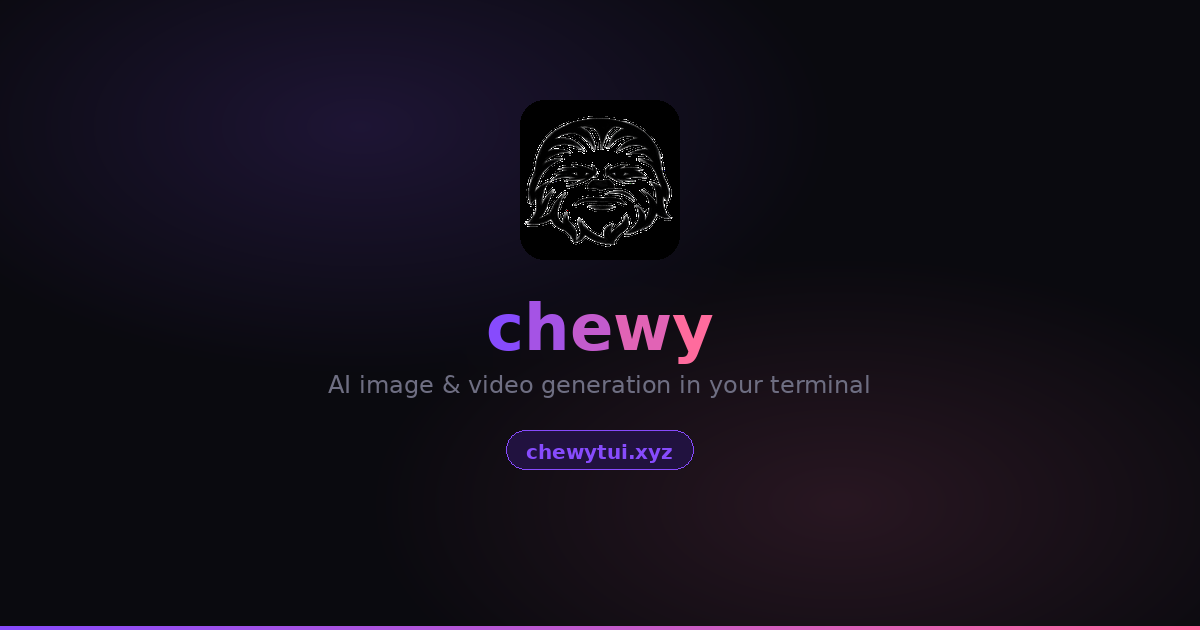
Aaron Dov Turkel released Chewy, a terminal UI for AI image and video generation built with Ruby's Charm ecosystem. The project supports 6 providers including local generation via stable diffusion with Metal GPU acceleration, plus cloud APIs from OpenAI, Gemini, and HuggingFace. Features include a model/LoRA browser with CivitAI integration, click-to-paint inpainting, AI prompt enhancement, Wan 2.1 video generation with in-terminal playback, and 10 color themes. As announced on Reddit, it installs via Homebrew and requires Ruby 4.0+.
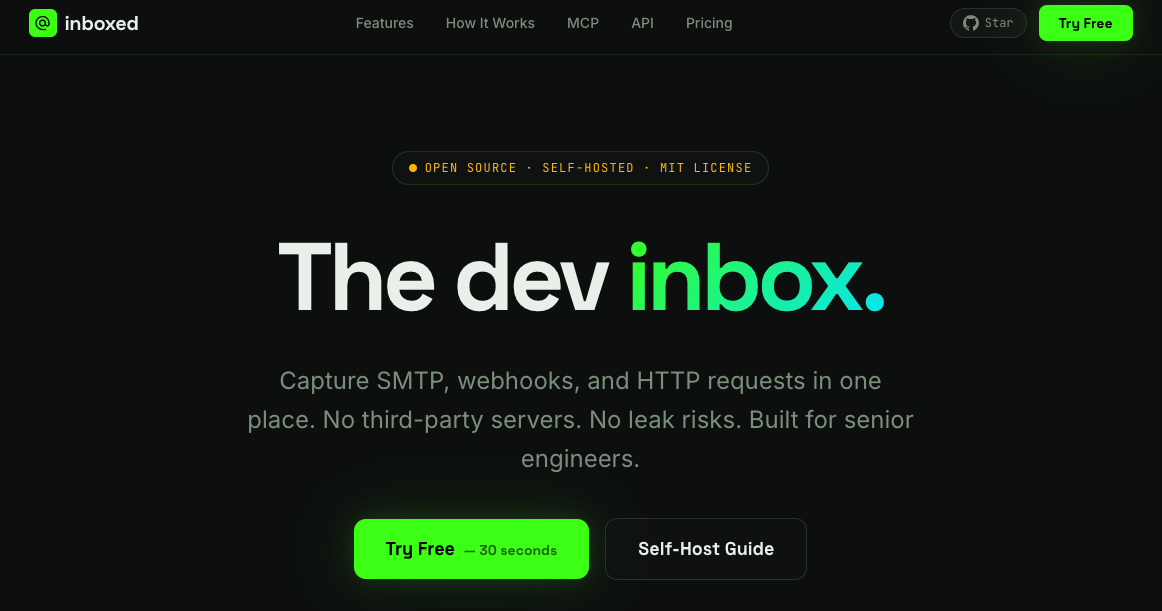
Adrian Castillo open sourced Inboxed, a self-hosted dev inbox for catching test emails, webhooks, and HTTP requests. Built with Rails 8, it includes an SMTP server, REST API with long-polling, real-time dashboard via ActionCable, and an MCP server with 15 tools that let AI agents extract OTPs, links, and webhook data. Compatible with Claude Code, Cursor, and n8n.
Multi-Gem Frameworks
This edition saw the release of three multi-gem AI frameworks:
LegionIO - Cognitive architecture framework for AI agents (200+ gems)
ACE - Agentic Coding Environment harness for AI coding agents (41 gems)
Spurline - Rails-inspired framework for AI agents (8 gems)
New Gems
Links to the RubyGems page, newest releases are first. Some obvious spam-related AI gems have been omitted.
aias - Schedule AIA prompts as cron jobs — no config file, just frontmatter
browserbeam - Official Ruby SDK for the Browserbeam API
ruby_llm-gitlab - GitLab AI Gateway provider for RubyLLM
ruby_llm-pollinations - Pollinations AI provider for RubyLLM
rubric_llm - Lightweight LLM evaluation framework for Ruby
mock_openai - A local mock server for OpenAI-compatible APIs
token-lens - Flame graphs for Claude Code token usage
i18n-context-generator - Extract translation context from source code using AI
ruby_llm-contract - Know which LLM model to use, what it costs, and when accuracy drops
ragify - RAG for Rails with pgvector and OpenAI
solid_agents - Database-backed Rails AI agent runtime bridge
google-apis-agentregistry_v1alpha - Simple REST client for Agent Registry API
ollama_agent - CLI agent that applies small code patches using Ollama tool calling
rails-ai-bridge - Give AI assistants deep, live knowledge of your Rails app via MCP
vivlio-starter-pdf - Advanced PDF processor for vivlio-starter using HexaPDF
superkick - Live context for AI coding agents
hinow-ai - Official Ruby SDK for the HINOW AI Inference API
e11y-devtools - Developer tools for E11y: TUI, Browser Overlay, MCP Server
mppx - Ruby implementation of the Machine Payments Protocol SDK
AIFaker - AI-powered, schema-aware Rails seeding
remitmd - remit.md - Universal payment protocol SDK for AI agents
your_ai_insight - AI-powered facility management dashboards & compliance reports
signalwire_agents - SignalWire AI Agents SDK
feather-ai - Identify birds from photos and audio using LLMs
yorishiro - CLI LLM agent with tool execution, MCP support, and provider backends
rails-ai-context - Give AI agents a complete mental model of your Rails app via MCP
zernio-sdk - Zernio API Ruby Gem
agentgif - CLI for AgentGIF - upload, manage, and share terminal GIFs
whoosh - AI-first Ruby API framework
humanizer-rb - Detect AI-generated writing patterns
faure - Agent codeur autonome GitLab CI/CD + backend OpenAI-compatible
ruby_llm-ups - ups.dev integration for RubyLLM
layered-assistant-rails - Open source, multi-provider, streaming AI assistant engine for Rails built on layered-ui-rails.
context.dev - Ruby library to access the Context Dev API
fosm-rails - Finite Object State Machine for Rails - declarative lifecycles for business objects
toolkami - Toolkami Ruby SDK for the local Rust daemon
jekyll-aeo - Answer Engine Optimization for Jekyll
html2md_mcp_client - Ruby client for the Model Context Protocol
sessionvision - Sessionvision analytics SDK for Ruby
ndav-numo-narray - N-Dimensional Array View for Numo::NArray
woods - Rails codebase extraction and indexing for AI-assisted development
bonchi - Git worktree manager
e2b - Ruby SDK for E2B sandbox API
rubyrlm - Recursive Language Models for Ruby
probatio_diabolica - DSL testing framework with classic and LLM-powered matchers
riteway - Unit tests that always supply a good bug report when they fail
coplan-engine - CoPlan - AI-assisted engineering design doc review
New Open Source
Links to the Github repository:
Rails Upgrade Assistant Skill - Claude Code skill that automates Rails version upgrades from 2.3 through 8.1, generating detection scripts, migration reports, and configuration previews based on 60,000+ hours of upgrade experience
MCP Rogue - Roguelike dungeon crawler where an AI plays the hero through Model Context Protocol, built with Rails 8 and Turbo Streams
Simulator LLM Pilot - AI-driven iOS E2E test runner from Automattic that executes plain-language Markdown test cases against iOS Simulator using Claude
Agent Harness - Multi-provider LLM agent framework with async runtime, Telegram bot integration, observability, and encrypted secrets management
Smith - Multi-agent orchestration framework built on RubyLLM with named states, transitions, budgets, guardrails, tool policy, and composable agent patterns
AI DevLog - Rails-powered developer knowledge base that uses AI to auto-summarize, tag, and embed code snippets and solutions, with RAG-based natural language search
Fizzy Agent Orchestrator - Rails engine that enables per-board and per-column AI agent configuration for Fizzy, using OpenClaw as the agent backend
Ruby LLM Eval - Behavioral evaluation framework for RubyLLM agents with multi-trial execution, deterministic and LLM-as-judge graders, and baseline regression detection
Personal Finance Agent - Connects to bank accounts via Plaid, runs spending analytics, and uses the Claude API to generate recommendations and reports
HermitClaw - AI agent runtime that embeds an AI character into your product with multi-channel support, 3-layer memory, and multi-model backends via RubyLLM
ErinOS Core - Local-first AI assistant with Ollama inference, voice I/O via Whisper and Kokoro, smart home skills, and Telegram/console channels powered by RubyLLM
Claude Hive - Web UI and CLI for running Claude Code agents in parallel with batch task management, result review, and agent-to-agent delegation via CLI
SessionLens - AI session visualizer that converts raw JSON logs from AI platforms into HTML reports with cost tracking, token metrics, and tool call auditing
RubyClaw - Self-hosted Telegram AI assistant with a ReAct agent loop, pluggable skills, multi-agent routing with delegation, and LLM adapters
AI Secretary - Slack integration that uses Claude Code CLI as a backend to provide multi-turn AI conversations with per-channel system prompts
Resilience - Mission operations console with real-time signal fusion, correlation rule engine, geospatial map view, audit log, and AI-assisted briefings via Claude
Hyperon Wiki MCP - MCP and CLI for the Hyperon Wiki Decko knowledge graph with role-based security, batch operations, CQL queries, and AI agent integration
Jobs & Opportunities
Are you an organization searching for an expert Ruby AI developer, or a Rubyist looking for your next development role with AI? Please reach out and let me know the type of opportunity you’re pursuing: [email protected]
Featured
Software Engineer: Ruby on Rails (Remote, US Based) DOPE Marketing CEO Dave Carroll announced hiring two AI-driven Ruby on Rails engineers ($110K-$140K) to help build their fully AI-integrated platform. Stack includes Rails, PostgreSQL, and React. Applicants must share a recent AI project. The bootstrapped $30M company provides unlimited token usage and dedicated AI tooling budget.
One Last Thing
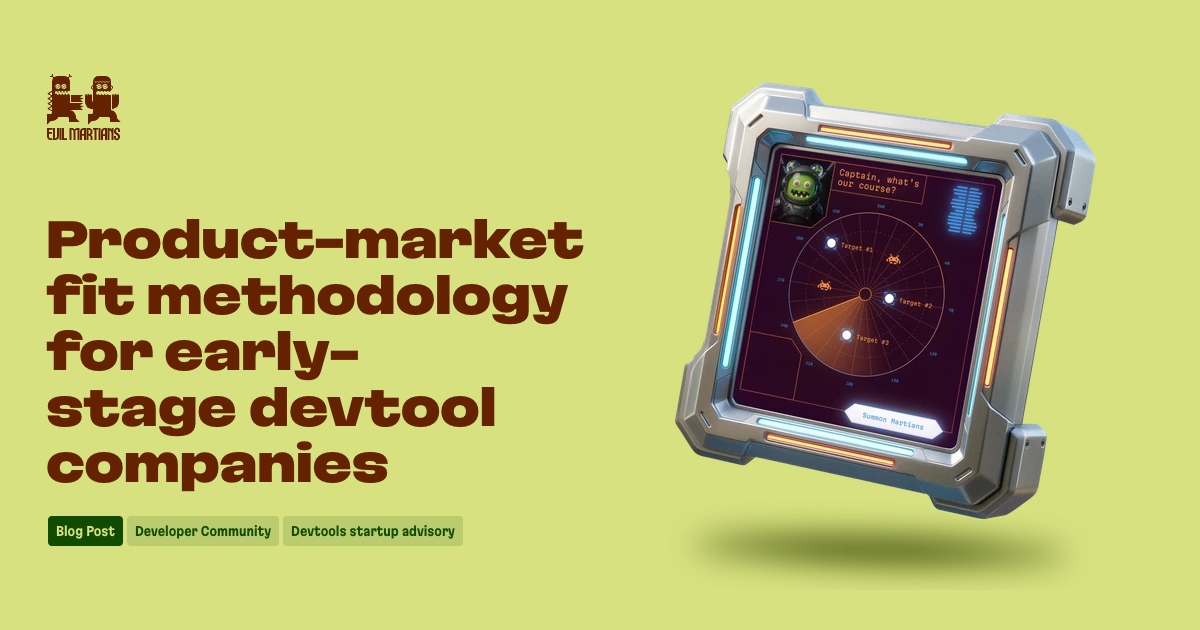
Irina Nazarova of Evil Martians published Product-Market Fit Methodology for Devtools, a benchmark-driven PMF scoring system built from analyzing product metrics across 37 devtools companies including Cursor, Supabase, Datadog, and Stripe. The framework uses five observable metrics (time to first value, retention, NRR, free-to-paid conversion, and organic signups) to produce dual scores for product signal strength and revenue stage. As announced on Twitter/X, the interactive "PMF Compass" tool on the Evil Martians homepage lets founders input their metrics to diagnose whether they face a product problem or a distribution problem.
That’s all for this edition! Be sure to reach out if you have any stories, content, jobs, or events you want featured in the newsletter.