- RoboRuby
- Posts
- Ruby AI News - October 18th, 2025
Ruby AI News - October 18th, 2025
The future of AI testing

Matt Solt
October 18, 2025

Welcome to the 17th edition of Ruby AI News! This edition features a new service to generate self-healing tests for Rails applications, Claude Code skills & plugins, an amicable resolution to the RubyGems situation, and much more.
Contents
Top Stories
Interview with Joe Leo: Introducing Phoenix
This week I had the privilege of interviewing Jeo Leo, the Founder and CEO of Def Method. In the interview, we discuss the launch of Phoenix, Def Method’s new service to continuously generate self-healing tests for Ruby on Rails applications. We also look at the schools of programming forming around generative AI, bringing the joy of Ruby to AI development, and the importance of staying curious in an ever-changing technological landscape. Thank you to Joe for taking the time to answer these questions! If you haven’t had a chance to yet, I highly recommend you check out the article. I had a chance to see a demonstration of Phoenix at the recent ArtificialRuby meetup and I’m incredibly excited for the public launch.

Claude Skills & Plugins
Anthropic introduced Claude Skills, a feature enabling task-specific performance improvements through folders containing instructions, scripts, and resources that Claude loads when relevant. Skills are composable (multiple skills work together automatically), portable (same format across Claude apps, Claude Code, and API), efficient (loads only necessary information), and can fall back to executable code for when traditional programming is more reliable than token generation.
Simon Willison argues Claude Skills are awesome, maybe a bigger deal than MCP, analyzing Anthropic's new system as potentially more significant than Model Context Protocol due to its token efficiency and simplicity. Skills are Markdown files with YAML frontmatter and optional scripts that consume a smaller ammount of tokens per summary during scanning, with full details loading only when relevant, compared to a potentially much larger MCP token overhead. Simon states "almost everything I might achieve with an MCP can be handled by a CLI tool instead" and predicts a "Cambrian explosion in Skills" exceeding MCP adoption, crediting the design's simplicity and portability across models.
Anthropic also announced plugins for Claude Code, enabling developers to package and share custom collections of slash commands, subagents, MCP servers, and hooks that install with a single /plugin command. Anyone can create plugin marketplaces to distribute customizations… like Kieran Klaassen.
Shortly after, Kieran Klaassen launched the Every Marketplace, a Claude Code plugin marketplace featuring the Compounding Engineering Philosophy plugin with AI-powered development tools including code review with multiple expert perspectives, automated testing and bug reproduction, PR management, and documentation generation. The plugin implements a Plan-Delegate-Assess-Codify workflow designed to ensure each unit of engineering work makes subsequent work easier, with installation available via /plugin marketplace add https://github.com/EveryInc/every-marketplace and /plugin install compounding-engineering.
Live! Try out the compounding engineering philosophy in Claude Code:
github.com/EveryInc/every…
— Kieran Klaassen (@kieranklaassen)
9:30 PM • Oct 9, 2025
The Ruby Community Grows Stronger
Yukihiro “Matz” Matsumoto announced the transition of RubyGems repository ownership to the Ruby core team to ensure long-term stability and alignment with the broader Ruby ecosystem. RubyGems and Bundler will be jointly managed by the Ruby core team and Ruby Central, maintaining their open-source licenses and community-driven development process while preserving all existing contributors' copyright and authorship rights.
Update: Atsushi Tatsuma released Rumale v2.0.0, a Ruby machine learning library providing Scikit Learn-like interfaces. The library supports classification, regression, clustering, dimensionality reduction, and ensemble methods including SVM, Random Forest, Gradient Tree Boosting, K-Means, PCA, and t-SNE. The v2.0.0 release transitions runtime dependencies from numo-narray to numo-narray-alt and from lbfgsb.rb to numo-optimize, showcasing continued development with actively maintained Ruby numerical computing libraries. Documentation includes examples for dataset classification workflows, cross-validation implementations, and performance optimization through OpenBLAS (Basic Linear Algebra Subprograms) acceleration and parallel processing support.
Announcement: Pete Matsyburka introduced Rllama in Run Open-source LLMs Locally with Ruby. RLlama is a Ruby gem providing FFI bindings for llama.cpp to run open-source LLMs locally without external APIs. The RLlama gem supports GGUF-format models, offering text generation with streaming, multi-turn chat context, embeddings, and a CLI interface for model exploration. Use cases include prototyping Rails features, building offline agents, semantic search, text summarization, and test data generation with complete data privacy. DocuSeal developed and uses the gem to enable semantic search for their API documentation using local embedding models.
This is the Ruby/LLM future you want. Open source models, FFI instead of C extensions... just write Ruby (or JRuby).
rllama: Ruby FFI bindings for llama.cpp to run open-source LLMs such as GPT-OSS, Qwen 3, Gemma 3, and Llama 3 locally with Ruby code.
— Charles Oliver Nutter (@headius)
11:15 PM • Oct 7, 2025
Podcast: On October 16th I was on the Reinteractive podcast Technology for Humans hosted by Errol Schmidt discussing Ruby and AI. We look at why Ruby is a great choice for AI applications, and what we need to do better as a community to fuel a Ruby AI renaissance. Errol is recording incredible episodes on the future of real world AI and Ruby, I encourage you to check them all out, including:
Article: In The Hackathon Where We Mostly Just Talked, Scott Werner recounted a Google hackathon where his team built Photoslider, an image generation tool that uses AI-generated attribute sliders to navigate creative space instead of text prompts. The team spent 95% of their time discussing architecture while AI agents wrote the actual code, leading Scott to argue that AI-assisted development shifts the failure mode from small bugs to architectural incoherence, i.e., spaghetti code. As a result, Scott is proposing a new type of hackathon, "The Iron Vibecoder", a format designed to test whether AI-generated applications can handle mid-event architectural pivots. Scott is looking for feedback, participants, judges, and ideas for the hackathon, so if this sounds of interest, please reach out to him!
Podcast: Joe Leo and Valentino Stoll of The Ruby AI Podcast interviewed Amanda Bizzinotto from Ombu Labs on Real-World Ruby AI: Practical Systems That Work, discussing practical AI implementations in Ruby consultancy work. The episode highlights Ombu Labs and FastRuby.io AI initiatives, including the creation of an AI bot to streamline internal processes, automated Rails upgrade roadmaps, and multi-agent architectures aimed at enhancing efficiency in Rails projects.
Podcast: Joe Leo was also on the Enabling B2B Buying Podcast with Charles Bernard in Joe Leo on Blending Creativity, Service, and AI to Enable Buying, discussing how creativity, AI, and service mindset transform B2B sales conversations. They discuss how Joe's consultancy Def Method built Phoenix, the first AI platform exclusively for Ruby on Rails applications. The conversation explores how AI can enhance human-led sales by improving clarity, personalization, and discovery.
Update: Dewayne VanHoozer introduced Multi Model Roles in AIA v0.9.20, enabling role-based collaboration across different AI models using inline syntax like MODEL=ROLE. The system allows assigning specialized roles (architect, security, etc.) to different models, instantiating the same model multiple times with different perspectives (optimist, pessimist, realist), and synthesizing responses via --consensus flag. Roles are stored as text files in ~/.prompts/roles/ and function as prompt prefixes, with isolated conversation contexts per model instance enabling concurrent parallel processing.
Article: Tony Dong of Propel analyzed Why LLMs Struggle with Ruby Code: The Training Data Problem, revealing that 93.5% of LLM solutions favor Python due to Python-centric evaluation datasets despite Ruby's adequate representation in training data. The article identifies five Ruby-specific challenges including non-idiomatic code generation, Rails convention failures, style guide ignorance, context-dependent magic method handling, and testing framework confusion. Propel aims to address these limitations through RAG and fine-tuning on specifically designed Ruby codebases.
Tutorial: Vitalii Elenhaupt demonstrated Building Real-Time Chat with Hotwire, combining Turbo Streams for DOM updates, Action Cable for bidirectional communication, and Stimulus for interactive behavior. The implementation includes asynchronous AI response processing through background jobs, providing instant user feedback while handling time-consuming operations. The tutorial covers the complete architecture from data models and controllers to scaling considerations including message pagination, job queue processing, and Redis adapters for horizontal scaling.
Article: Vicente Reig published Rich Signatures, Lean Schemas with DSPy.rb, introducing BAML schema format support in v0.28.2 via the sorbet-baml gem. In testing, the optimization achieves a nearly 85% aggregate token reduction across signatures without further training or optimization. Developers activate BAML through a single configuration parameter schema_format: :baml, making it valuable for complex signatures with 5+ fields over JSON schema prompt signatures.
Update: Abdelkader Boudih released RailsLens 0.2.9, a Rails documentation gem that automatically annotates models with complete schema details, routes with endpoint documentation, and mailers with parameter documentation. Unlike static analysis tools, RailsLens connects directly to your database to read the actual schema, handling complex scenarios like metaprogramming, multi-tenant schemas, and multiple database dialects (PostgreSQL, MySQL, SQLite3). The gem includes AI-powered analysis that provides intelligent warnings about performance issues, missing indexes, and Rails convention violations, plus generates Mermaid ERD diagrams that preview directly on GitHub.
Tutorial: Nick Schwaderer published A Claude Commands and Personality System Primer, showing how to create persistent context and personality for Claude Code through a structured system. The implementation uses a /preserve-memory command to capture timestamped session notes, shell hooks in ~/.claude/settings.json to auto-load memories at startup, and manual personality injection via CLAUDE.md using shell aliases. Nick argues that separating efficient tool mode from collaborative teammate mode based on task requirements makes AI interactions more effective.
Announcment: Dewayne VanHoozer released KBS, a Ruby gem implementing the RETE algorithm for building rule-based systems with pattern matching and persistent memory management. Use cases include algorithmic trading, industrial automation, expert systems, and business rules engines requiring auditable decision trails, with persistent blackboard memory supporting SQLite/Redis backends.
Update: David Berube released the newest version of durable-llm, a Ruby gem providing a unified interface for multiple LLM APIs, now supporting ten more providers including x.ai, Together, Opencode, and Perplexity, bringing the total to 14 major platforms. The gem offers consistent methods across providers including quick_complete(), chat(), embed(), and stream() for real-time responses, with built-in error handling, retry mechanisms, and environment variable configuration. The companion durable-llm-registry provides structured documentation for each provider with model catalogs, OpenAPI specs, and JSONL metadata files.
Tutorial: Ilia Markov of Mellisearch published two guides on building Retrieval Augmented Generation applications: Build RAG Apps on Rails and Build RAG Apps on Ruby. The Rails guide demonstrates implementing a Recipe Search Assistant using meilisearch-rails and httparty with a three-step process of retrieval, augmentation, and generation. The Ruby guide covers tools including Langchain.rb for orchestration, Qdrant-ruby for vector storage, APIs for embeddings, and Meilisearch for hybrid search. Both articles provide implementation details for document chunking, embedding generation, vector storage, LLM integration, and production best practices including error handling, monitoring, and caching strategies.
Release: OpenAI released Openai-ruby SDK versions 0.28.0-0.32.0, the official Ruby library for accessing the OpenAI API. The v0.28.0 update introduced breaking changes for function call outputs to support images and files alongside text, plus batch usage tracking. v0.29.0 added realtime calls support, v0.30.0 incorporated 2025 Developer Day launches (ChatKit and Video enhancements), v0.31.0 added comparison filter in/not in functionality, and v0.32.0 introduced the gpt-4o-transcribe-diarize audio transcription model. The SDK includes streaming support, auto-pagination, structured outputs, webhook verification, automatic retries with exponential backoff, and comprehensive type support via Yard, RBS, and RBI formats.
Announcment: As part of the 2025 Developer Day launches, OpenAI also released ChatKit JS, a React framework for building AI-powered chat interfaces with minimal configuration. The library provides response streaming, agentic integration with tool usage visualization, interactive widgets, file management, conversation threading, and source attribution.
Article: Heriberto Pérez of MagmaLabs published Rails Upgrade with Cursor AI: $20 vs $200 AI Tool, documenting a successful Rails upgrade from version 4.2 to 7.1 using Cursor AI, a $20 code editor alternative to premium AI tools costing $200+. Heriberto leveraged Docker for containerized environments, comprehensive test suites as specifications, and markdown documentation as context to guide the AI through the upgrade process. The article demonstrates that strategic preparation and workflow design matter more than tool cost for AI-assisted Rails development.
Release: Paulo Arruda released Swarm SDK, a reimagining of Claude Swarm that runs all AI agents in a single process using RubyLLM for LLM interactions. The new SDK enables developers to define collaborative AI agents through Markdown files with YAML frontmatter. Features include multi-level Claude agent orchestration, MCP support, custom system prompts, tool permissions, and session monitoring, management, and restoration capabilities.
Launch: Anush DSouza and Rand Arete of Heroku announced Heroku Vibes, an AI-powered collaborative agent for turning ideas into running applications. The pilot program, available at vibes.heroku.com, is described as a successor to Heroku Garden, which enabled developers to quickly create and deploy Rails applications. Heroku Vibes provides an opinionated, turnkey environment that streamlines the application creation and deployment process by enabling you to build apps with natural language.
Help Wanted: Charles Oliver Nutter posted Call to Action: Ruby SDK for PebbleOS seeking help to add Ruby support to the PebbleOS SDK, which currently only supports Python and JavaScript. The developer proposes using mruby as a way to bring Ruby to the Pebble smartwatch platform and is seeking collaboration from the PebbleOS team and Rubyists with mruby experience via a GitHub issue.
Announcement: Joshua Wood of Honeybadger released honeybadger-mcp-server, a Model Context Protocol server enabling AI assistants and agents to access Honeybadger error monitoring data directly. The release provides structured API access through MCP protocol for managing projects, retrieving error information, viewing occurrence counts, and querying affected user data. The server runs in read-only mode by default for security, with optional write operations for project management.
Update: Alex Larra announced Internator Now Works with Latest OpenAI Codex, updating the Ruby command-line tool for compatibility with Codex v0.46.0 and adding a new login system. Internator automates development workflows by applying code changes step by step, generating AI-powered commit messages, pushing automatically, and repeating the cycle as needed. Source code is available on GitHub.
Release: Aaron Stanton added two new tools to the RubyLLM ecosystm. The first is ToolForge, a Ruby gem providing a unified DSL for defining tools that convert to both RubyLLM and Model Context Protocol formats. The gem supports parameter validation, type conversion, instance and class-level helper methods, and converts tools via to_ruby_llm_tool() and to_mcp_tool() methods. The second is ruby_llm-docker, a companion gem integrating Docker management tools into RubyLLM across container operations, image management, network administration, and volume management, ported from DockerMCP to function as native RubyLLM tools.
RubyLLM is powering @37signals’ new Fizzy!
From 0 to this in 7 months. Open source is wild 🔥
— Carmine Paolino (@paolino)
10:19 AM • Oct 9, 2025
Podcast: Sami Birnbaum interviewed Pablo Curell, software developer at Recovr, on Giant Robots Smashing Into Other Giant Robots episode 594 AI is Draining, examining the long-term sustainability of AI technology beyond the hype. They discuss why coding skills remain essential despite AI advancement, current and potential future AI applications, and the unsustainable economics surrounding AI token consumption and backend infrastructure requirements.
Update: José Valim released Tidewave for Rails v0.4.0, implementing Streamable HTTP instead of requiring a threaded web server. Tidewave is a coding agent for full-stack Rails development deeply integrated from database to UI, also functioning as a standalone Model Context Protocol server compatible with various editors. The v0.4.0 update simplifies usage by removing the threaded web server requirement, though users leveraging Tidewave as an MCP may need to update their editor configuration.
Tutorial: Vinicius Negrisolo of Hashrocket published a two-part series on AI-driven spec development: How Product Owners Can Ship Features Faster with AI and How Developers Implement Features with AI-Driven Workflows. The workflow uses GitHub's spec-kit with commands /speckit.constitution to establish project standards, /speckit.specify to generate comprehensive specifications from minimal requirements, /speckit.clarify to identify ambiguities, /speckit.plan for technical architecture, /speckit.tasks to generate actionable items, and /speckit.implement for code execution. The process separates product owner responsibilities from developer tasks, surfacing edge cases and requirements early while creating audit trails.
Release: The Model Context Protocol organization released Ruby MCP SDK v0.4.0, introducing client-side resource management with resources/list and resources/read operations, plus _meta field support for Tool and Prompt schemas. New features include a call_tool_raw method for accessing complete tool response data, structured content support in tool responses, and a title field for prompt arguments.
Launch: hoop.dev launched RailsGuard, a security solution for Rails console access featuring live AI-powered PII masking, passwordless authentication via Google SSO with MFA, and comprehensive session auditing. The one-line integration provides real-time AI data filtering with zero-setup sensitive data protection, just-in-time access grants, and compliance automation for HIPAA, SOC 1/2, PCI, and GDPR.
Tutorial: Amrendra Pratap Singh wrote about Building Intelligent AI Agents in Ruby on Rails: HRMS Automation Guide, demonstrating how to design and implement autonomous AI agents using Rails and OpenAI for human resource management software automation.
Discussion: A discussion posted to Reddit on Is Ruby's Implementation Worse than Python for Heavy Computation?, examined whether Ruby's "everything as an object" design causes performance issues compared to Python for AI/ML workloads. The community consensus clarified that Python's heavy computation isn't done in Python itself but in C/Fortran libraries like NumPy, and Ruby has similar capabilities through Numo::NArray. Further comments explained that raw compute speed comes from native arrays and BLAS in both languages, but Python's buffer protocol enables zero-copy memory sharing between NumPy, PyTorch, and pandas, while Ruby lacks a standard zero-copy protocol. The discussion concluded that Python's heavy AI usage stems from historical factors including early adoption and ecosystem inertia rather than inherent technical superiority.
Article: Evil Martians released AgentPrism, an open-source React component library built in collaboration with Quotient AI that transforms OpenTelemetry traces into visual debugging tools for AI agents. The library replaces manual JSON inspection with clear visualizations that instantly reveal infinite loops, errors, and cost spikes, helping teams ship production-grade AI systems faster.
Newsletter: Evil Martians also published Martian Summer: Blog, Talks, Open Source, and SFRuby in November, an update highlighting tons of their AI-related content, open source contributions, and the forthcoming San Francisco Ruby Conference (there’s still time to get general admission tickets until October 22nd).

Events
Previous
ScotRUG: Gavin Morrice presented Language models in Ruby at ScotRUG on October 9th, 2025, demonstrating how to build statistical language models from scratch using Ruby. The accompanying RubyLM repository provides working code examples including text generation with temperature scaling, drawing on foundational resources like "The Hundred-Page Language Models Book" and "Attention is All You Need" to make language model concepts accessible to Ruby developers.
SFRuby: Yatish Mehta provided a recap of The San Francisco Ruby Meetup on September 30th, featuring talks by Kody Kendall on Llamapress, an open-source platform for building Ruby on Rails apps with LLMs, Arjun on how Ruby is being used in medical software to build 3D models from 2D scans, and Pranav from Chatwoot on their open-source gem for building AI agents based on Ruby LLM.
Boulder Ruby: Boulder Ruby posted a video by Scott Werner of Sublayer on Frameworks as Pidgins & Creoles: How Humans Will Talk to AI About Software. He argues that linguistics gives us an answer in the concepts of pidgins and creoles. First new frameworks will start as pidgins, shared dialects that humans and AIs use to coordinate intent, architecture, and invariants, and then once they've been around long enough to make it into the training data they turn into creoles. The talk unpacks this analogy and demostrates it in action with Scott’s new AI agent Ruby gem VSM.
Upcoming
October 18th - Conference: XORuby in San Diego on October 18th will include a talk by Sunjay Armstead titled Never Fear, Unicorns Are Here!, exploring how developers can respond and evolve in the midst of AI’s rapid advancement.
October 23rd - Meetup: The PoznańRubyUserGroup will meet on October 23rd in Poznań, Poland and have an exposition by Justyna Wojtczak on when AI meets automation - the hybrid multimodal approach that crafting your app.
October 23rd - Meetup: The Lisbon Ruby Meetup Sardines.rb will gather on October 23rd in Lisbon, Portugal for a talk titled Don't be shy! Talk to your AI! by Valentin Zavadsky.
October 25h - Conference: XORuby in Austin, Texas on October 25th will feature a presentation by Landon Gray on Intelligent Event Discovery with Ruby, sharing his experience building an AI-powered event recommendation engine.
October 28th - Meetup: Philly.rb is meeting at Indy Hall in Philadelphia on October 28th for a presentation on How FastRuby.io Built an Automated, AI-Enhanced Roadmap for Rails Upgrades by Fiona Lapham. In the talk, Fiona will share how OmbuLabs created an automated version of FastRuby.io, the obstacles encountered along the way, and the lessons learned while bringing the an automated Rails upgrade roadmap to life.
October 29th - Meetup: The Winnipeg Ruby User Group is getting together on October 29th in Winnipeg, Canada to host Muz Ali for From Alert Fatigue to Intelligent Investigation. The talk presents an automated investigation system that mimics how one site reliability team at Shopify is leveraging a blend of AI and Rails to debug production incidents as they happen.
October 30th - Meetup: The Philippine Ruby Users Group is meeting on October 30th in Manila, Philippines for a talk by Al Serafica on his NYC Taxi database's MCP Server.
November 7th - Conference: RubyWorld Conference 2025 on November 6th and 7th in Matsue, Japan will include four Ruby AI and hardware talks:
Takayuki Yoshioka: Redmine × Generative AI - The Potential of Issues Management
Koichi Ito: Ruby x LLM Ecosystem
Hayao Kimura: Exploring the World of Electronic Engineering with PicoRuby
Hitoshi Hasumi: Why Now Is the Right Time for PicoRuby
November 12th - Meetup: Ruby on Rails Schweiz is gathering on November 12th in Zürich, Switzerland to host Hana Harencarova for Level Up Your Engineering Career with Mentorship, Pairing, and AI. The presentation will discuss how to tap into mentorship, pair programming, and AI to accelerate your skillsket.
November 12 - Meetup: The Tokyo Rubyist Meetup will meet on November 12th in Tokyo, Japan for a demonstration by Justin Bowen on Agent Oriented Programming with Active Agent, an open source framework to help Ruby and Rails developers easily build AI products and features.
November 15th - Workshop: Rails Fever will be hosting another Rails AI event on November 15th (rescheduled from October 18th) in Philadelphia. This interactive session presented by Peter Bailey will explore how AI is reshaping the modern software development lifecycle. Following the presentation covering the landscape of AI-assisted software engineering, there will be a hands-on workshop to build your own AI-enhanced software development automation.
November 19th - Workshop (Paid, $1,000): Every is hosting Claude Code for Beginners, a one-day online workshop teaching beginners how to build and ship an AI app using Claude Code on November 19, 10 a.m. ET–5 p.m. ET. The beginner-friendly course is designed for both developers and non-developers, featuring live instruction with step-by-step walkthroughs, peer breakouts for collaboration, independent building time, and real-time feedback to ship a project.
November 19th - Conference: The San Francisco Ruby Conference on November 19th through the 21st in San Francisco will include an extensive AI program schedule featuring:
Workshop - Justin Bowen: Building Agents with Rails
Presentation - Brandon Weaver: Rails Expertise, Distilled: AI Agents That Get Your Monolith
Presentation - Tia Anderson: Peace, Love, and CRUD: Finding Calm in the Chaos with Ruby, AI, and a Little Garden Magic
Presentation - José Valim: Navigating Programming Language Evolution in the AI Era
Presentation - Paweł Strzałkowski: AI Interface in 5 Minutes - Model Context Protocol on Rails
Presentation - Enrique Carlos Mogollán: The MCP Fog Made Me Do It: A Ruby Inspector's Unexpected Journey
Keynote - Obie Fernandez: Ruby & AI Conversation
Roundtable - Edward Kim & Ryan King: CTO Roundtable
Keynote - Carmine Paolino: RubyLLM: One API, One Person, One Machine for AI
Presentation - Sarah Mei: The Role of Software Design in an AI World
Startup Demos - Featuring AI companies Fin AI, Bolt.new, Stepful, Simple AI, Sixfold AI, Cora Computer, Superconductor
Roundtable - A panel of venture capitalists interested in Ruby and AI-based startups
Keynote - Vladimir Dementyev: AI-powered Developer Tooling for Rails
November 21st - Conference: The Tiny Ruby Conf on November 21st in Helsinki, Finland will include two AI-related presentations including:
Hana Harencarova: Level Up Your Engineering Career with Mentorship, Pairing, and AI
Louis Antonopoulos: Unlocking the Rubetta Stones: Translating a Hoard of Ancient Tablets with Ractors and AI
December 3rd - Meetup: ArtificialRuby is hosting a meetup at Betaworks in New York City on December 3rd. If you are interested in presenting at an ArtificialRuby meetup, please fill out this form and let them know.
Open Source Updates
New Gems
Links to the RubyGems page, newest releases are first:
blackman_client - Blackman AI Ruby SDK
vibe-sort - AI-powered array sorting using OpenAI's GPT models
numruby-ufunc - NumRuby: Central ufunc registry and core elementwise ops
numruby-stats - NumRuby: Statistics & probability library
numruby-linalg - NumRuby: Linear algebra
numruby-plot - NumRuby: visualization layer
numruby - NumRuby: Meta-gem for the Ruby scientific ecosystem
payloop - Cost visibility for AI agents
claude-agent-sdk - Unofficial Ruby SDK for Claude Agent
swarm_cli - Command-line interface for SwarmSDK
swarm_sdk - Lightweight multi-agent AI orchestration using RubyLLM
mathpix - Secure Ruby client for Mathpix OCR API with MCP integration
sightengine-rb - A Ruby wrapper for the Sightengine API
rubyml-ai - Chat with LLMs from Ruby
aihype - Auto-approve interactive prompts with blacklist protection
kapso-client-ruby - Ruby SDK for the Kapso.ai API
hangarx - Ruby SDK for HangarX - AI-powered Growth OS
llm-docs-builder - Build and optimize documentation for LLMs - generate llms.txt
tool_forge - Build AI tools for LLMs with a single DSL
kbs - Knowledge-Based System with RETE inference, Blackboard architecture, and AI integration
moondream-client - Ruby client for MoonDream API.
deeprails - Ruby library to access the Deeprails API
net-llm - Ruby client for OpenAI, Ollama, and Anthropic LLM APIs
ruby_llm-docker - Docker management tools for RubyLLM - comprehensive container, image, network, and volume operations
open_router_enhanced - Enhanced Ruby library for OpenRouter API with tool calling, structured outputs, and intelligent model selection
docker_mcp - A gem to manage Docker via MCP.
ticuna - Ruby Agents with AI
rllama - Ruby bindings for Llama API
tavus - Ruby client for the Tavus API
dredger-iot - Generic hardware integration for embedded Linux (GPIO, I2C) with sensor drivers
fal - Ruby client for FAL API
New Open Source
Links to the Github repository:
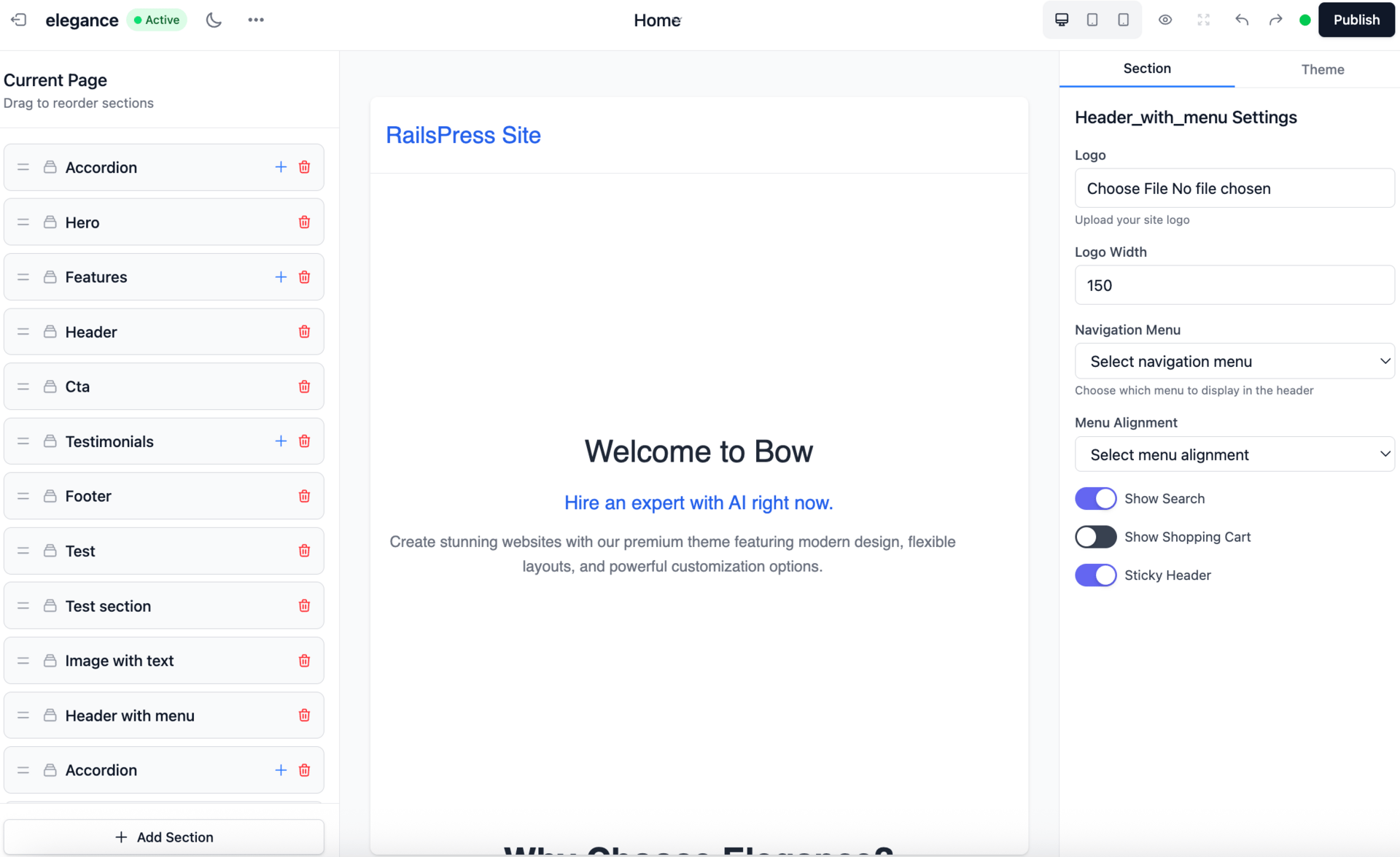
Railspress
Railspress CMS - Content management system + AI framework for next gen content powered experiences
TechHub - AI-powered trading cards for GitHub profiles
VCBench - Academic-grade multi-agent VC evaluation system
Savant - Local repository indexer and MCP search layer
Groove.rb - Builds, curates, and syncs Spotify playlists using natural-language prompts
MCP Auth - OAuth 2.1 authorization for Model Context Protocol servers in Rails applications
ColesV2 - Retail Agentic AI System with MCP server implementation, ask/act/alert modes, and comprehensive retail management tools
TinyHNewsMCP - MCP server that wraps the TinyHNews gem to provide Hacker News top stories functionality to AI assistants
JumpAI - AI-powered assistant designed for financial advisors
CV Analyzer - AI-integrated Rails application that evaluates candidate CVs
AgentBill Ruby SDK - OpenTelemetry-based SDK for automatically tracking and billing AI agent usage
Claude Config - Centralized collection of instructions, guidelines, and custom slash commands for AI coding agents
Rails MCP Playground - Implements an MCP server via JSON-RPC, providing endpoints to list and invoke tools
Nu::Agent - Ruby gem for AI agent integration with Anthropic and Gemini APIs
Smart Note Finder - Integrates AI embeddings and PostgreSQL with pgvector to store and search notes by meaning
SureFinance MCP Server - MCP server for SureFinance financial data integration
Smart Travel Hub - AI-powered travel booking platform
My MCP Server - Minimal MCP server engine for Rails and Sinatra
Jobs & Opportunities
We’re close to the launch free job matching platform for Rubyists. Even with only 400 organizations indexed so far, there are hundreds of opportunities available every week. If you would like to beta test the service, or are an organization searching for Ruby engineers, please reach out at [email protected].
One Last Thing

Google launched Grounding with Google Maps in the Gemini API, enabling developers to build location-aware AI applications by connecting Gemini's reasoning with data from over 250 million places. Use cases include detailed itinerary planning with travel times and hours, hyper-local personalized recommendations based on user preferences, and local place-based answers derived from reviews and Maps data across travel, real estate, retail, and logistics sectors. The tool can be combined with Grounding with Google Search for enhanced contextual responses, providing both structured Maps data and timely web context
That’s all for this edition! Be sure to reach out if you have any stories, content, jobs, or events you want featured in the newsletter.