- RoboRuby
- Posts
- Ruby AI News - July 17th, 2026
Ruby AI News - July 17th, 2026
Ruby's second act is almost here

Matt Solt
July 17, 2026

Welcome to the 34th edition of Ruby AI News! This edition features a Ruby implementation of the new Open Knowledge Format, a history lesson on chatbots, the return of the San Francisco Ruby Conference, and much more.
Thank you to SerpApi, the world’s leading API provider of search data, for sponsoring this edition. Be sure to check out their careers page, they’re hiring!
Contents
Top Stories
Open Knowledge Format, Ruby Style

Google's Open Knowledge Format made our Need to Know AI News list last edition, a spec that turns the LLM-wiki pattern into something portable. A knowledge base becomes a folder of Markdown files with YAML frontmatter, one concept per file, nothing to install and nothing to export. Rodrigo Serradura, the author of Ruby’s first implementation of the format, frames the stakes better than Google does. Every team, he writes, has a second codebase, the one in people's heads, why the billing service exists, what counts as an "active user", which schema decision looks wrong but was made on purpose. Right now it lives in a stale wiki, an overloaded CLAUDE.md, an agent's private memory, and coworkers who eventually leave. Put it in an OKF bundle and it sits in the repo next to the code it explains, versioned, reviewed in pull requests, and readable by humans and agents alike.
okf-gem is Rodrigo's answer, announced on r/ruby as a complete harness for the format, open source and fully local. It teaches your agent to author and curate a bundle, gives you a CLI to validate, lint, and search one, and draws the whole thing as a knowledge graph you can explore in the live demo. In practice you run /okf produce against your code and docs, let /okf maintain or its Claude Code plugin keep the bundle up to date, and leave the reading to okf server. Continuing to innovate and iterate on the format and gem, he recently added a Docker image for teams without a Ruby toolchain, an okf render command that bakes the graph into a single HTML file GitHub Pages can host, and /okf migrate, which adopts the docs you already wrote without changing a word of them. With okf-mcp and okf-sqlite3 in progress, the “second codebase” might finally be getting a proper home, and the Ruby community continues to adopt the leading agentic coding solutions.
As an editor’s note, I use Obsidian as a second codebase / brain, but this is a top story because this is an incredibly critical piece of agentic coding infrastructure. I’m excited to see it becoming a standard, and Ruby developers building with AI should pay close attention to this space.
In the Beginning, There was Eliza

ELIZA was a conversational AI before many of this newsletter's readers were born. Joseph Weizenbaum's therapist chatbot from MIT's Project MAC became the most famous program of its era, then its source vanished for half a century, until Jeff Shrager tracked down the original MAD-SLIP listings and IEEE Spectrum pieced together its many personalities. Valentino Stoll has now given that history a Ruby ending. His Neural Therapy Terminal runs ELIZA in the browser as Ruby compiled to WebAssembly, and typing *cacm replays the famous session Weizenbaum published in his 1966 paper. The first chatbot lives again, and this time in Ruby-native version.
If you’re a regular reader, you already know Valentino is one of the leaders bringing Ruby into the AI era. He co-hosts The Ruby AI Podcast, where the most recent episode has Ernesto Tagwerker on AI-powered Rails upgrades, and his agent Minerva shows up in this edition's Announcements, recently moved off OpenClaw onto a fenced-off Mac mini and now publishing a journal it now uses in its RL pipeline. In Taste Over Tooling on Gusto's engineering blog, he argued that agents have made execution a commodity and craftsmanship has moved up the stack, showing his work with a production skill system whose context inflates 13x before the agent reads a line of the user's question. His agentic gem is the practical example, with v0.2.0's self-assembling agents and the new agentic-examples turning the whole surface into runnable proofs that each exit clean only when the behavior they demonstrate holds, LLM runs included, recorded once and replayed offline. Sixty years sit between ELIZA's scripted conversation and Minerva's journal, and Valentino is building at the forefront.
San Francisco Ruby Conference, Part Two

Last November I recapped the first SF Ruby Conference after more than 400 Rubyists and dozens of AI-powered startups showed up with a clear message. Ruby is ready for the AI era, and the community is ready to build it together. Now SF Ruby and Evil Martians are doing it again. Year two runs November 10th to 12th at SFJAZZ, keynoted by Garry Tan, President of YCombinator. Noted Rubyists Vladimir Dementyev, Carmine Paolino, and Marco Roth all keynoted last year and return, joined by Chris Oliver, Rosa Gutiérrez Escudero, and founders and engineers from Intercom, Persona, and GitHub. This is a different kind of conference, with networking a key part of the program, and tickets are on sale now.
The CFP is open through July 27 with two tracks, Ruby startup stories and Ruby scaleup stories. Talks run 30 minutes, first-time speakers are welcome, and selected speakers get a free ticket and a seat at the speaker dinner. I closed last year's recap writing that you're no longer limited by how fast you can write code but by how big you can dream. I know many Rubyists are grappling with the implications of AI right now, and the future seems unclear. But your experience and expertise matter. Conferences bring everyone together, and those connections are more valuable than ever. We’re just getting started, and I hope to see you in November.

Need to Know AI News
HuggingNews Nikolai Yakovenko launched an AI-curated news feed that ranks roughly 50 AI stories a day into scannable headlines and a short daily brief. Clem Delangue recommended it after weeks of use, suggesting you ask your agent for the top ten stories each morning, with Hugging Face profile personalization coming next.
A Field Guide to Fable: Finding Your Unknowns Thariq Shihipar of Anthropic argued Fable 5's output is bottlenecked by clarifying your unknowns, with patterns from blindspot passes to quizzes. Matt Shumer's How I Prompt Fable supplied the tactics, goals instead of steps, house rules, and a loop against a hard bar that a fresh sub-agent grades.
Control the Ideas, Not the Code Salvatore Sanfilippo (antirez) argued the volume of AI-generated code makes line-by-line review impractical, urging developers to control architecture, design docs, and testing instead. He cautioned young programmers still need to write foundational code to build mental models.
Introducing Inkling Mira Murati's Thinking Machines Lab released open weights for a 975B-parameter multimodal mixture-of-experts model with a 1M context and an adjustable thinking-effort dial. Jack Morris called it a big deal as the only open-weight frontier model trained without distilling from OpenAI or Anthropic.
Apple Sues OpenAI Over Alleged Trade Secret Theft Sarah Perez reported Apple's federal suit accusing OpenAI executives, including former Apple design chief Tang Tan, of coaching recruits to take confidential material on unreleased products, filed as OpenAI builds hardware that could rival the iPhone.
Announcements

Mistri Muhammad Ahmed Cheema wrote a zero-dependency agent harness for a Ruby ecosystem where agent tooling is otherwise TypeScript or Python. It offers resumable append-only sessions, steering a run mid-flight, sub-agents, tool approvals, and one interface for LLMs, and already runs a production assistant. Docs at mistri.sh.
Avo 4 Adrian Marin shipped a major release of the Rails admin framework with a refreshed UI and new add-ons like Kanban boards, notifications, and dynamic filters. It also leans into AI. Generated JSON APIs agents can use, a generated CLI and LLM skill for team workflows, and an MCP add-on coming soon.
The Boring AI Engineer Andrew Kwak published a book arguing that boring technology wins when AI writes the code, plus a companion starter of small Rails files to copy into your app. The starter routes every model call through one front door, keeps agent state in database rows, and treats an agent as a loop with a budget.
2x-skills Akshay Katyal and Brian Scanlan open-sourced Fin's curated set of Claude Code skills and hooks used by hundreds of Intercom engineers. Akshay detailed the review discipline behind their 600-skill marketplace, including a skill that reviews skills, and Brian wrote up what separates good skills from bad.
Engram Alex Kholodniak built a memory layer between a Ruby or Rails app and the model. Durable facts stored in your own Postgres, recalled selectively per message, and injected into the next prompt instead of resending history. The pre-1.0 gem ships Rails, pgvector, and RubyLLM adapters plus scope isolation and secret filtering.
LangExtract David Paluy released a Ruby port of Google's LangExtract for structured extraction you can trace. It maps every extracted value back to its source character and token offsets, keeps an explicit alignment status, and flags results that cannot be grounded, with RubyLLM integration.
data_redactor Daniele Frisanco created a gem that strips secrets and personal data from any string before it leaves your app, whether bound for logs or LLM prompts. A purpose-built C engine scans 89 patterns in a single pass, up to 2.5 times faster than a pure-Ruby gsub loop, with Logger, Rails, Rack, and RubyLLM integrations.
rails-ai-context Cris Nahine updated an open-source MCP server to 39 tools that give AI agents live access to a Rails app, from model, route, and schema introspection to safety-gated SQL. It works with major coding agents with recipes and an API for custom tools.
LocalLingo Mikael Henriksson published docs for his i18n toolkit that extends i18n-tasks with AI translation of missing and changed keys through RubyLLM, per-key source-hash drift detection, strict CI validation, quality linting with an optional AI review pass, and RuboCop cops.
mcp-agents Thomas Witt shipped updates to his MCP server wrapping AI coding agent CLI tools so any MCP client can call them as tools. Built for the "one builds, one judges" pattern where Claude plans and Codex builds, it fixes built-in MCP mode timeouts and adds model selection and goal injection.
ZBoy Abhishek Parolkar built a sovereign macOS coding agent that runs in a disposable Apple Container micro-VM with local MLX inference on Apple Silicon. It builds Rails 8 apps on a 16GB Mac, and its agent rules cast it as a child-safe Ruby mentor for its 8-year-old tester, who vibecodes HTML games instead of tokenmaxxing on Claude.
Rails Cost Model for AI Development Abhishek also proposed treating Rails apps as finite state machines to make cost of change measurable. Bounding changes to ~30 primitives logged in git yields a self-calibrating cost model that prices human and AI work in equal Work Units and hands sales an Uber-style receipt.
Rails MCP with Streamable HTTP Erich Stark added a remote MCP endpoint to a production Rails app using the official mcp gem. A single JSON-RPC entrypoint that reuses the API's bearer tokens and filters the tool registry through the same CanCanCan abilities, so agents only see what their token's scopes allow.
Can an AI Agent Navigate Ruby? Luc Perussault Diallo benchmarked whether agents can find everything that depends on a central model across 13 real codebases. Cold agents found a fraction and declared the audit done, while adding Sense's structural code map lifted cited recall +0.26 overall and +0.48 on dependents for the strongest model.
Ruby LLM Discoverability Scorecard Irina Nazarova updated her scorecard tracking how well Ruby sites surface in AI training data and agent retrieval. The 30-day change is new llms.txt files from ecosystem providers, new markdown routes, sitemaps from Bridgetown and AnyCable, and Karafka's robots.txt welcoming AI crawlers.
Nuke on Rails Supply-Chain Audit Alan Alves extended his repo-audit skill after fake recruiters started sending trojaned take-home assessments. Distilled from real credential-stealer samples, the checks catch eval'd remote payloads, install hooks, obfuscated base64, and paste-bin kill-switches, auditing the repo without executing it.
Minerva Valentino Stoll detailed his autonomous agent's work to the public. A Claude-powered agent on a Mac mini handling email triage, code commits, infrastructure, and product research, journaling everything on its own site, including a self-audit of its first 50 days.
Pgbus Mikael Henriksson previewed pgbus, a PostgreSQL-native job processor and event bus for Rails built on PGMQ: ActiveJob adapter, topic-routed events, dead-letter queues, worker recycling, and SSE streams with no Redis, plus a built-in diagnostics MCP server and a CLI for real debugging.
Maquina Components 0.5.0 Mario Chávez released an update to his Rails component library with a Drawer whose state survives Turbo navigations and morphs and tears down cleanly before page cache, plus scaffold templates so rails generate scaffold produces Maquina-styled views.
Apple Email Triage with Ruby Mario also demonstrated an Apple Mail triage agent written in Ruby with RubyLLM underneath. It’s built with his agent harness for RubyLLM, nexo, where you write the agent once, then tweak its skill to your liking.
rails-starter TheCodingEnd refreshed and open-sourced the AI-friendly Rails SaaS starter behind several production projects. Rails, React 19 and shadcn/ui via Inertia, RubyLLM, Devise, and Solid Queue. Org & team auth and phone-based auth each landed after a few hours with GPT-5.5 and Claude Opus.
Keeping Agents Read-Only in Production Jorge Manrubia shared a deterministic Claude hook that steers agents to the read-only "rails query" instead of "rails runner" or db: tasks in production, and asked how others balance the productivity of agent-run scripts against the risk.
Generative UI Web Browser Jesse Waites introduced an Electron browser where Chrome renders hidden offscreen and a realtime diffusion model repaints every frame as felt, clay, or oil paint. Clicks and scrolls in the AI-generated view map back to the real page, keeping the illusion fully interactive.
Best AI for Ruby Coding Jenova pitched its Ruby coding assistant for building, debugging, and shipping Rails apps through conversation, claiming Rails 8 mastery, ActiveRecord optimization, and modern Hotwire/Turbo patterns for developers battling shifting best practices.
SimpleCov 1.0.0 Erik Berlin announced the coverage tool's first stable release, the biggest in its 16-year history. The 1.0 line consolidates a redesigned configuration API with new verbs like skip, group, and cover, builds in the JSON formatter, filters test directories by default, and raises the minimum to Ruby 3.2.
RubyEvents Guides Hans-Jörg Schnedlitz launched guides.rubyevents.org, a site for people who want to organize Ruby conferences and meetups. Built from interviews with experienced organizers like Jeremy Smith, Andy Croll, and Amanda Perino, it surfaces the knowledge that usually lives in private chats and organizers' heads.
Lexxy Sandbox Markup View Jorge Manrubia added an option to the Lexxy sandbox to inspect the markup the editor generates, contributed by Zoltan Hosszu, showing off the clean, semantic HTML it produces compared to other rich-text editors.
Articles
Ruby Is the Most AI-Friendly Stack Is Half True Luc Perussault Diallo distilled his Sense benchmark campaign into a seven-part series: models write Ruby fluently but navigate it poorly, and no model upgrade closes the gap, since a map hands the agent a computed fact where a bigger model hands a more confident guess. He recorded an agent auditing GitLab and its million edges, shared a four-command self-audit protocol, admitted his first AI judge called a half-finished audit exhaustive, and ran it on Forem, catching a frontier model reciting stale memory about the engine dev.to runs on. Per-repo deep dives continue on Medium, including Rails itself and raix.
Fable and Opus Build a Multiplayer Feature Irina Nazarova raced Fable 5 and Opus 4.8 at rebuilding Fizzy's collaborative editing (Yjs, yrby, AnyCable) from the same kickoff prompt. Fable's version was safer, Opus's cleaner, and both replayed documents inside the transaction holding row locks, missing the one extraction her own pass made.
Closing the Verification Loop Kieran Klaassen detailed how compound engineering's /ce-dogfood skill closes the gap between merged and working: it diff-scopes the branch, drives a real browser through every changed flow as user personas, fixes what breaks, and re-verifies until the branch carries proof it is ready.
The Compounding Knowledge Lifecycle Kieran Klaassen explained how a lesson learned once keeps paying: each solved problem becomes a markdown learning in docs/solutions/, and retrieval is built into five skills, planning greps the memory and review audits diffs against it, so knowledge resurfaces instead of rotting.
Introducing Fragua: The Harness Already Composed for Rails Mario Chávez opened a private beta of Fragua, an AI agent orchestrator for Rails that walks a one-line idea to a pull request: brief, research, plan, and spec persist as artifacts feeding the execution agent, which picks up accepted specs on its own and runs on your machine.
Idempotent AI Workers in Rails Danial Asghar showed why Sidekiq's at-least-once delivery makes retried LLM jobs double-charge and double-write, then walked the fix in his open-source ticket triage engine: a status gate on a stable UUID, atomic state transitions, and an audit trail that makes retries cheap.
Audit a Rails Project with the Thoughtbot Audit Skill Daniela Baron ran thoughtbot's Rails audit skill on her five-year-old analytics side project, then turned the markdown report into a severity-tiered, labelled GitHub backlog, sharing the findings and the workflow for fixing them one issue at a time.
Snooping on GitHits.com Stas Katkov pried open the GitHits MCP server with mcpsnoop and raced it against its CLI, WebFetch, and Lightpanda on a gem changelog question: MCP burned 1.3M tokens over 9:27 versus Lightpanda's 203K in 1:03, so he removed it (nothing leaked; it was just wasteful).
llmemory: Persistent Memory for LLM Agents in Ruby Entaina wrote up (in Spanish) its llmemory gem giving Ruby agents short-term, long-term, and cognitive memory: LLM-extracted facts or a knowledge graph with hybrid retrieval and conflict resolution, plus Rails, Redis, PostgreSQL, and MCP integrations.
How I Used Fable Last Week Irina Nazarova logged a week of Fable builds with token counts: an 8-bit Super Mario-style sfruby.com rebuild, multiplayer editing on a Fizzy fork tested by 40 Martians at once, a benchmarking harness, a Slidev theme, and a Rails refactor, each between 600K and 1.7M output tokens.
From AI Opportunity to AI Feature: Where We Start in Rails Applications Aysan Isayo argued a Rails app's first AI feature should prove value before ambition: start with semantic search over content users already have, layer summarization and decision support next, and reach for agents only once something simpler has earned it.
AI Coding Workflow for Beginners Celso de Sá published the article behind his beginner guide: a July 2026 model snapshot plus an OpenCode and OMO-SLIM setup where agent lanes split research from edits, AGENTS.md carries instructions, .context/ files persist memory, and Rails wins because conventions shrink the AI's decision space.
I Built a SaaS That Lets AI Build and Publish Sites, Then Scrapped It shuent recounted (in Japanese) building miyo Sites, a Rails platform where Claude Code pushes generated HTML over MCP or API for instant publishing with forms, CRM, and analytics, then scrapping it after concluding that hosting AI-generated pages was a security mistake.
Building Private AI Evals: Why Your Company Needs Them and How to Start David Paluy argued in an X article that AI projects stall because nobody defined what good means: a private eval encodes that definition as versioned cases with allowed tools, reference answers, and scoring rubrics, measuring your workflow rather than a lab benchmark.
DSLs Enable Reliable Use of LLMs Unmesh Joshi wrote on Martin Fowler's site that LLMs need boundaries to generate what's intended: domain abstractions and DSLs form the harness, with the LLM as a partner that iteratively builds the DSL and then serves as its natural-language interface.
Claudeshoring: Your Company's Best First AI Project Michael Carroll argued enterprises fail at AI (MIT counts 95%) by picking never-done-before processes, and coined Claudeshoring: take a process you already offshored, with its documented handoffs and measured costs, and make that your first AI migration.
Trust Is Not a Vibe Chuck Blake wrote two field notes from his background agent jobs. After a happy-path lie in a job posting music across six networks, he trusts the trail of logs and artifacts over any single good run, and in When the Script Wants to Become a Product he traced how Glance, the dashboard watching those jobs, pulled him into real product work.
Why AI Coding Assistants Work Suspiciously Well With Rails Muhammad Ur Rehman argued Rails accidentally built the ideal AI foundation. Conventions act as a system prompt shipping with every project, twenty years of code fill the training data, and Ruby packs more meaning per token.
Videos
Claude Skills Dave Kimura of Drifting Ruby demonstrated creating Claude slash commands for a Rails app, building an /analytics command that acts as a data analyst: it answers business questions by running read-only ActiveRecord queries through bin/rails runner until it can back the answer with real numbers.
Using Claude Design and Fable to Build a Ruby on Rails Web App Justin Jackson showed his workflow from idea to working Rails app: articulate the vision in Claude Design, iterate on the interactive prototypes it builds instantly, then hand off to Fable for the functional build. Ideas he sat on for years now prototype in an afternoon.
TalkGenerator on RubyEvents.org Rachael Wright-Munn streamed a session on RubyEvents.org's TalkGenerator after using it for RubyConf Africa, walking through the big update pull request and open issues around events like Kansai RubyKaigi 09.
Podcasts
The Ruby AI Podcast: AI-Powered Rails Upgrades: NextRails and the Future of Framework Modernization Joe Leo and Valentino Stoll interviewed Ernesto Tagwerker about the Next Rails dual-boot gem, the Claude Code skills encoding FastRuby's upgrade expertise, and why one human plus one agent now matches two humans on upgrade projects.
CTO Confidential: AI in LegalTech Mike Rispoli interviewed Lawrence Krubner, CTO of Scorealytics, on why legal tech wastes AI on keyword search instead of extracting meaning from text. They covered antagonistic agents from different LLMs verifying claims, open-source models beating frontier ones, and Rails playing well with AI.
The Opinionated thoughtbotter: AI Doesn't Make Us More Productive Svenja Schäfer talked with thoughtbot senior developer Sally Hall about why chasing AI productivity is the wrong goal: productivity as a buzzword, products built from generated code failing to last, and incentives that reward writing more code over valuable code.
Additional Reading
Evil Martians: AI vs. Human Illustrators? AI + Human Illustrators!
Andrew Nesbitt: Scrutineer: Scanning Open Source Without Flooding Maintainers
Vicente Reig: Your Job, Their Loop
Ender Ahmet Yurt: Every AI Commit Is Someone's Future Legacy Code
Abhilash Veettil: Why Ruby on Rails Feels Built for the AI Coding Era
Burraq Ur Rehman: Integrating AI into Ruby on Rails the Right Way (A Practical Guide)
Events
Previous
Brighton Ruby: In The Model Doesn't Matter, Brian Casel moved past AI spinning up fresh apps to the harder case, one of an established codebase with years of decisions, conventions, and real users. He argued experienced developers hold the biggest AI-era advantage as the developer, designer, and product roles blur.
Brighton Ruby: In Code, Prompts, and Stories, Shopify's Maria Yudina showed what screenwriting teaches about writing code and prompts. The craft principles that make stories work, clarity, structure, and naming apply across code, prompts, and communication.
ChicagoRuby: The July meetup explored staying valuable in the AI age. Alan Ridlehoover of Cisco drew on Hidden Figures to urge engineers to retool as AI transforms the work, and Hashrocket's Tony Yunker demonstrated read-only Rails models with a metaprogramming trick that permits writes during test setup.
Philippine Ruby Users Group: In Is Ruby Dead? Absolutely Not, Artem Blazhievskii made the case for Rails as the One-Person Framework. A solo developer or small team can now build and launch products that once took massive teams.
Upcoming
July 22nd - Meetup: SF Ruby Meetup @ Sentry is on July 22nd in San Francisco at Sentry's HQ, hosted by Evil Martians. The new "fewer talks, more connecting" format features Cameron Dutro on Garnet.js and implementing the YARV virtual machine, plus talks from Alexander Baygeldin and Marco Roth, followed by a full round of lightning intros.
August 4th - Meetup: AI on Rails: Ruby Meets Generative AI is on August 4th in Paris at Algolia's office, co-hosted by AI Tinkerers Paris and ParisRB.new. The "show, don't tell" evening features live-coding demos of developers wiring LLMs, agentic workflows, vector search, and prompt engineering natively into Ruby and Rails, plus a Homebrew-inspired Science Fair for hands-on project walkthroughs.
August 21st - Conference: RubyConf Africa 2026 runs August 21st to the 22nd in Nairobi, Kenya at the Sarit Expo Centre, themed "Beyond Code: Innovating for the Future." AI-flavored sessions include Chris Hasiński's "Cool Things You Can Do With Embeddings," Nicolo Rebughini's "Accidentally Building a Neural Network: A Ruby Product Recommendation Journey," and FH Ndiritu's "In the Age of Abundance, Are We Bottlenecks?"
Open Source Updates
Code Spotlight
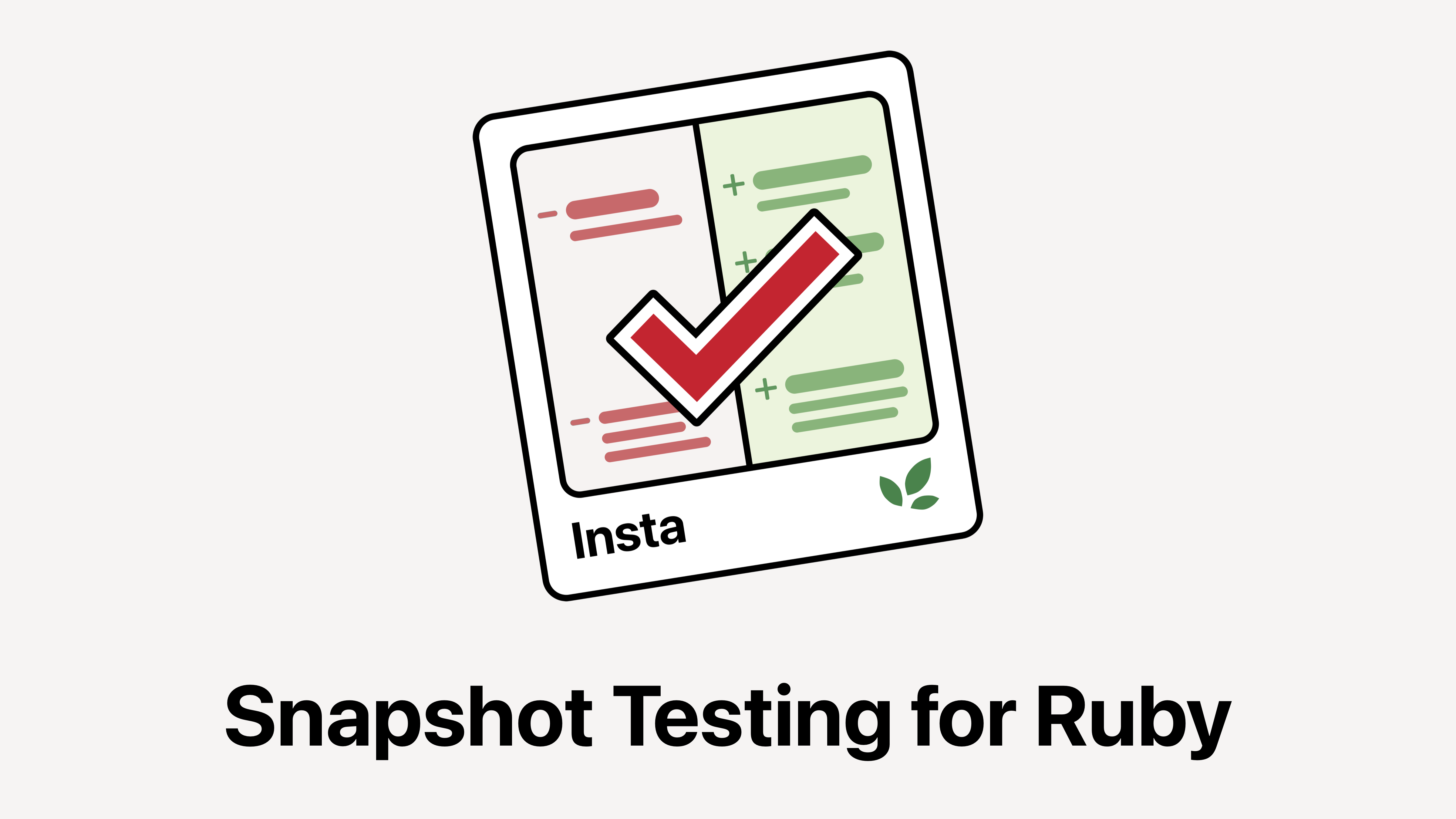
Marco Roth released Insta at RubyConf 2026 in Las Vegas, a new snapshot testing library for Ruby, extracted from Herb's test suite (where a hand-rolled snapshot module had grown past five hundred lines keeping thousands of parser tests honest) and modeled on Armin Ronacher's insta crate for Rust. His introduction presents it as assert_equal where the expected value manages itself. A failing test writes a pending snapshot, insta review shows a difftastic-powered diff, and accepting is a pure file operation that never re-runs the suite. The gem supports Minitest and RSpec, inline snapshots that rewrite your test source, JSON and YAML serializers, snapshot metadata, and jq-like redactions that swap volatile IDs and timestamps for stable placeholders.
For Ruby AI work this is a near-perfect fit, because LLM pipelines produce exactly what snapshots testing was built for: output that is large, changes often, and is tedious to assert by hand. Pin the model call with VCR (the README is explicit that cassettes manage what goes in while Insta reviews what comes out), then snapshot rendered prompt templates, structured-output JSON, and tool-call payloads, redacting request IDs and token counts. Prompt regression testing becomes a review loop, where you tweak a template, watch every affected snapshot diff, and accept the intentional drift in one session instead of thirty hand-edits. The Rust ecosystem hints where this goes next. Ratatui apps snapshot entire rendered terminal frames through a test backend, the analog of golden-copy testing an agent CLI's transcript, and cargo-insta combines pair snapshots with mutation testing, and a no new snapshots in CI rule to keep suites accurate. All of it ports naturally to Ruby agents, and to Herb-rendered ERB views.
New Gems
Links to the RubyGems page, newest releases are first:
google-cloud-vector_search - Vector database designed to power next-generation search
silas - Durable AI agents on the Rails you already run
maglev-rb - Rails-native semantic knowledge layer for ActiveRecord object graphs
nanobananapro - Free AI image generator powered by Google Gemini 3 Pro Image
envoy_ai - Governed, tool-calling agent chat as a mountable Rails engine
enconvert - Read any page or file into agent-ready Markdown, JSON, or screenshots, every read scored
norn - A pluggable LLM-driven agent development framework
mutation_tester - Simple mutation testing framework for Ruby with RSpec, AI workflow and Minitest support
x_aeon_agents - AI agents skills to be used for X-Aeon projects
ruby_llm-resilience - Circuit breakers and fallback chains for LLM apps
gdkbox - Spin up a GitLab Development Kit in a box, ready for VS Code and Claude Code
bugsage - AI-powered debugging assistant for Ruby on Rails
zer0-image-generator - AI preview/social images for any Jekyll site
okf-sqlite3 - A SQLite storage and full-text search engine for OKF
okf-mcp - A Model Context Protocol server for OKF
floe-servicenow - ServiceNow API Integration for Floe
omnibot-ruby - Rails-first LLM agents for Ruby
transcript-viewer - Pure Ruby static HTML renderer for LLM agent session transcripts
okf - The complete toolkit for the Open Knowledge Format
saleseq - Official SalesEQ Ruby SDK
ruby_llm-voyage - Voyage retrieval APIs for RubyLLM
protege - Email-native AI agent toolkit
rails-agent-stack - Dead-simple AI agents for Rails
chorus-llm - Framework for multi-agent LLM orchestration with contextual routing
hcn - Ruby client for the HouseCanary API
simple_llm - common wrapper for all LLM providers
utobo-email - Official Ruby SDK for the utobo email Email Platform
cpee-llm - CPEE Conversational Agents
visiq - Agent-governance SDK - local, in-process policy decisions.
llmshim - Ruby client for the llmshim multi-provider LLM proxy
locallingo - AI-assisted i18n translation, drift detection, and quality linting on top of i18n-tasks
mcp_toolkit - Opinionated toolkit for building account-scoped, read-only MCP servers
collavre_linear - Linear integration for Collavre
lyman - A composable agentic harness, delivered as code you own - a pure generator in the shadcn/ui mold, built on shifty
ruby_llm-bedrock_invoke - RubyLLM provider for Anthropic Claude via the AWS Bedrock InvokeModel API
worldmonitor - Official Ruby SDK for the World Monitor global-intelligence API
hob - Client for hob, a personal LLM substrate
skill-extractor - Extract skills from job postings and resumes - 32K-skill gazetteer + MiniLM embeddings + MLP context classifier
mistri - The agent harness for Ruby applications
model-language - A typed, safe template language for AI-agent prompts (WebAssembly-backed)
fetch_util - AI for fetching in Ruby
cardinal-ai - A Kanban board where dragging a card to In Progress hires an AI agent to do the task
nightona - Ruby SDK for Nightona
nightona_toolbox_api_client - Nightona Toolbox API Ruby Gem
nightona_api_client - Nightona Ruby Gem
velix-sdk - SDK oficial do VELIX para Ruby
resque-mcp - MCP server for Resque, mountable as a Rails engine
verica-observability - Two-line LLM tracing for Verica
panteao-client - Ruby client for Panteao BDI Coprocessor
prompt_injection - Detects prompt injection attacks in free-text input for LLMs
vector_amp - Ruby SDK for the VectorAmp API
ultrasafeai - Ruby client library for the Ultrasafeai API
crisphive - Official Ruby SDK for the Crisphive API
geminai - Use googles gemini interactions api
emb-server - emb: Redis-compatible embedding server
emb - Client for emb: a Redis-compatible embedding server
New Open Source
Links to the Github repository:
Machina - Agent-native rails new template with a CLAUDE.md operating manual, 32 curated skills, and 17 path-scoped rules, the production starter ZAR uses internally
Zimmer - Self-hostable orchestrator that gives a coding agent a task and a repo, runs an isolated Claude Code or Codex session, and hands back a pull request
Redmine MCP - Redmine plugin adding an MCP endpoint so AI coding agents can search, read, create, and update issues and read wiki pages, over stateless Streamable HTTP
Cardinal AI - Kanban board where dragging a card to In Progress hires a Claude agent that does the task on its own branch, asks when stuck, and hands you a PR to review
DeepForge - Local HTTP/SSE agent runtime for AI-powered GUI apps, managing conversational loops with tool orchestration, context compaction, and pluggable capabilities
Agent Coordination - CLI and workflow helpers for coordinating concurrent agent work across machines, from a zero-config local store to a Cloudflare Worker backend for teams
Groww MCP - MCP server for the Groww trading platform with 25 tools, automated TOTP auth, GTT and OCO smart orders, option chains with Greeks, and backtesting
Printwright - Agent-buyable marketplace for licensed 3D-printable models where humans or agents pay per print over x402 on Hedera and get verifiable license certificates
DocInsightAI - Rails app that answers questions about uploaded PDFs with page-level citations, grounded only in the documents and admitting when they lack the answer
Calvin - CI agent that reads project context from .calvin/, shapes dense tasks in chat, and drives asynchronous implementation through GitHub Actions and external LLMs
Agent Rules Skill - Skill that bootstraps vendor-neutral agent configuration in .agents/ and generates adapters for Cursor, Claude Code, Codex, and opencode
Rulepack - PKGBUILD-inspired package manager for agent rules and skills, with per-package descriptors and a four-stage build pipeline
ai-config - Model-agnostic configuration layer where one canonical AGENTS.md drives Claude, Codex, Copilot, Antigravity, and Grok in lockstep
ForceDream SDK - SDK for the ForceDream A2A network to discover, invoke, and cryptographically verify AI agents, with Ed25519 handled by the OpenSSL standard library
Workmori - Multi-tenant SaaS (in Korean) giving small-business owners a virtual AI employee for marketing, configurable by personality, duties, channels, and cost limits
Bill - Rails bar-tending web app (in French) that recommends cocktails through a conversational interface built on Hotwire and GitHub Models
Jobs & Opportunities
Are you an organization searching for an expert Ruby AI developer, or a Rubyist looking for your next development role with AI? Please reach out and let me know the type of opportunity you’re pursuing: [email protected]
Featured

SerpApi is hiring a Senior Fullstack Engineer to build and maintain the Ruby on Rails APIs behind its web search platform, which structures results from Google and 100+ engine APIs and powers AI products like Perplexity. The worldwide, remote-first role pays $150,000 to $180,000 plus profit share, with total compensation averaging $232,448, working in Ruby, Rails, MongoDB, and AWS across proxies, CAPTCHA solving, and browser scraping. SerpApi operates transparently with a public roadmap, shared financials, async-first scheduling, and a neurodivergent-friendly culture.
One Last Thing
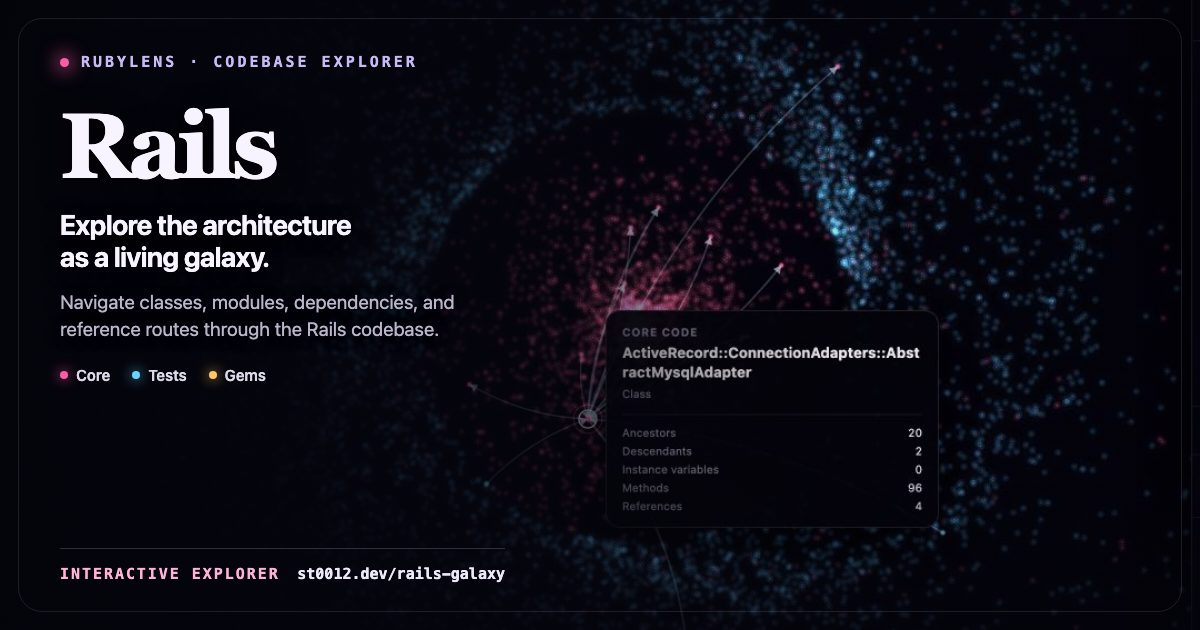
Stan Lo teased that he is cooking something on X/Twitter. Rails Galaxy is an interactive demo that renders a Rails codebase as an explorable galaxy through RubyLens. Selecting a class, module, or gem reveals its strongest resolved constant-reference routes, and you orbit, pan, and zoom through the dependency structure. The demo publishes only the architectural shape, deliberately excluding source, comments, and file paths, the same structural map of a codebase that coding agents have lately been to find their way around large Rails apps.
That’s all for this edition! Be sure to reach out if you have any stories, content, jobs, or events you want featured in the newsletter.